The Southern Hemisphere for families feels like a secret club on a globe. I point to the Equator and smile. Then I show kids the half below that line. It includes Australia, New Zealand, Antarctica, southern Africa, and South America.
What is the Southern Hemisphere for families?
The Southern Hemisphere for families sits below the Equator. Oceans cover more of it than the north; in fact, according to a 2025 publication in Cambridge University Press, 80% of the Southern Hemisphere is covered by oceans, across the Pacific, Indian, Atlantic, and Southern Oceans. As a result, weather and seasons can surprise you. For example, winter in London is summer in Sydney. I show that flip with a globe and a flashlight.
Key latitude markers help explain the region. The Tropic of Capricorn sits near 23.5 degrees south. The Antarctic Circle lies about 66.5 degrees south. Large places below the Equator include Tasmania, Patagonia, and Madagascar. Cities we might know are Sydney, Melbourne, Auckland, Buenos Aires, Cape Town, and Santiago.
Oceans, currents and weather
Oceans shape life below the Equator. Strong currents, such as the Antarctic Circumpolar Current, circle Antarctica and steer weather. Also, patterns like El Niño and La Niña change rainfall and storms for Australia and South America. These shifts affect families who live there and the animals they meet. In recent years, the Southern Hemisphere has faced significant climate changes, such as April 2023 being the warmest April on record, with temperatures exceeding 0.90°C above the 20th-century average.
Skies, animals and people
The night sky offers a new show in the south. Look for the Southern Cross to find south. Because the south celestial pole lacks a bright pole star, the cross becomes a handy guide. You can also see Centaurus and Carina, constellations that many northern viewers miss.
Wildlife below the Equator feels wonderfully different. I tell small stories about kangaroos, kiwis, penguins, and llamas. Plants such as eucalyptus and southern beeches seem like words you can taste. Indigenous peoples hold deep sky and land stories. When possible, choose resources made or approved by community storytellers, like Australia First Peoples and Māori, to show respect.
Antarctica and explorers
Antarctica is a frozen continent. It remains set aside for science under the Antarctic Treaty. As a result, animals and research can thrive there. In 2023, Antarctica reached its annual maximum sea ice extent on September 10, covering 16.96 million square kilometers, which marked the lowest maximum extent on record. I also tell a short, brave tale of Roald Amundsen. He reached the geographic South Pole on December 14, 1911. Interestingly, the Southern Hemisphere experienced its lowest sea ice extent on record in 2023, with a minimum of just under 1.8 million square kilometers, about 39% less than the 1981–2010 average, according to NASA’s Global Modeling and Assimilation Office.
Simple family activities and audio stories
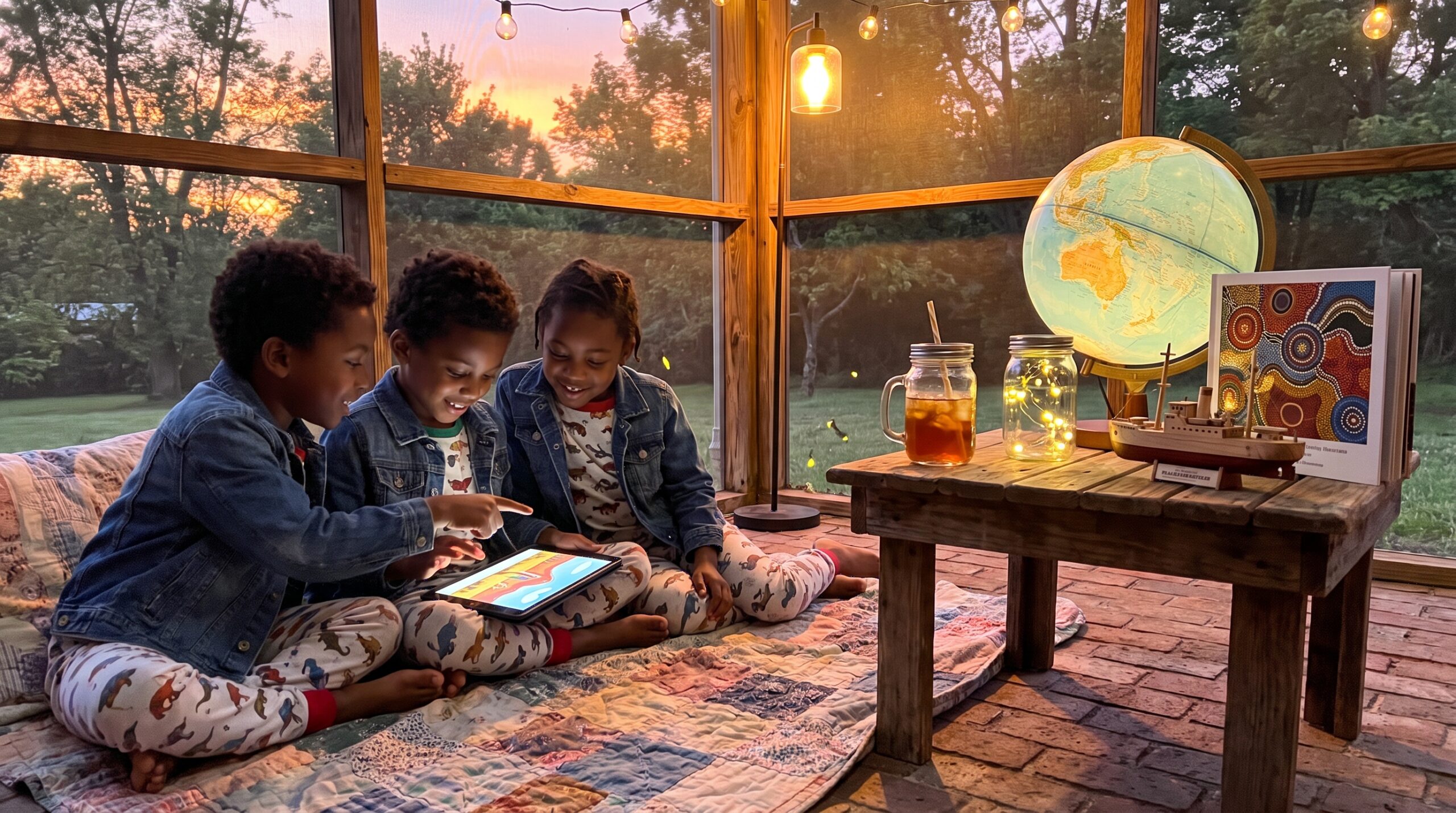
Try this tonight with your child. Spark curiosity by spinning a globe and finding the Equator, Tropic of Capricorn, and Antarctic Circle. Then name three southern cities. Next, ask your child to pick an animal and tell its one-line story. Finally, shine a flashlight on the globe to show why seasons flip.
Star and craft ideas
- Face south and hunt the Southern Cross.
- Make a paper Southern Cross and use it as a soft night light.
- Read a short tale about a southern animal at bedtime to spark calm curiosity.
Read or listen to a story about Southern Hemisphere now: Read or listen to a story about Southern Hemisphere now: For 3-5 year olds, For 6-8 year olds, For 8-10 year olds, and For 10-12 year olds.
Also, visit the Storypie home page to explore more audio stories and activities. Play an audio story from Australia First Peoples, early explorers, and Amundsen for a gentle bedtime routine. Try asking one question: what would you pack for the South Pole?
These small routines make bright little lessons. They keep wonder alive and make geography feel like play.