English

Southern Hemisphere
The half of the Earth that is south of the Equator, known for its unique seasons, constellations…
Reads at Grades 3–5 Listens at Grades 1–5
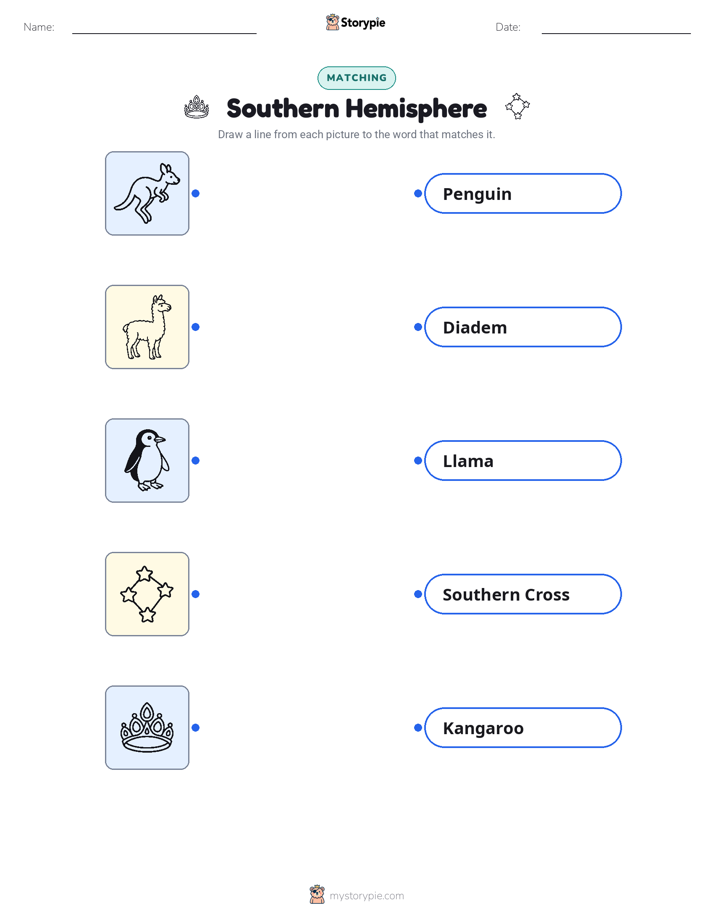
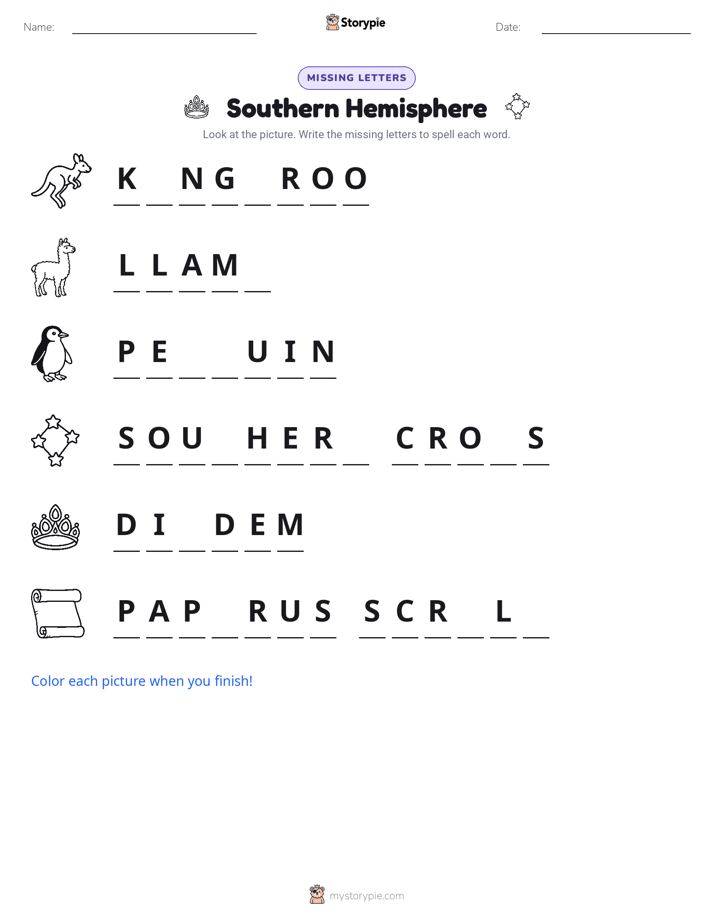
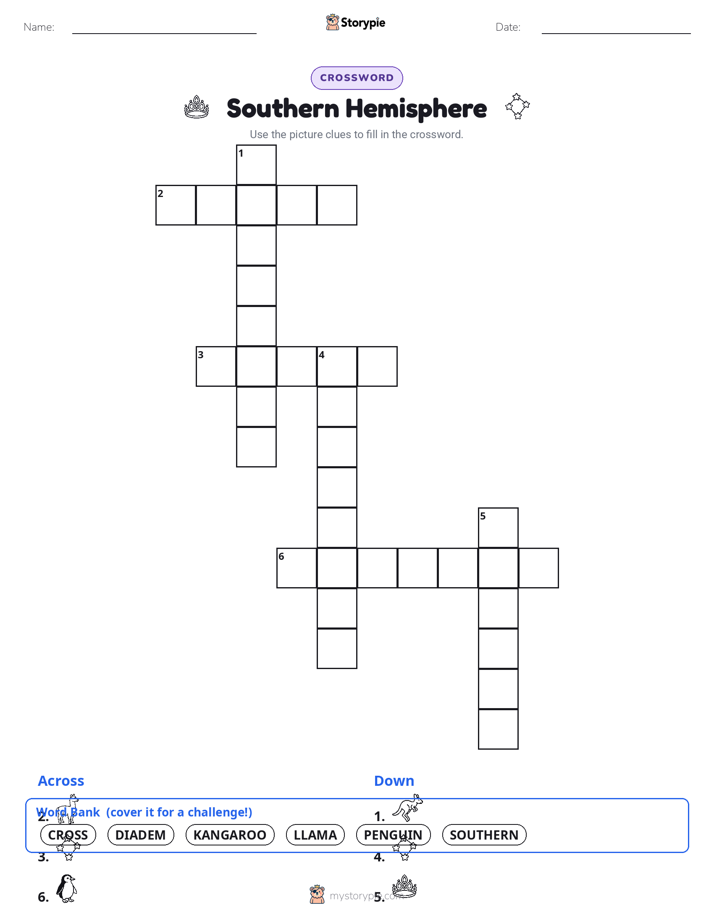
Print & create
Answer keys·No prep·Free with an account
28 worksheets · answer keys · full story · quiz · Ages 8-10 · CEFR B1
Plus adds 164,000+ more stories in 27 languages, audio for every one, and printables for all of them.
Just want Southern Hemisphere?
Have you ever wondered what it would be like to live in a world flipped upside down? Imagine celebrating summer holidays in December, with sunny skies and warm breezes instead of snow. When you look up at the night sky, you wouldn’t see the Big Dipper. Instead, you would see a brilliant diamond of stars called the Southern Cross, a guide that sailors have used for hundreds of years to find their way across my endless oceans. My lands are home to hopping kangaroos, fluffy koalas, and penguins that waddle across icy shores. For most of human history, I was a great mystery, a place of dreams and legends. I am the bottom half of the world. I am the Southern Hemisphere.
For a very long time, I wasn't a real place on a map, but an idea in people's minds. It all started long ago in ancient Greece. Around the 4th century BCE, a brilliant thinker named Aristotle looked at the world and thought it needed to be balanced. He saw all the land in the Northern Hemisphere—Europe, Asia, and northern Africa—and believed there must be a huge southern land to keep the Earth from tipping over. He couldn't prove it, but the idea was powerful. People started calling this imaginary place 'Terra Australis Incognita,' which is Latin for the 'Unknown Southern Land.' For centuries, mapmakers would draw a giant, blurry continent at the bottom of their maps, filling the empty space with this mysterious land they hoped to find. I was a giant question mark, a puzzle that sparked the curiosity of sailors and kings, who all wondered what wonders and secrets I held.
The Unknown Southern Land
Have you ever wondered what it would be like to live in a world flipped upside down? Imagine celebrating summer holidays in December, with sunny skies and warm breezes instead of snow. When you look up at the night sky, you wouldn’t see the Big Dipper. Instead, you would see a brilliant diamond of stars called the Southern Cross, a guide that sailors have used for hundreds of years to find their way across my endless oceans. My lands are home to hopping kangaroos, fluffy koalas, and penguins that waddle across icy shores. For most of human history, I was a great mystery, a place of dreams and legends. I am the bottom half of the world. I am the Southern Hemisphere.
For a very long time, I wasn't a real place on a map, but an idea in people's minds. It all started long ago in ancient Greece. Around the 4th century BCE, a brilliant thinker named Aristotle looked at the world and thought it needed to be balanced. He saw all the land in the Northern Hemisphere—Europe, Asia, and northern Africa—and believed there must be a huge southern land to keep the Earth from tipping over. He couldn't prove it, but the idea was powerful. People started calling this imaginary place 'Terra Australis Incognita,' which is Latin for the 'Unknown Southern Land.' For centuries, mapmakers would draw a giant, blurry continent at the bottom of their maps, filling the empty space with this mysterious land they hoped to find. I was a giant question mark, a puzzle that sparked the curiosity of sailors and kings, who all wondered what wonders and secrets I held.
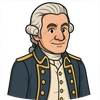
That curiosity finally sent brave sailors out onto my vast, blue waters during the Age of Exploration. A determined Portuguese explorer named Ferdinand Magellan set sail from Spain in 1519. His mission was to find a new route to the Spice Islands, but his journey became something much bigger. His crew sailed for three long years, and though Magellan himself did not survive, his ships completed the first voyage all the way around the world in 1522. They proved how enormous my Pacific Ocean truly is. More than two hundred years later, an English captain named James Cook came searching for the great southern continent. Between 1768 and 1779, he made three incredible voyages. He was a brilliant mapmaker, charting the coastlines of New Zealand and eastern Australia with amazing accuracy. On January 17th, 1773, he became the first person to sail across the Antarctic Circle. He never found the giant 'balancing' continent people imagined, but he revealed the truth: I was a hemisphere filled with many real islands and lands, each with its own story.
My final secret, my icy crown, was finally revealed when explorers first sighted Antarctica in 1820. This vast, frozen continent at the very bottom of the world was the true southern land, a place of incredible beauty and harsh cold. It was so special that people decided it should not belong to any one country. On December 1st, 1959, many nations came together to sign the Antarctic Treaty. They agreed that Antarctica should be a place for peace and science forever. Today, scientists from all over the world work together there, studying the ice and the unique animals that live there. From bustling cities in South America and Australia to the quiet, icy plains of Antarctica, I am a place of wonder. I am home to kangaroos and penguins, rainforests and deserts. I remind people that there are always new things to discover and that when we work together, we can explore and protect this amazing planet we all call home.
Wow facts
About
The half of the Earth that is south of the Equator, known for its unique seasons, constellations, and continents like Australia, Antarctica, and most of South America.
Take a Quiz
Question 1 of 5
The story says ancient thinkers believed a southern land 'must exist to balance the world.' What does 'balance' mean in this sentence?
Explore next
Want to do even more?
Go beyond exploring. Unlock tools that turn every story into real learning.

Storypie Plus for families
Full stories, quizzes, and printables. Nights and car rides, sorted.
- Unlimited audio stories
- Create Mode: your child stars in the story
- Offline downloads
- Printable worksheets & coloring pages

Why Storypie for Schools
Students engaged. Prep in seconds. Evenings back to you.
- Worksheets & Quizzes
- Classroom Management
- Formative Assessment
- Custom Curriculum & Lesson Plans
- 27 Languages

Why Storypie for Homeschool
Curriculum done. They'll ask for more. Hours back in your day.
- Worksheet Generator
- First-Person Audio Stories
- Built-in Comprehension Quizzes
- Custom Curriculum & Lesson Plans
- Print & Go Activities