English

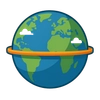
Southern Hemisphere
The half of the Earth that is south of the Equator, known for its unique seasons, constellations…
Reads at Grades 6–8 Listens at Grades 4–8
Print & create
Answer keys·No prep·Free with an account
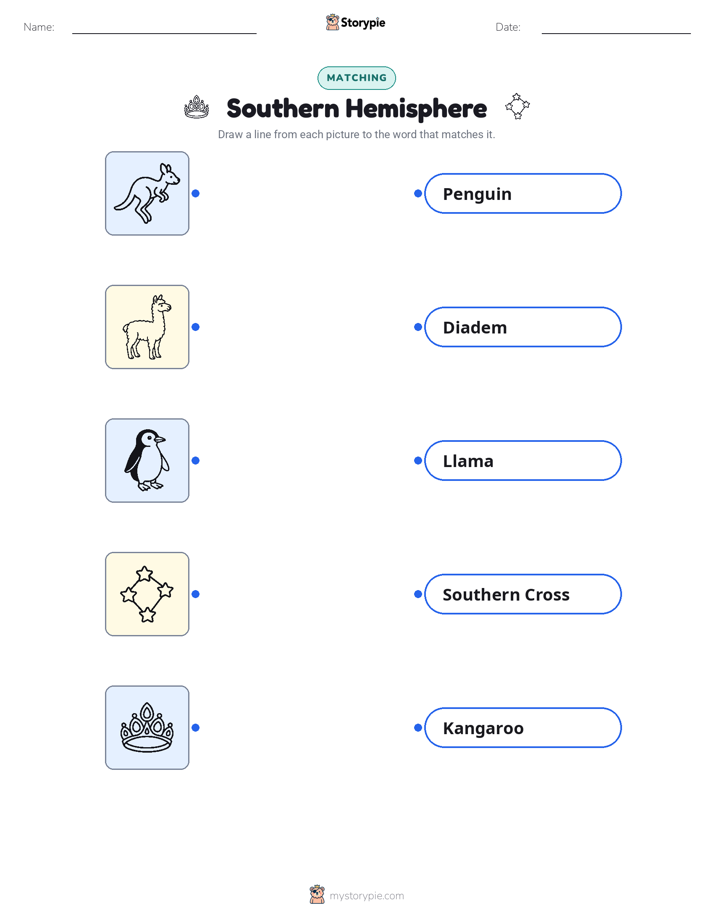
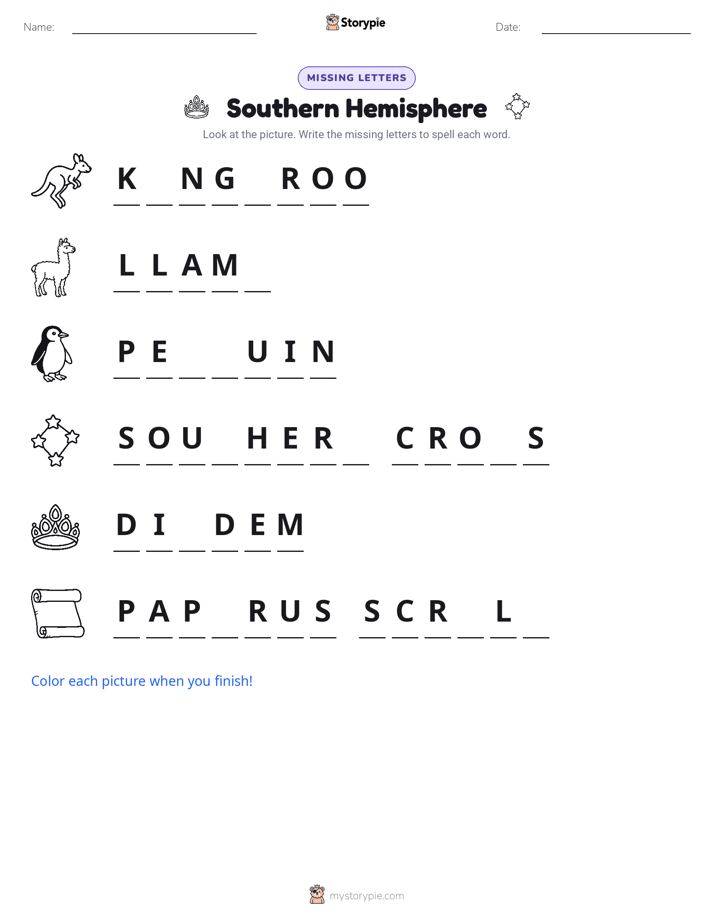
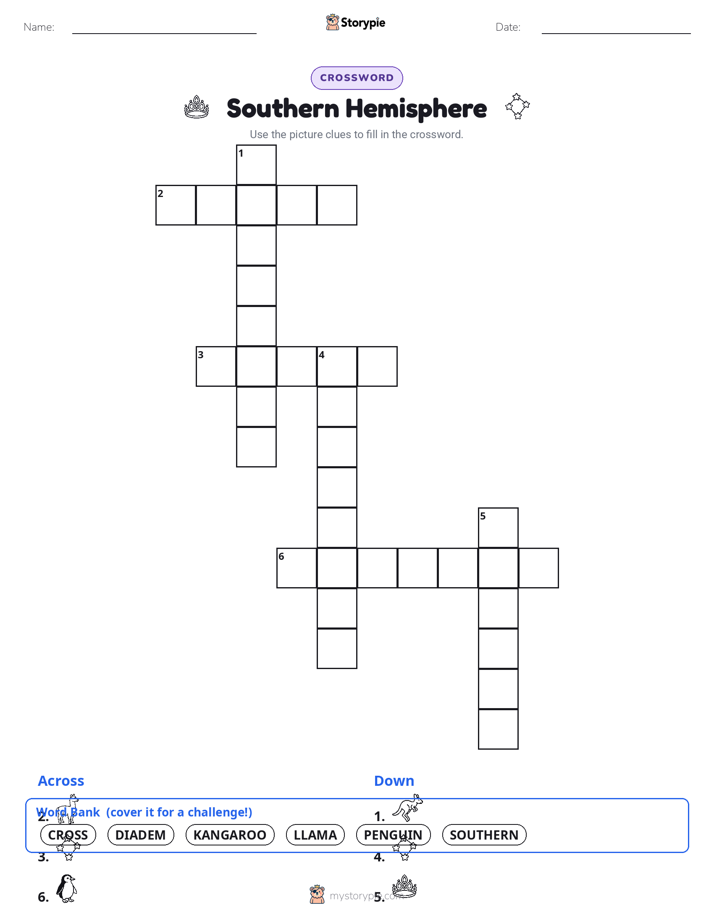
28 worksheets · answer keys · full story · quiz · Ages 10-12 · CEFR B2
Plus adds 164,000+ more stories in 27 languages, audio for every one, and printables for all of them.
Just want Southern Hemisphere?
Imagine a world where the sun is highest and hottest in December, and winter's chill arrives in June. Look up at the night sky, and you won't see the North Star. Instead, a brilliant diamond-shaped pattern of stars, the Southern Cross, guides your way. Here, water swirls down the drain in the opposite direction, and unique animals like kangaroos, llamas, and penguins roam lands that feel both ancient and new. For centuries, I was a mystery, a great unknown on the bottom of the map, a place of legends and dreams. I am the part of the world that holds continents like Australia and Antarctica, most of South America, and the southern third of Africa. I am the Southern Hemisphere.
My story began long before maps had names for my lands. For tens of thousands of years, First Peoples thrived here, developing rich cultures and a deep understanding of my landscapes, from the Australian outback to the Amazon rainforest. In another part of the world, ancient thinkers were dreaming of me. Around the year 150 CE, a brilliant Greek astronomer and geographer named Ptolemy looked at the known world and believed that for the Earth to be balanced, there must be a massive landmass in the south. He called it 'Terra Australis Incognita,' the Unknown Southern Land. This idea captured imaginations for over a thousand years. It wasn't until the Age of Exploration that sailors grew brave enough to test the theory. In 1488, a Portuguese explorer named Bartolomeu Dias faced treacherous storms to sail around the southernmost tip of Africa, proving that a sea route existed south of the Equator and opening a new chapter in my relationship with the world.
A Story from the Other Side of the World
Imagine a world where the sun is highest and hottest in December, and winter's chill arrives in June. Look up at the night sky, and you won't see the North Star. Instead, a brilliant diamond-shaped pattern of stars, the Southern Cross, guides your way. Here, water swirls down the drain in the opposite direction, and unique animals like kangaroos, llamas, and penguins roam lands that feel both ancient and new. For centuries, I was a mystery, a great unknown on the bottom of the map, a place of legends and dreams. I am the part of the world that holds continents like Australia and Antarctica, most of South America, and the southern third of Africa. I am the Southern Hemisphere.
My story began long before maps had names for my lands. For tens of thousands of years, First Peoples thrived here, developing rich cultures and a deep understanding of my landscapes, from the Australian outback to the Amazon rainforest. In another part of the world, ancient thinkers were dreaming of me. Around the year 150 CE, a brilliant Greek astronomer and geographer named Ptolemy looked at the known world and believed that for the Earth to be balanced, there must be a massive landmass in the south. He called it 'Terra Australis Incognita,' the Unknown Southern Land. This idea captured imaginations for over a thousand years. It wasn't until the Age of Exploration that sailors grew brave enough to test the theory. In 1488, a Portuguese explorer named Bartolomeu Dias faced treacherous storms to sail around the southernmost tip of Africa, proving that a sea route existed south of the Equator and opening a new chapter in my relationship with the world.
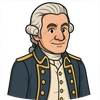
After Dias, the race to understand my full extent was on. From 1519 to 1522, Ferdinand Magellan’s expedition undertook one of the most daring voyages in history. They sailed across my vast Pacific Ocean, facing starvation and uncertainty, to complete the first circumnavigation of the globe. Their journey proved the Earth was round and my oceans were all connected. But the idea of one giant southern continent persisted. It took the methodical genius of Captain James Cook to finally reveal my true shape. Between 1768 and 1779, Cook led three scientific voyages into my waters. With advanced instruments, he meticulously charted the coastlines of New Zealand and the eastern coast of Australia. His detailed maps proved they were islands, not the edge of a great supercontinent. Cook’s work replaced the myth of 'Terra Australis Incognita' with the reality of my true geography, forever changing how the world saw me.
My most remote and challenging region remained a mystery: my icy crown, Antarctica. At the beginning of the 20th century, this frozen continent became the stage for a dramatic 'Race to the Pole.' On December 14th, 1911, the Norwegian explorer Roald Amundsen and his team, using expert knowledge of cold-weather survival, became the first humans to reach the South Pole. It was a monumental achievement of endurance and courage. For decades, different nations made claims on parts of Antarctica, and it seemed my icy heart might be carved up by rivalries. But then, something wonderful happened. In a spirit of global unity, nations came together and signed the Antarctic Treaty on December 1st, 1959. This remarkable agreement dedicated the entire continent to peaceful scientific research. It is a place where scientists from all over the world work together to study climate change, astronomy, and the secrets of our planet, a symbol of what humanity can achieve when we cooperate.
Today, I am no longer an unknown land. I am home to bustling cities, ancient cultures, and some of the most spectacular biodiversity on the planet. From the peaks of the Andes to the Great Barrier Reef, my landscapes are precious and vital. The scientific research done in Antarctica helps protect the entire world. My story shows that what once seemed separate and distant is actually deeply connected. The health of my oceans affects the weather in the Northern Hemisphere, and the discoveries made here benefit all of humanity. We are not two separate halves, but one beautiful, interconnected world. My journey from a mythical idea to a known, shared part of our planet is a reminder to always stay curious, to explore with respect, and to work together to protect our only home.
Wow facts
About
The half of the Earth that is south of the Equator, known for its unique seasons, constellations, and continents like Australia, Antarctica, and most of South America.
Take a Quiz
Question 1 of 5
Which of these events happened first in the exploration of the Southern Hemisphere?
Explore next
Want to do even more?
Go beyond exploring. Unlock tools that turn every story into real learning.

Storypie Plus for families
Full stories, quizzes, and printables. Nights and car rides, sorted.
- Unlimited audio stories
- Create Mode: your child stars in the story
- Offline downloads
- Printable worksheets & coloring pages

Why Storypie for Schools
Students engaged. Prep in seconds. Evenings back to you.
- Worksheets & Quizzes
- Classroom Management
- Formative Assessment
- Custom Curriculum & Lesson Plans
- 27 Languages

Why Storypie for Homeschool
Curriculum done. They'll ask for more. Hours back in your day.
- Worksheet Generator
- First-Person Audio Stories
- Built-in Comprehension Quizzes
- Custom Curriculum & Lesson Plans
- Print & Go Activities