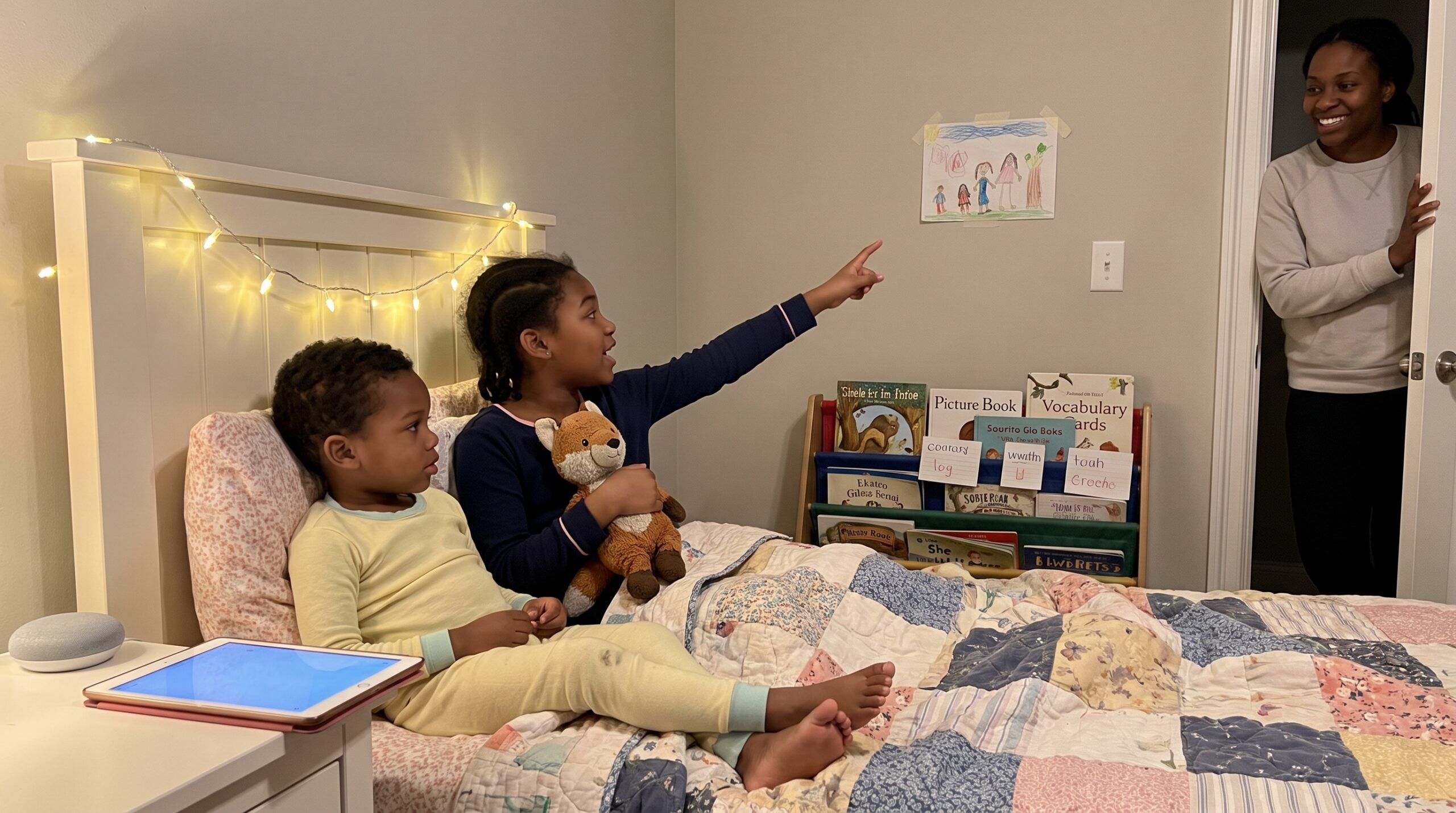
Education through storytelling ages 3-12 is a practical, quietly powerful approach to learning. First, stories wrap facts in cause and feeling. They create mental images. Children remember what makes sense and what feels like someone’s life. In fact, a 2023 study reported that children who learned through storytelling retained 70% of the information, compared to just 10% when taught through traditional methods.
What education through storytelling means
Education through storytelling ages 3-12 uses short, character-led tales to teach vocabulary, social ideas, and facts. This approach grows from folk tales, oral traditions, and progressive education in the 20th century. Also, researchers such as Bruner and Vygotsky showed narrative organizes memory and social learning. A 2021 meta-analysis of interventions to improve narrative language in preschool and elementary school–age children found overall positive effects, with effect sizes of d = 0.51 for narrative production and comprehension in group-design studies, and a larger effect size of d = 1.24 in single-case design studies.
Why education through storytelling ages 3-12 works
Stories give sequence and cause. That helps the brain encode events. Emotion and character motives help consolidation. For example, vivid scenes trigger mental imagery that pairs with words. Therefore, coherent plots form stronger memory traces than isolated facts. Furthermore, a cluster-randomized intervention study conducted between January and March 2021 with 293 preschoolers compared three approaches—interactive elaborative storytelling (IES), repeated-reading, and phonemic awareness—and found that IES produced the greatest improvements in story-vocabulary, emphasizing the importance of storytelling in vocabulary development.
How stories match children by age
- Ages 3-4: Simple plots, routines, and clear emotions.
- Ages 5-7: Cause and effect feels natural; new words come from context.
- Ages 8-10: Children infer motives and follow multi-step plots.
- Ages 11-12: They grasp multiple perspectives and abstract lessons.
Short audio episodes and memory
Short, well-paced audio invites children to build their own scenes. Without pictures, kids create images in their head. Character voices model language and rhythm. Episodes under attention span limits make repetition natural, and repetition builds vocabulary and recall.
Documented benefits and caveats
Research finds narrative formats often beat plain exposition for recall, comprehension, and transfer. Studies report gains in vocabulary, listening comprehension, empathy, and theory of mind. However, quality and age alignment matter. Stories plus discussion produce the strongest gains. For instance, a study published in 2025 evaluating teacher-designed e-storybooks for young children showed that the experimental group’s mean narrative-competence score rose from 17.9 (pre-test) to 31.4 (post-test), a gain of 13.5 points, yielding a very large effect size (Cohen’s d = 1.87). This underscores the impact of digital storytelling tools on enhancing narrative competence, which is vital for children’s learning.
What parents and teachers notice
Practical caregivers often see improved attention and richer retells after repeated listening. Routine listening fits busy days. Also, short episodes work well at bedtime, in the car, and during quiet moments. When a child returns to a story on their own, the method is working.
Why Storypie’s short audio episodes work
Storypie makes short, character-driven audio episodes designed for ages 3-12. Episodes usually run three to five minutes. They organize content by age and theme, so adults can pick age-fit scenes quickly. Research shows that a 2026 systematic review of educational digital storytelling found small-to-medium, statistically significant positive effect sizes: 0.40 for cognitive outcomes, and 0.479 for affective learning outcomes, underscoring the positive impact of digital storytelling on both cognitive and emotional learning.
Limits and a final note
No single story guarantees learning. Passive listening has trade-offs. For best results, pair stories with brief conversation. Finally, the goal is tidy, memorable episodes that invite image, feeling, and reason. Repeat over time and watch curiosity deepen.
Learn more about Storypie and its short audio episodes at the Storypie library or get the Storypie app for quick access to age-organized stories.