Isamu Akasaki biography begins with a simple truth: he was a Japanese physicist who kept trying. Born on January 30, 1929, in Kagoshima Prefecture, he later taught at Nagoya University, where he received his Doctorate of Engineering (D.Eng.) in 1964. He died on April 1, 2021, at the age of 92. Pronunciation tip: Isamu Akasaki (roughly “EE-sah-moo Ah-kah-sah-kee”).
Isamu Akasaki biography: The blue LED breakthrough
Isamu Akasaki solved very hard materials problems. He learned how to grow high-quality gallium nitride, or GaN, on cheaper substrates. Also, his lab achieved p-type doping. That step made p-n junction LEDs practical. In 1989, Akasaki and his team developed the first gallium nitride (GaN) p-n junction blue light-emitting diode (LED). These advances fixed two big roadblocks to blue light from semiconductors: crystal defects and the lack of positive charge carriers. Then his student Hiroshi Amano added low-temperature buffer layers. Shuji Nakamura made complementary strides in industry. In 2014, the three shared the Nobel Prize in Physics for their combined achievement.
Why the blue LED matters
Blue was the missing piece in bright, efficient white light. Combine red, green, and blue and you can make white. Also, a blue LED plus a yellow phosphor coating creates bright white light. As a result, LEDs could replace incandescent and fluorescent bulbs. They use far less electricity and they last tens of thousands of hours. They run cool. That saves money and cuts greenhouse gas emissions. Akasaki received many national and international awards beyond the Nobel Prize, including the Kyoto Prize in Advanced Technology in 2009 for his pioneering work on GaN-based p-n junction blue LEDs. Universities, cities, and industry groups honored his contributions to light and technology.
Everyday benefits at home
Blue LEDs changed how families live. For example, they made lights, screens, and toys brighter and cheaper to run. Here are three quick ways LEDs help daily life:
- Brighter, longer lasting lights indoors and on streets.
- Phones and TVs with richer color and lower power use.
- Toys and flashlights that stay bright and safe.
Try a simple color activity
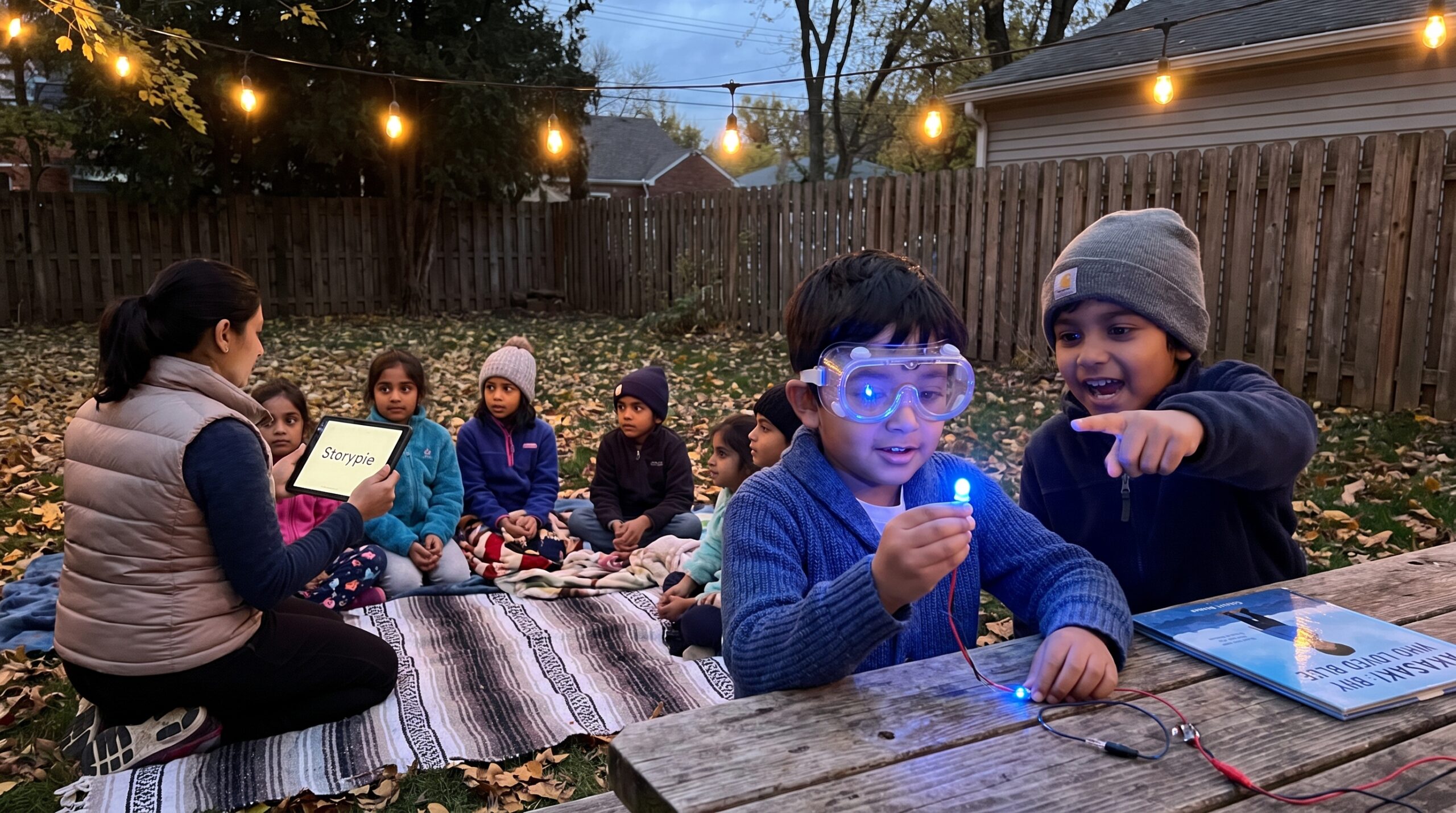
Mix colored cellophane filters or use an RGB app. Overlap red, green, and blue and watch the light move toward white. This shows how red, green, and blue add together. It is a joyful, hands-on way to see the big result of tiny color choices.
Akasaki the persevering scientist
Isamu Akasaki modeled patience and curiosity. He kept adjusting temperatures, layers, and recipes until the crystals behaved. Small, repeated changes led to breakthroughs. He published more than 700 journal and international conference papers and was granted over 200 patents. For kids, his story says: Try, tweak, and try again. Sprinkle in playful spark and wonder.
Practical impact for families
LEDs are now in home lamps, night lights, screens, traffic signals, and toys. Less energy for the same brightness means lower bills. Longer life means fewer trips to the store. For children, that means steadier light for reading and more colorful screens for learning.
At Storypie, we love stories that turn a child’s question into a big idea. Try a 10-minute Storypie about inventors tonight. Read or listen to a story about Isamu Akasaki now: For 3-5 year olds, For 3-5 year olds, For 6-8 year olds, For 8-10 year olds, and For 10-12 year olds.
Find more kid-friendly biographies and science stories at Storypie.