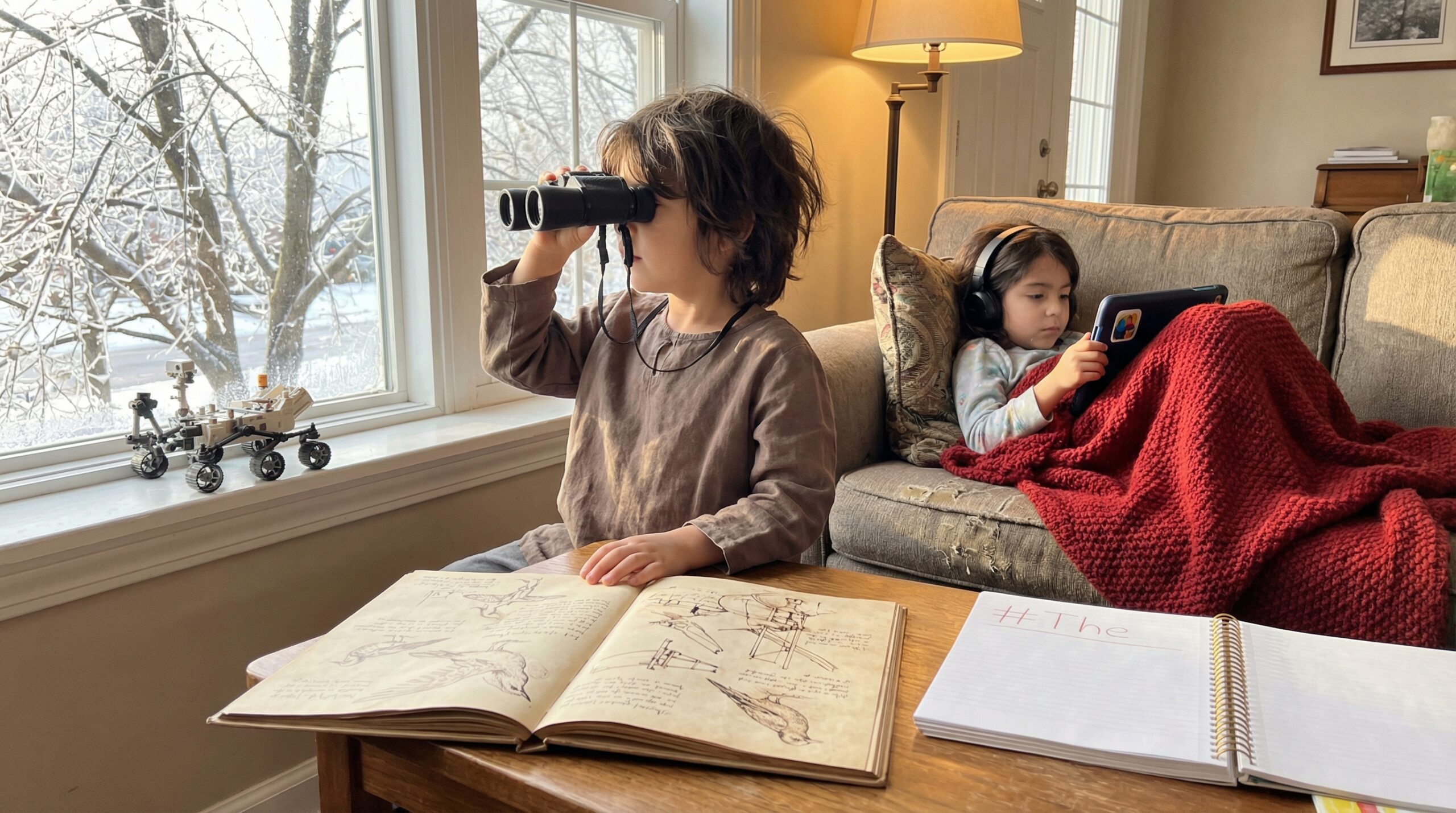
Renaissance for kids begins with wonder. On a winter morning, Leonardo, born on April 15, 1452, turned bird-watching into sketches. He drew a wing, then another. He watched closely and wondered how things moved. That quiet curiosity changed much. Leonardo is remembered as one of the most influential figures of the Renaissance, which reached its height between the 1490s and the 1520s, a period known as the High Renaissance, according to Encyclopaedia Britannica.
Renaissance for kids: A quick view
The Renaissance was a cultural rebirth in Europe from about the 1300s to the 1600s. It began in Italy, and Florence mattered most. Wealth from trade and families like the Medici supported artists and thinkers. Soon, ideas spread north to Flanders, Spain, and England. Cities changed. Buildings rose. Art grew cleverer and science grew more curious.
Humanism and everyday life
Humanism means that people and the world are worth studying. Scholars read ancient Greek and Roman books. They asked practical questions and looked at nature, not just old rules. As a result, artists drew from life, and scientists measured and tested.
Art and invention
Art learned new tricks. Perspective made pictures look deep. Light and shadow made faces feel alive. Leonardo used sfumato to blur edges so skin seemed soft. Brunelleschi solved how to build a huge dome for Florence cathedral. Michelangelo carved a David that seems ready to breathe. These wonders still stop us in our tracks.
Science and books
Science sped up during the Renaissance. Copernicus suggested the sun sits near the center. Galileo pointed a telescope at the sky and saw moons around Jupiter. Vesalius studied human bodies to learn how they work. People began to trust careful observation. That shift helped shape modern science.
Also, printing changed how people learned. The invention of the printing press by Johannes Gutenberg around 1440 revolutionized the dissemination of knowledge, making books more accessible and affordable, and facilitating the spread of Renaissance ideas, according to Encyclopaedia Britannica. Gutenberg’s Latin ‘Gutenberg Bible’ was produced in the 1450s, with an estimated 160–185 copies originally printed, of which fewer than 50 survive today, as noted by the Library of Congress. Ideas moved quickly. Writers chose everyday language. Dante, Petrarch, and later Shakespeare wrote in speech people used at home. As a result, stories reached more people and felt utterly delightful.
Patrons and people
Patrons paid artists and scholars to create. Wealthy families and popes wanted beauty and prestige. Their support let artists practice and experiment. A few women, like Isabella dEste and Artemisia Gentileschi, shaped taste and made art too.
Why the Renaissance matters to a child
The Renaissance shows curiosity at work. It links art, science, and play. It shows that careful looking leads to invention. One small question can become a tiny masterpiece. That idea feels like magic, and it still matters today.
Curiosity projects at home
- Observation drawing. Read a short paragraph about Leonardo. Ask a child to draw one thing they remember. It sharpens attention and is pure fun.
- Simple perspective. Place a toy on a table. Draw it close, then from farther away. Talk about how things shrink with distance.
- Mini-patron project. Let a child pick a Renaissance image. Make a simple frame or a label that explains why the work matters.
- Virtual museum visit. Try the Uffizi or the Louvre online. Point to faces, light, and shadow.
Read or listen to a story about The Renaissance now: For 3-5 year olds, For 6-8 year olds, For 8-10 year olds, and For 10-12 year olds. Also, try a cozy listen on Storypie.
Keep it simple and playful. Let questions lead. A short sketch, a tiny experiment, or a cozy listen can spark long-lasting wonder.