
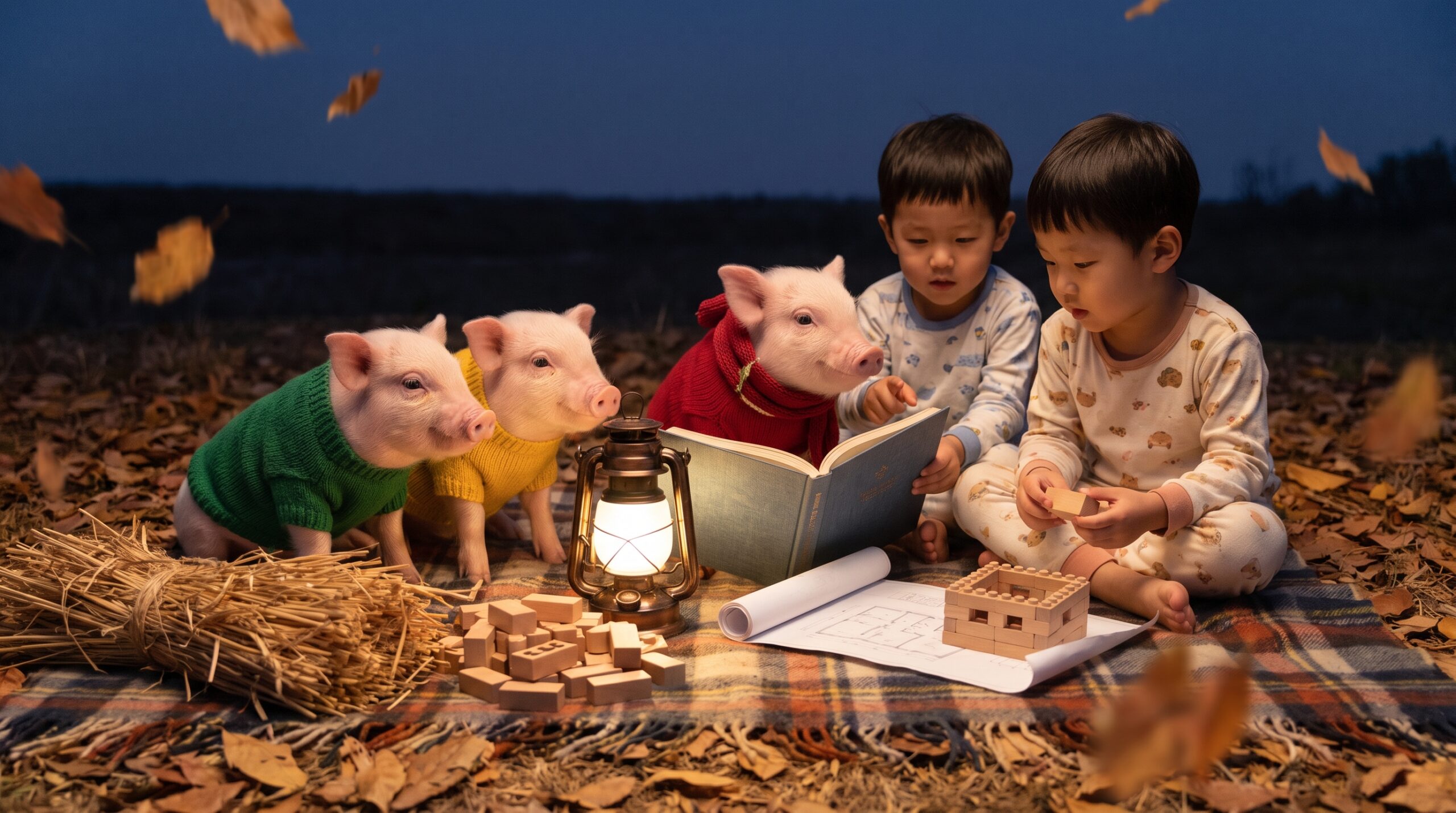
The Three Little Pigs – English is a cozy, memorable folktale your family can enjoy again and again. It features rhythmic refrains and a tidy moral about planning and effort.
The Three Little Pigs – English: Why it endures
This English-language folktale follows three pigs who build houses of straw, sticks, and bricks. Then a Big Bad Wolf huffs and puffs. Finally, only the pig with the brick house stays safe. Short, repeated lines like “I will huff and I will puff” and “Not by the hair of my chinny chin chin” make the story sing. The best-known English version of “The Three Little Pigs” was first published in English Fairy Tales by Joseph Jacobs on June 19, 1890, crediting James Orchard Halliwell‑Phillipps as his source, marking its significance in literature.
Language, age range, and learning
The Three Little Pigs – English uses simple, rhythmic language. As a result, it appeals to preschool and early elementary listeners. Additionally, the story supports vocabulary and sequencing. It also illustrates cause and effect and a moral about planning and hard work. In fact, the Joseph Jacobs version contains precisely 946 words, with an average word length of 3.61 characters, and a Flesch Reading Ease score of 92.5, which corresponds to a grade level of 4.6, making it particularly accessible for young readers. Commonly, editions aim at ages 3 to 8. However, gentler retellings suit toddlers. Meanwhile, older children may enjoy historic or comic variants.
Origins, variants, and cultural reach
The tale grew out of oral folk tradition and reached print in the late 19th century. Since then, creators have adapted it into picture books, stage plays, songs, and animation. Variants change tone and endings. For example, some versions add a chimney gag that outwits the wolf. Others include darker or more comic twists. According to the Aarne–Thompson–Uther folktale classification system, “The Three Little Pigs” is assigned the tale type ATU 124, situating it within a broader context of folklore with thematic similarities to other stories. Classic late 19th century texts are often public domain, while modern editions and recordings are copyrighted.
Formats and modern presence
The Three Little Pigs – English appears in many formats. You will find short picture books, dramatized audio, puppets, and interactive app versions. Also, a famous early 20th century animated short, which premiered at Radio City Music Hall on May 25, 1933, and won the 1934 Academy Award for Best Animated Short Film, helped spread the tale internationally. These formats keep the story lively across generations.
Read or listen to a story about The Three Little Pigs – English now: Read or listen to a story about The Three Little Pigs – English now: For 3-5 year olds, For 6-8 year olds, For 8-10 year olds, and For 10-12 year olds.
Final thought
The Three Little Pigs – English keeps working because it blends a tidy plot, catchy language, and a clear lesson about effort. Whether in a classic edition or a playful retelling, this tale sparks smiles and a little triumphant cheer for the pig who planned ahead. Cozy up and enjoy the charm.