
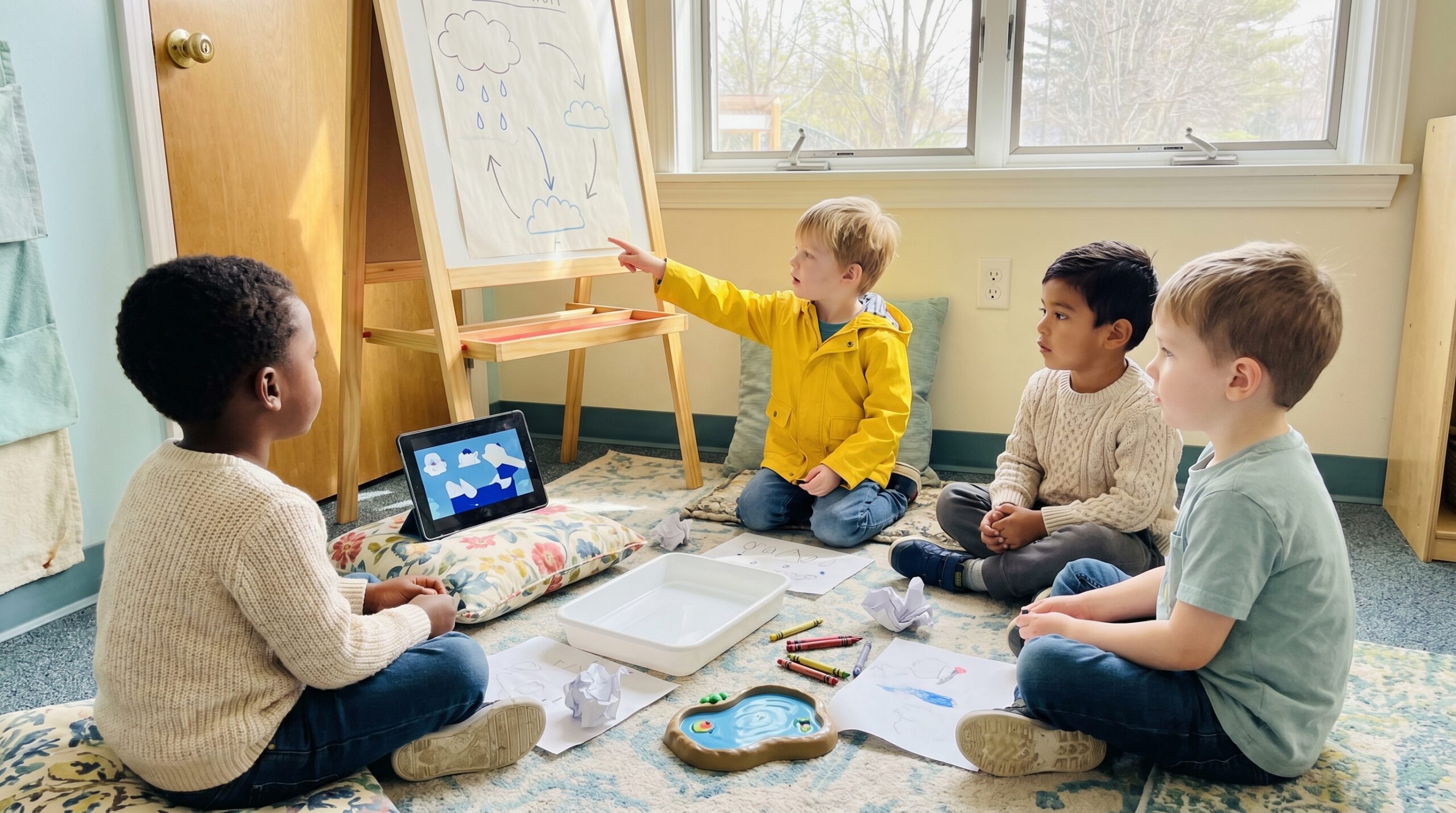
The water cycle for kids tells the simple, wonder-full story of how water travels around Earth. First, it rises as vapor. Next, it gathers into clouds. Then, it falls and finally it rests. That loop never stops. It keeps plants growing, rivers flowing, and taps running.
What is the water cycle for kids?
The water cycle is a continuous journey of water on our planet. It moves from oceans to sky to land and back again. In short, it is nature’s recycling system for water. For children, it can feel like a tiny raindrop’s adventure. Approximately 97% of Earth’s water is stored in the oceans, while only about 2.5% is freshwater, highlighting the importance of this cycle for sustaining life.
Main stages of the water cycle for kids
There are four main stages to learn. First, evaporation happens when the sun warms liquid water and turns it into vapor. Also, transpiration adds vapor when plants release moisture. Then, condensation occurs as vapor cools and clings to tiny dust particles to form clouds. Finally, precipitation falls as rain, snow, sleet, or hail. In addition, collection gathers water in oceans, lakes, soil, and underground aquifers. Notably, the oceans contribute about 86% of global evaporation, making them the primary source of water vapor in the atmosphere.
Quick list of stages
- Evaporation: sun-warmed water becomes vapor.
- Transpiration: plants release vapor into the air.
- Condensation: vapor cools and forms clouds.
- Precipitation: droplets fall back to Earth.
- Collection: water gathers in bodies of water and underground.
How clouds and weather form
Warm air rises and then cools. As a result, water vapor turns into tiny droplets. Next, droplets join until they become heavy. Then gravity pulls them down. Also, temperature and height decide the type of fall. For example, cold air makes snow while warm air makes rain. Strong updrafts can build hail. It’s simple and a little dramatic, like a tiny raindrop hero finding its way home. The residence time of water in the atmosphere is approximately 10 days, meaning a water molecule spends about 10 days in the atmosphere before precipitating back to Earth’s surface.
Other parts and why the cycle matters
Other parts of the cycle matter too. First, infiltration is when water soaks into soil. Next, runoff is water racing over land into streams. Groundwater lives in aquifers and can stay there for years. Also, the atmosphere holds only a small share of Earth’s water. However, it moves water fast from oceans to continents. Why it matters: the water cycle feeds life and shapes landscapes. For families and classrooms, it explains where water comes from. In addition, it controls weather and long-term climate. In 2023, an estimated 3.6 billion people were facing water shortages; this figure is projected to exceed 5 billion people by 2050, underscoring the importance of understanding the water cycle for future sustainability. Therefore, it decides where water is plenty and where droughts bite. Also, the cycle can carry pollution if we let it.
How people change the water cycle
People affect the cycle in many ways. For example, warming shifts evaporation and rainfall. Also, melting glaciers reduce natural freshwater stores. Paved cities speed runoff and reduce infiltration. Finally, pumping groundwater can lower aquifers. Small household actions help. For example, fix drips, plant a tree, and use less fertilizer. Little actions add up.
Simple home experiments to watch the cycle
Try a sealed plastic-bag experiment. First, add a little water to a clear bag and tape it to a sunny window. Next, watch evaporation and condensation in a day or two. Or, fill a jar with hot water, cover it with a lid and place ice on top to see quick condensation. Also, build a small terrarium and observe how plants recycle water. Above all, make it a short observation ritual. Check once a day, mark a sticker, and give a tiny reward when patterns appear.
Short history note
People watched rain, rivers, and wells for centuries. By the 1600s naturalists began testing ideas that tied evaporation to rain. Gradually, modern hydrology grew from curiosity and careful measurement. Today, scientists still track the water cycle with better tools and new insights, such as the current global mean precipitation of 2.82 mm/day, with ocean mean at 3.13 mm/day and land mean at 2.10 mm/day.
For a gentle listen or read, visit Storypie. Try it: Get the Storypie app.
Read or listen to a story about Water Cycle now: For 3-5 year olds, For 6-8 year olds, For 8-10 year olds, and For 10-12 year olds.