
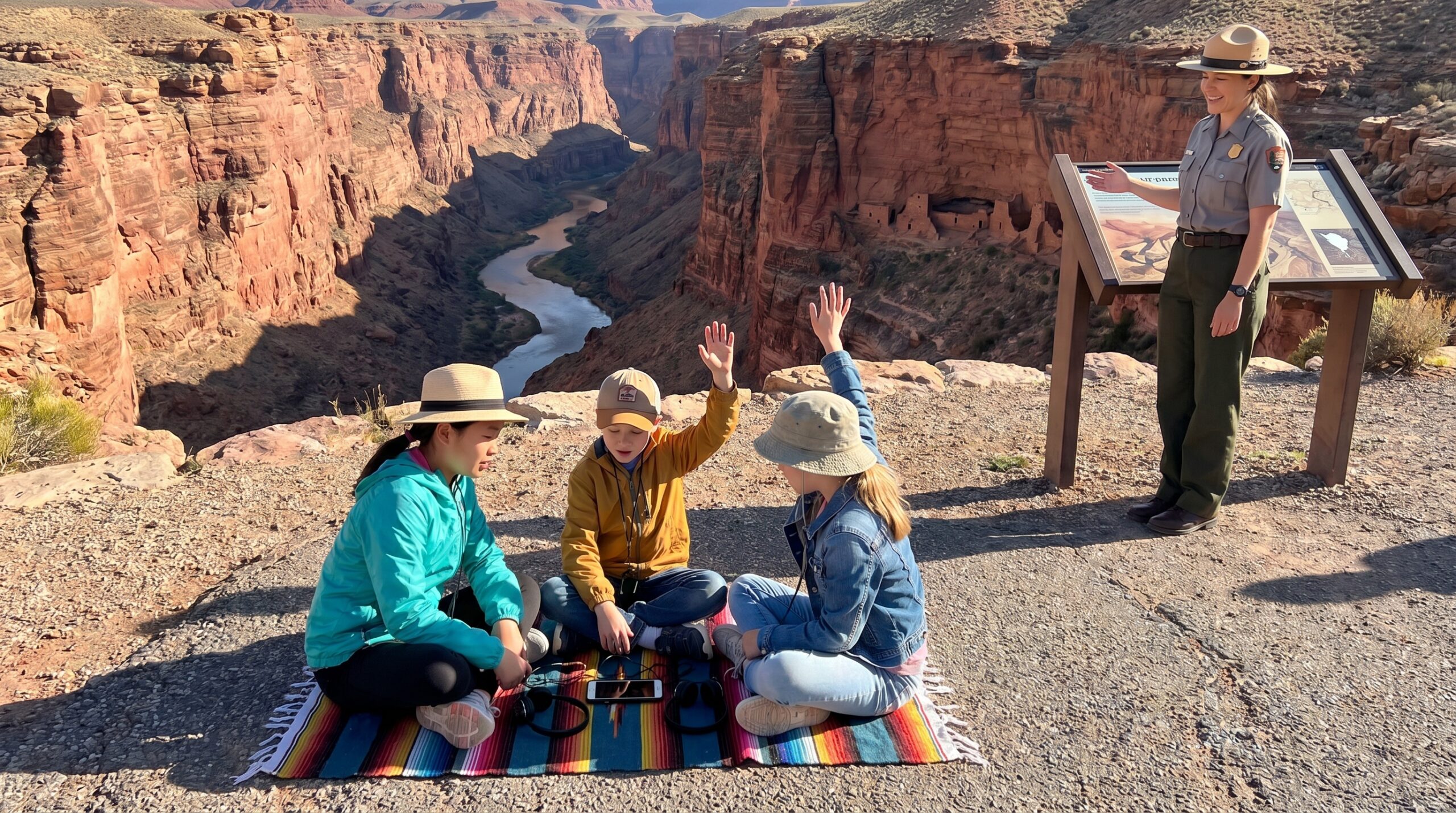
Grand Canyon for kids opens a huge, natural storybook about Earth. First, the Colorado River carved deep for millions of years. In addition, uplift of the Colorado Plateau raised the land so the river could cut down. In fact, geological studies indicate that the Colorado River established its course through the Grand Canyon approximately 6 million years ago, according to the U.S. National Park Service.
Big picture: Grand Canyon for kids
The main carving began about five to six million years ago, most scientists say. Yet the rock layers below record nearly two billion years of history. For example, the Vishnu Schist at the bottom is around 1.7 to 1.8 billion years old. These layers show ancient seas, deserts, and rivers. In short, the canyon is a layered time machine.
How big is the canyon?
The Grand Canyon spans approximately 278 river miles (447 km) in length and stretches roughly 277 miles long, with an average depth of about 1 mile (1.6 km) in places. Width changes from roughly four to eighteen miles. No wonder it feels enormous. Stand on a rim and you can see a carved world stretching far away. In 2024, Grand Canyon National Park received 4,919,163 recreational visits, generating an estimated $905,346,000 in local gateway economies and supporting approximately 8,778 jobs, highlighting its significance to the local community.
People and history
People have lived with the canyon for a very long time. Tribal nations with deep ties include Havasupai, Hualapai, Hopi, Navajo, Paiute, Yavapai, and Zuni. Many places in the canyon remain sacred. For example, Havasu Canyon sits on tribal land and needs special permission to visit. Early recorded encounters include Spanish explorers in the sixteenth century. Later, John Wesley Powell led a famous river expedition in 1869. Then Theodore Roosevelt helped protect the land. Consequently, the Grand Canyon became a national park in 1919 and a UNESCO World Heritage Site later on.
Plants, animals, and life zones
The land changes with elevation. Rim forests hold ponderosa pines and pinyon-juniper. Steeper slopes have hardy shrubs. Meanwhile, the inner canyon is hot and dry. Near the Colorado River you find lush riparian plants and cooler pockets of life. Wildlife includes mule deer, bighorn sheep, elk, and coyotes. Also, many birds live here. California condors return through careful recovery efforts.
Visiting tips for families
For families, the South Rim is the most accessible. It is open year round and offers many viewpoints. Next, the North Rim sits higher and feels quieter. However, it is seasonal. Plan ahead if you want Havasupai. Many activities need permits. Remember this hiking rule: what goes down must come up. Carry lots of water. Wear sun protection. Keep little ones away from cliff edges and stay on trails.
Respect and conservation
Conservation matters. The canyon faces threats from pollution, changing river flows, and heavy visitation. Also, respect tribal places and follow rules. Teach children to be stewards of wild places. After a visit, ask a small question like, “What is one thing we could do to help protect places like the Grand Canyon?” Gentle actions add up. In 2023, visitors to Grand Canyon National Park spent $768 million in nearby communities, supporting 10,100 jobs and contributing a total of $1 billion to the local economy, emphasizing the importance of protecting this natural wonder.
Quick ideas for curious kids
- Try a simple tray erosion experiment at home.
- Match toy rocks to canyon layers for hands-on fun.
- Listen to river and wind sounds and imagine the canyon’s age.
Grand Canyon for kids is best when wonder meets care. So enjoy the view today, and help keep it wild for tomorrow. The Grand Canyon’s Dark Skies Program also hosts astronomy programs, and in 2025, it reached 73,080 visitors with 250 programs and the help of 178 volunteers contributing 6,103 hours of service, showcasing the park’s commitment to education and community involvement.
Read or listen to a story about The Grand Canyon now: For 3-5 year olds, For 3-5 year olds, For 6-8 year olds, For 8-10 year olds, and For 10-12 year olds.
Find more family stories and learning on Storypie at Storypie. Enjoy gently and explore safely.