English

The Brothers Grimm
Jacob and Wilhelm Grimm were German academics, linguists…
Reads at Grades 6–8 Listens at Grades 4–8
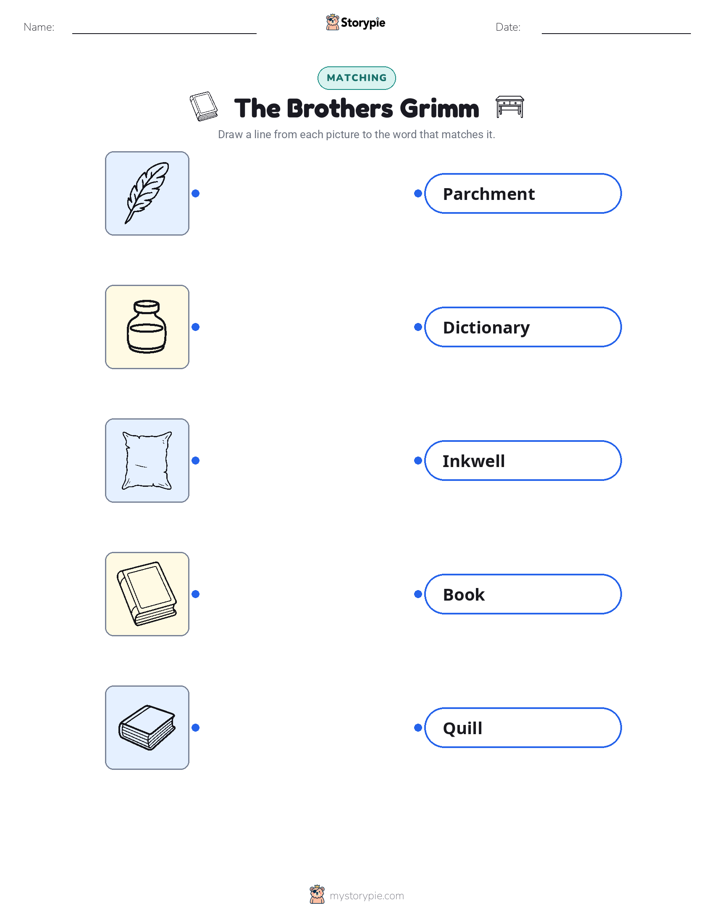
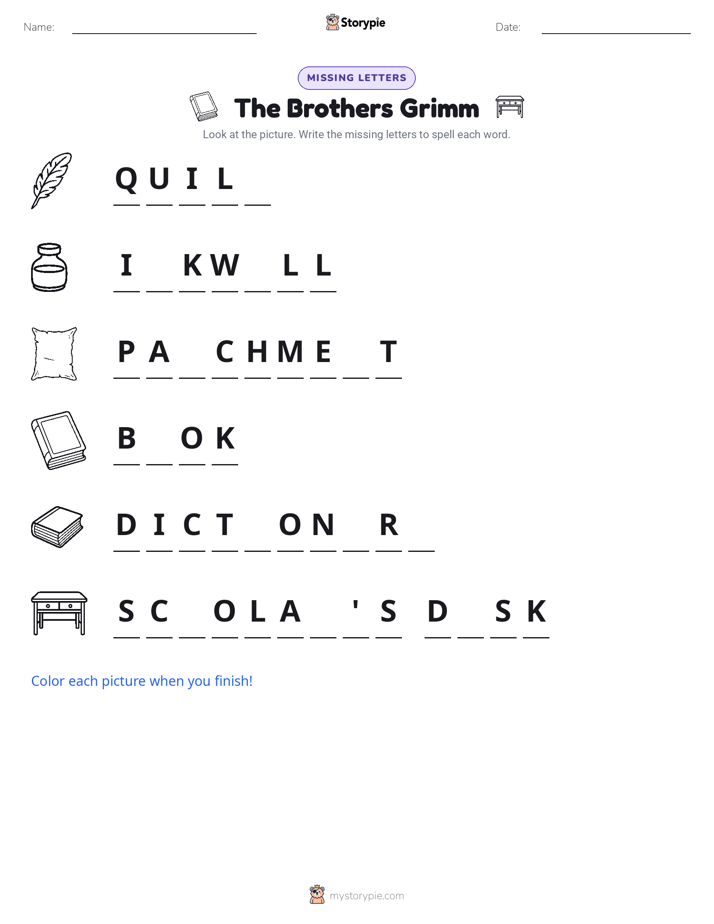
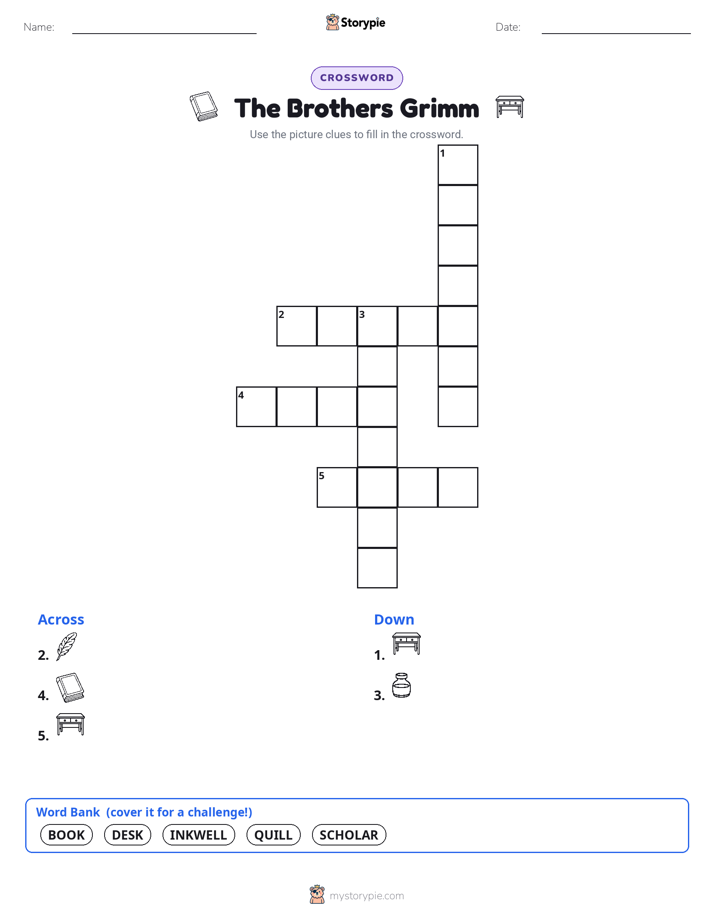
Print & create
Answer keys·No prep·Free with an account
28 worksheets · answer keys · full story · quiz · Ages 10-12 · CEFR B2
Plus adds 164,000+ more stories in 27 languages, audio for every one, and printables for all of them.
Just want The Brothers Grimm?
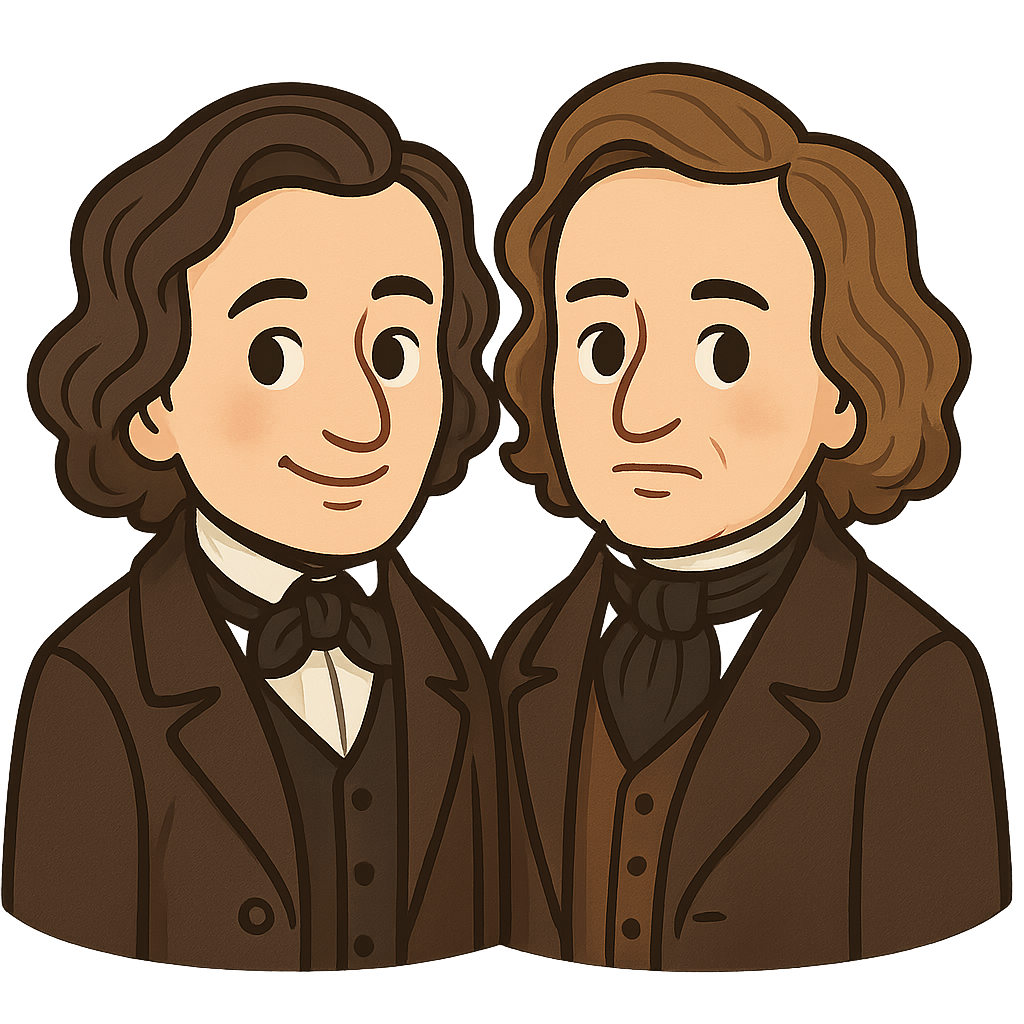
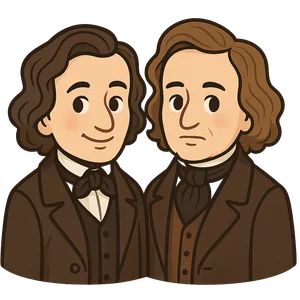
Hello, we are Jacob and Wilhelm Grimm, and we want to share our story with you. We were brothers, born just about a year apart in the town of Hanau, Germany. I, Jacob, was born first on January 4th, 1785, and my brother Wilhelm followed on February 24th, 1786. From our earliest days, we were the closest of friends and did everything together. We shared a deep love for books and the stories they held. Our world changed dramatically in 1796 when our dear father passed away, leaving our family in a difficult situation. That hardship didn't break us; instead, it fueled our determination to work hard, succeed, and take care of our family. It was a bond forged in love and necessity that would guide us for the rest of our lives.
Our journey into the world of stories truly began around 1802, when we enrolled at the University of Marburg to study law. There, we met a professor who would change our lives forever: Friedrich von Savigny. He saw the passion we had for learning and generously opened his private library to us. Surrounded by ancient texts, he taught us to look at the past in a new way. He inspired us to see history not just in laws and royal decrees, but in the old poems, languages, and tales of the German people. It was a powerful realization for us. We understood that the stories a grandmother might tell her grandchildren in a small cottage were a form of history just as important as the books written by famous scholars. We knew we had a mission: to save these oral tales before they vanished forever.
The Brothers Grimm: Guardians of Germany's Stories
Hello, we are Jacob and Wilhelm Grimm, and we want to share our story with you. We were brothers, born just about a year apart in the town of Hanau, Germany. I, Jacob, was born first on January 4th, 1785, and my brother Wilhelm followed on February 24th, 1786. From our earliest days, we were the closest of friends and did everything together. We shared a deep love for books and the stories they held. Our world changed dramatically in 1796 when our dear father passed away, leaving our family in a difficult situation. That hardship didn't break us; instead, it fueled our determination to work hard, succeed, and take care of our family. It was a bond forged in love and necessity that would guide us for the rest of our lives.
Our journey into the world of stories truly began around 1802, when we enrolled at the University of Marburg to study law. There, we met a professor who would change our lives forever: Friedrich von Savigny. He saw the passion we had for learning and generously opened his private library to us. Surrounded by ancient texts, he taught us to look at the past in a new way. He inspired us to see history not just in laws and royal decrees, but in the old poems, languages, and tales of the German people. It was a powerful realization for us. We understood that the stories a grandmother might tell her grandchildren in a small cottage were a form of history just as important as the books written by famous scholars. We knew we had a mission: to save these oral tales before they vanished forever.
Now, you might imagine us wandering through dark forests, listening for stories on the wind, but our method was much more practical. Starting in the early 1800s, we invited storytellers directly into our home in the city of Kassel. These were often ordinary women from the town and countryside who held entire libraries of tales in their memories. One of the most important contributors was a woman named Dorothea Viehmann, whose stories were a treasure trove. We would sit for hours, listening with great care as they spoke. Our job was to be scribes, to write down every word exactly as it was told to us, preserving the unique voice of the storyteller. This careful and dedicated work resulted in our very first collection, which we published in 1812. We called it Kinder- und Hausmärchen, which means Children's and Household Tales.
While we are best known for these fairy tales, collecting them was not our only passion or profession. We were serious academics who worked as librarians and university professors. Our most ambitious project, even bigger than the story collection, was the creation of a massive dictionary of the German language, called the Deutsches Wörterbuch. We began this monumental task in 1838. At that time, Germany was not one country but a collection of separate kingdoms, each with its own dialect. Our goal was to trace the history and origin of every single German word, showing how the language connected all the German-speaking people. We believed that by documenting our shared language, we could help give our people a shared sense of identity and unity.
There was a time when we had to risk our careers for our principles. In 1837, we were both professors at the prestigious University of Göttingen. A new king came to power and tried to cancel the constitution that guaranteed certain rights to the people. We could not stand by and let this happen. Along with five of our fellow professors, we wrote and signed a formal protest against the king’s unlawful act. We became known throughout the land as the 'Göttingen Seven.' The king was enraged by our defiance and, as punishment, he fired all seven of us from our university positions. It was a very difficult period for us, but we never regretted our decision. We knew then, as we do now, that it is always important to stand up for what is right.
After leaving Göttingen, we eventually moved to Berlin, where we could continue our important work on the German dictionary. We dedicated many more years to our studies of language and stories. I, Wilhelm, lived to be 73 years old and passed away in 1859. My dear brother Jacob joined me four years later, in 1863, at the age of 78. Though our time on Earth ended, our work has lived on. The tales we carefully collected, like 'Cinderella,' 'Hansel and Gretel,' and 'Snow White,' have traveled far beyond Germany and are now read by children all over the world. We are remembered not only for saving these magical stories, but for our work that helped shape the study of language and bring a sense of unity to the German people. Our hope was always that the stories and words we preserved would continue to inspire and connect people for generations to come.
Wow facts
About
Jacob and Wilhelm Grimm were German academics, linguists, and cultural researchers who collected and published folklore during the 19th century, popularizing stories like "Cinderella," "Hansel and Gretel," and "Snow White."
Take a Quiz
Question 1 of 5
What was the primary goal of the Brothers Grimm in collecting fairy tales?
Explore next





Want to do even more?
Go beyond exploring. Unlock tools that turn every story into real learning.

Storypie Plus for families
Full stories, quizzes, and printables. Nights and car rides, sorted.
- Unlimited audio stories
- Create Mode: your child stars in the story
- Offline downloads
- Printable worksheets & coloring pages

Why Storypie for Schools
Students engaged. Prep in seconds. Evenings back to you.
- Worksheets & Quizzes
- Classroom Management
- Formative Assessment
- Custom Curriculum & Lesson Plans
- 27 Languages

Why Storypie for Homeschool
Curriculum done. They'll ask for more. Hours back in your day.
- Worksheet Generator
- First-Person Audio Stories
- Built-in Comprehension Quizzes
- Custom Curriculum & Lesson Plans
- Print & Go Activities