English

Democritus
Democritus was an Ancient Greek pre-Socratic philosopher primarily remembered today for his formulation of an…
Reads at Grades 6–8 Listens at Grades 4–8
Print & create
Answer keys·No prep·Free with an account
28 worksheets · answer keys · full story · quiz · Ages 10-12 · CEFR B2
Plus adds 208,000+ more stories in 27 languages, audio for every one, and printables for all of them.
Just want Democritus?
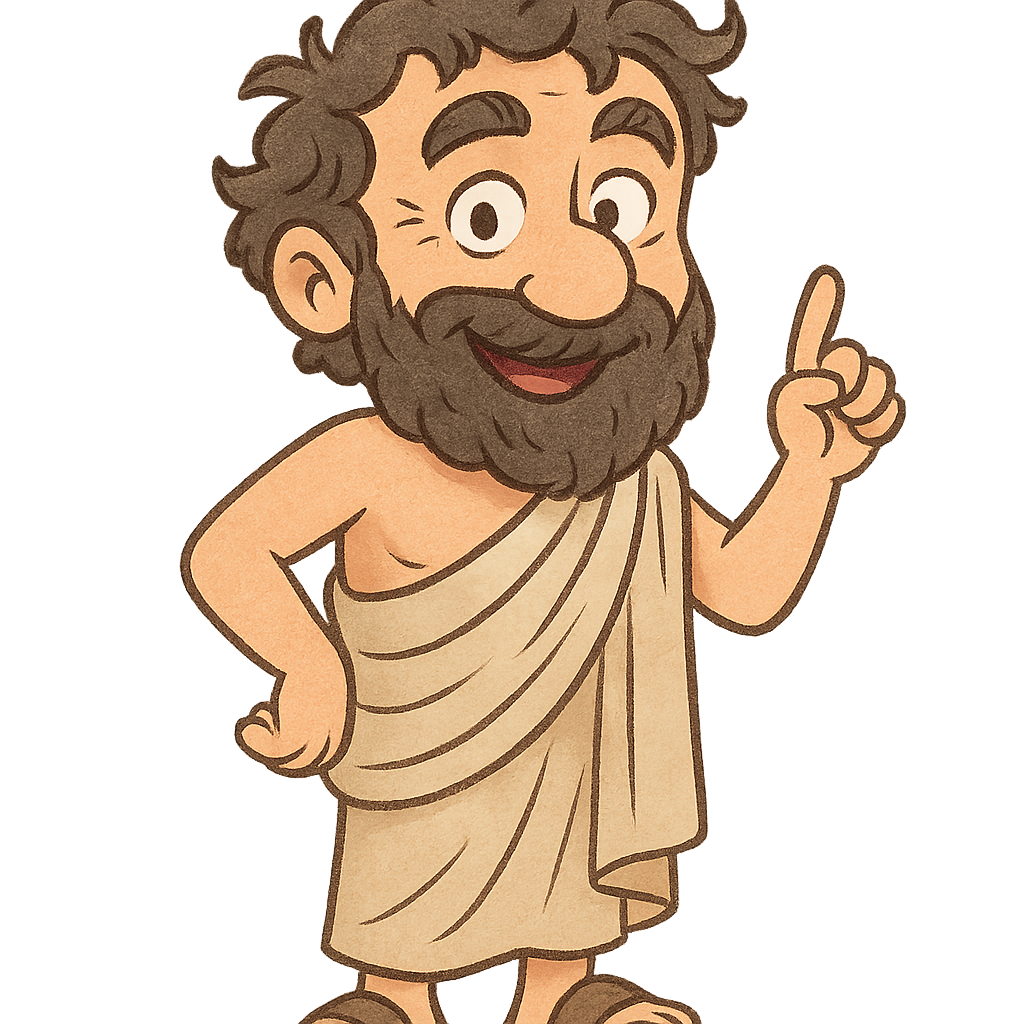
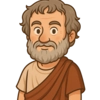
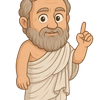
Hello, I am Democritus, and you might know me by my nickname, 'the Laughing Philosopher.' I was born around the year 460 BCE in Abdera, a lively city in Ancient Greece. It was an exciting time to be alive. All around me, people were beginning to look at the world and ask big questions, not just accepting old stories but seeking real answers. My own mind was filled with curiosity from a young age. I didn’t just want to know what things were; I wanted to know what they were made of, deep down. This curiosity would become the driving force of my entire life and lead me to an idea that would echo for thousands of years.
I was fortunate to be born into a family with enough money to support my greatest passion: learning. After my father passed away, I used my inheritance not for a life of luxury, but for a life of exploration. Around the mid-5th century BCE, I began a great journey for knowledge. I traveled far from Greece, visiting the ancient lands of Egypt and Persia. I was not a tourist seeing the sights; I was a student on a mission. My goal was to meet and learn from the wisest people in the world. I studied mathematics with Egyptian scholars and learned about the stars from astronomers in Persia. Every conversation and every new idea was a treasure that I collected, preparing me for the great question I would soon try to answer.
During my studies, I met the man who would become my greatest teacher, a brilliant philosopher named Leucippus. He introduced me to an idea that was both simple and revolutionary. He asked me to consider a simple question: what if you could take any object, like a piece of cheese or a stone, and cut it in half again and again? Would you be able to do this forever? Or would you eventually reach a piece so tiny that it could not be cut any further? This single question sparked my imagination like nothing before. It set me on the path to developing my most famous theory and forever changed how I viewed the world.
Democritus: The Laughing Philosopher
Hello, I am Democritus, and you might know me by my nickname, 'the Laughing Philosopher.' I was born around the year 460 BCE in Abdera, a lively city in Ancient Greece. It was an exciting time to be alive. All around me, people were beginning to look at the world and ask big questions, not just accepting old stories but seeking real answers. My own mind was filled with curiosity from a young age. I didn’t just want to know what things were; I wanted to know what they were made of, deep down. This curiosity would become the driving force of my entire life and lead me to an idea that would echo for thousands of years.
I was fortunate to be born into a family with enough money to support my greatest passion: learning. After my father passed away, I used my inheritance not for a life of luxury, but for a life of exploration. Around the mid-5th century BCE, I began a great journey for knowledge. I traveled far from Greece, visiting the ancient lands of Egypt and Persia. I was not a tourist seeing the sights; I was a student on a mission. My goal was to meet and learn from the wisest people in the world. I studied mathematics with Egyptian scholars and learned about the stars from astronomers in Persia. Every conversation and every new idea was a treasure that I collected, preparing me for the great question I would soon try to answer.
During my studies, I met the man who would become my greatest teacher, a brilliant philosopher named Leucippus. He introduced me to an idea that was both simple and revolutionary. He asked me to consider a simple question: what if you could take any object, like a piece of cheese or a stone, and cut it in half again and again? Would you be able to do this forever? Or would you eventually reach a piece so tiny that it could not be cut any further? This single question sparked my imagination like nothing before. It set me on the path to developing my most famous theory and forever changed how I viewed the world.
From that spark, I developed my atomic theory. I proposed that everything in the universe—the ground beneath your feet, the water in the sea, and even you—is made of tiny, solid particles that are eternal and cannot be cut or destroyed. I gave them a name: 'atomos,' which is a Greek word meaning 'uncuttable.' I imagined these atoms were too small for our eyes to see, constantly moving and colliding in an infinite empty space that I called 'the void.' You can picture it like specks of dust you see dancing in a beam of sunlight; my atoms were always in motion. I reasoned that all the different things we see and touch are created by the various shapes, sizes, and arrangements of these atoms. A smooth object was made of smooth, round atoms, while a bitter taste was caused by sharp, jagged atoms.
My curiosity was not limited to what the world was made of; I also spent a great deal of time thinking about how a person should live a good life. I taught that the most important goal for any person was to achieve a state of 'euthymia,' which means cheerfulness, contentment, and calm. I believed that a person could find true happiness by living moderately, enjoying life's simple pleasures, and not being troubled by fear or superstition. This is the real reason people called me the 'Laughing Philosopher.' It wasn't because I thought everything was a joke, but because I believed that true joy came from wisdom, understanding, and maintaining a cheerful spirit no matter what life brought.
I lived a long and full life. I lived to be about 90 years old, passing away around 370 BCE. Over my lifetime, I wrote as many as 70 books, but sadly, most of them have been lost to time. However, my most important idea—the atom—was written about by other scholars and survived the centuries. Thousands of years later, in the early 1800s, a scientist named John Dalton performed experiments that helped prove my ancient theory was correct. It shows that sometimes, a simple question from a curious mind can echo through time and forever change how we understand the entire universe.
Wow facts
About
Democritus was an Ancient Greek pre-Socratic philosopher primarily remembered today for his formulation of an atomic theory of the universe.
Take a Quiz
Question 1 of 5
Why was Democritus known as the 'Laughing Philosopher'?
Explore next




Want to do even more?
Go beyond exploring. Unlock tools that turn every story into real learning.

Storypie Plus for families
Full stories, quizzes, and printables. Nights and car rides, sorted.
- Unlimited audio stories
- Create Mode: your child stars in the story
- Offline downloads
- Printable worksheets & coloring pages

Why Storypie for Schools
Students engaged. Prep in seconds. Evenings back to you.
- Worksheets & Quizzes
- Classroom Management
- Formative Assessment
- Custom Curriculum & Lesson Plans
- 27 Languages

Why Storypie for Homeschool
Curriculum done. They'll ask for more. Hours back in your day.
- Worksheet Generator
- First-Person Audio Stories
- Built-in Comprehension Quizzes
- Custom Curriculum & Lesson Plans
- Print & Go Activities