English

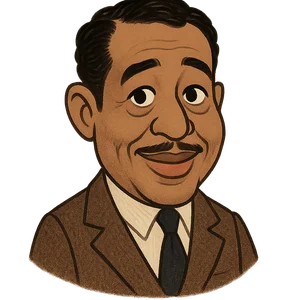
Duke Ellington
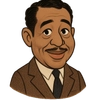
Duke Ellington was a groundbreaking American composer, pianist, and leader of a jazz orchestra…
Reads at Grades 3–5 Listens at Grades 1–5
Print & create
Answer keys·No prep·Free with an account
28 worksheets · answer keys · full story · quiz · Ages 8-10 · CEFR B1
Plus adds 244,000+ more stories in 27 languages, audio for every one, and printables for all of them.
Just want Duke Ellington?
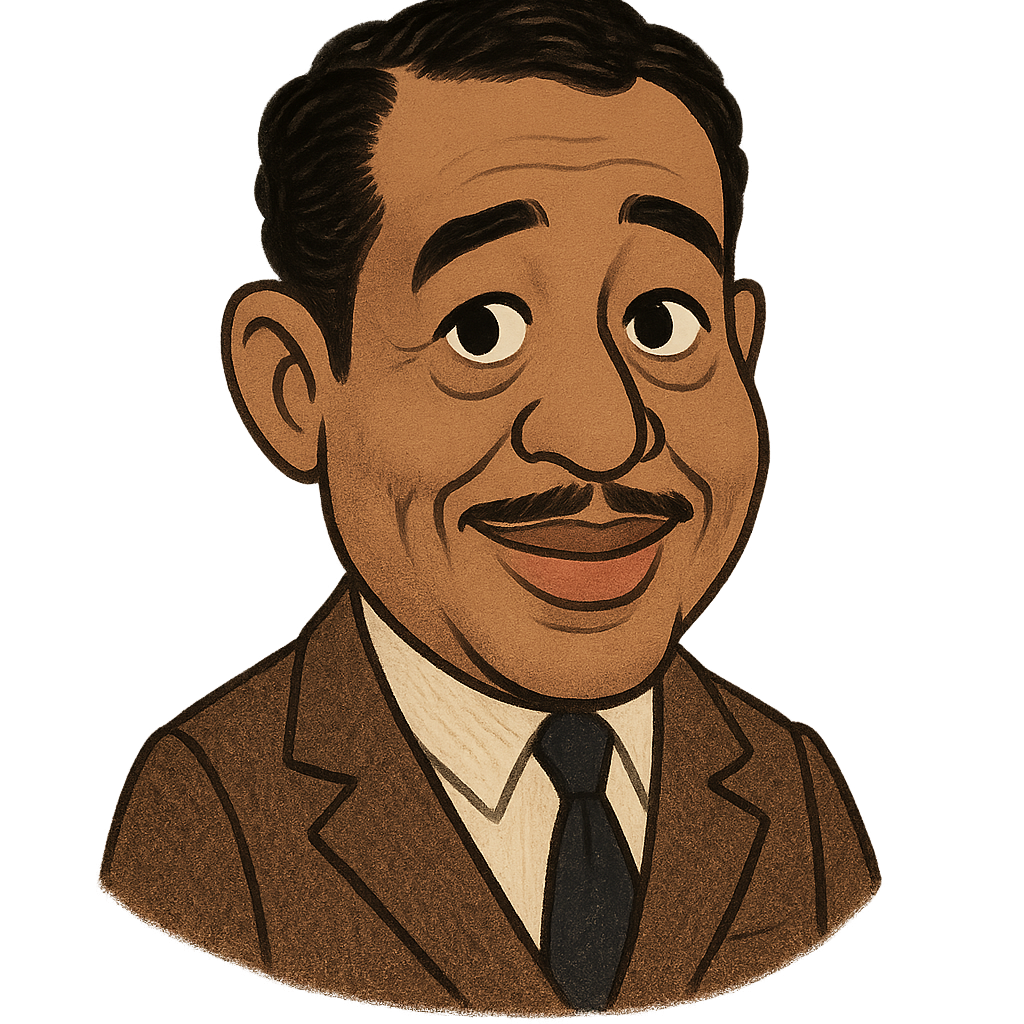
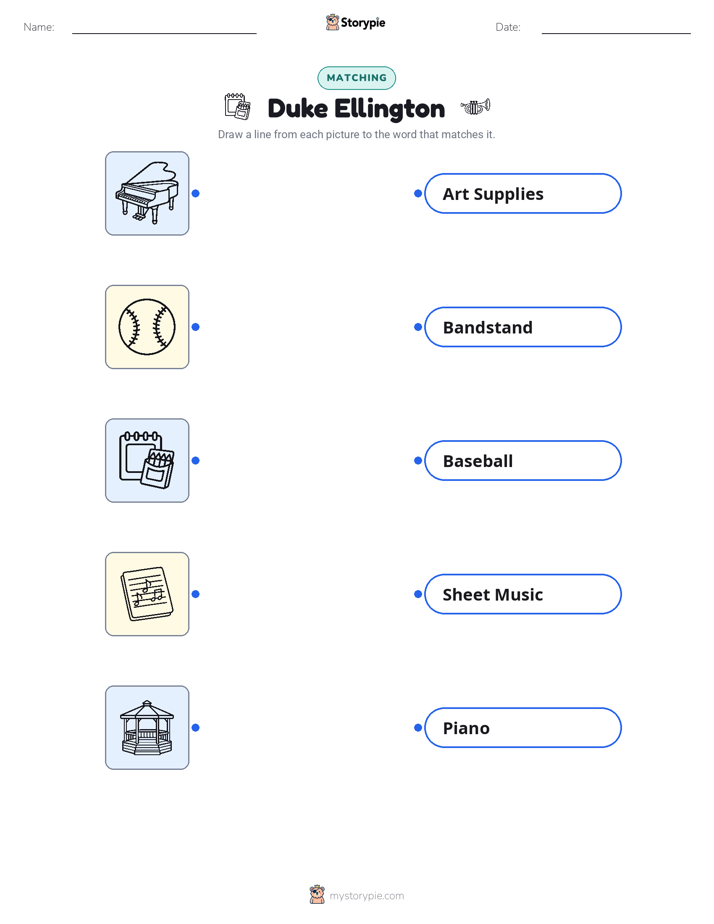
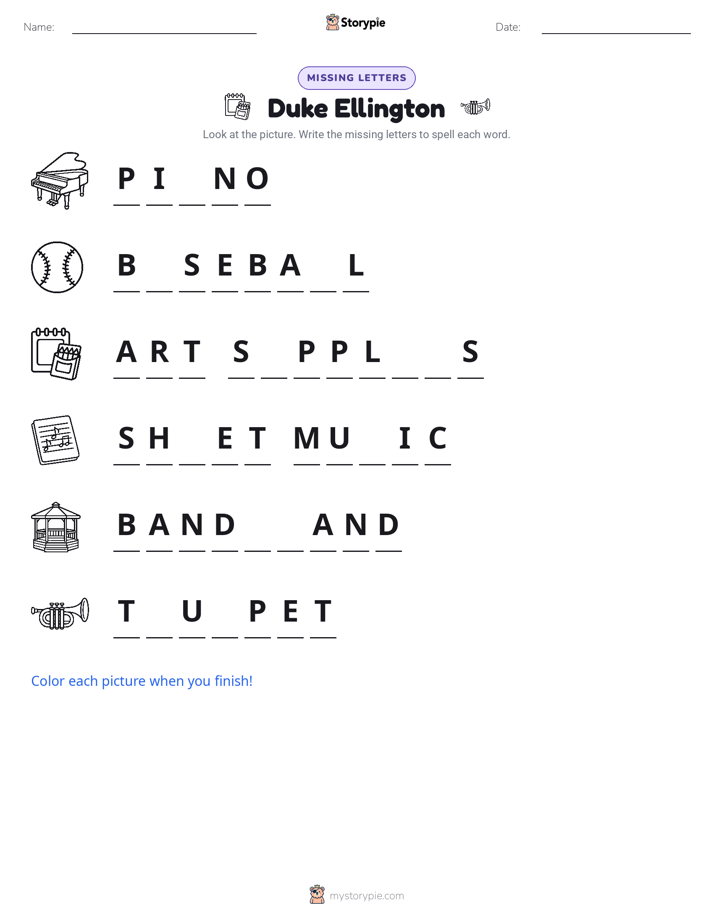
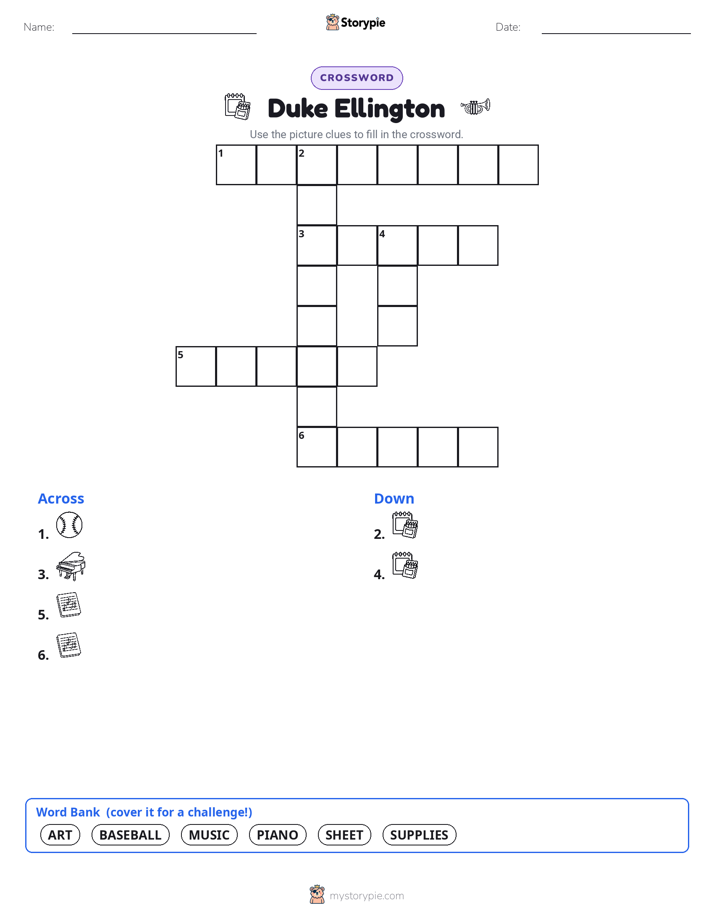
Hello! My name is Duke Ellington, and I'm a musician. I was born Edward Kennedy Ellington on April 29th, 1899, in Washington, D.C. My wonderful parents, Daisy and James, always filled our home with music and taught me to have good manners and be proud of who I was. Because I was always polite and dressed sharply, my friends gave me the nickname 'Duke,' saying I was like a young nobleman. I started taking piano lessons when I was about seven years old, but I must tell you a secret—I was much more interested in playing baseball back then!
But everything changed for me when I first heard a style of music called 'ragtime.' It was so full of life and fun that I suddenly knew I had to learn how to play it. Around 1914, when I was a teenager, I started going to all the places in my city where I could listen to talented pianists. I would listen carefully and then go home and teach myself to play by copying what I had heard. Soon, I wrote my very first song, which I called 'Soda Fountain Rag.' It wasn't long before I started my own band, The Duke's Serenaders. We played music for parties all over Washington, D.C., and I knew I had found my true passion.
In the early 1920s, I knew I had to follow my dream, so I moved to the biggest city I could think of: New York City. I went to a neighborhood called Harlem, which was an amazing place buzzing with energy and creativity. It was a very special time that people now call the Harlem Renaissance, where Black artists, writers, and musicians like me were creating incredible new things. My band grew larger, and we decided to call ourselves The Washingtonians, to remember where we came from. Our big break came in 1927 when we became the main band at a very famous nightclub called the Cotton Club. It was the most popular spot in town, and everyone wanted to be there.
Duke Ellington
Hello! My name is Duke Ellington, and I'm a musician. I was born Edward Kennedy Ellington on April 29th, 1899, in Washington, D.C. My wonderful parents, Daisy and James, always filled our home with music and taught me to have good manners and be proud of who I was. Because I was always polite and dressed sharply, my friends gave me the nickname 'Duke,' saying I was like a young nobleman. I started taking piano lessons when I was about seven years old, but I must tell you a secret—I was much more interested in playing baseball back then!
But everything changed for me when I first heard a style of music called 'ragtime.' It was so full of life and fun that I suddenly knew I had to learn how to play it. Around 1914, when I was a teenager, I started going to all the places in my city where I could listen to talented pianists. I would listen carefully and then go home and teach myself to play by copying what I had heard. Soon, I wrote my very first song, which I called 'Soda Fountain Rag.' It wasn't long before I started my own band, The Duke's Serenaders. We played music for parties all over Washington, D.C., and I knew I had found my true passion.
In the early 1920s, I knew I had to follow my dream, so I moved to the biggest city I could think of: New York City. I went to a neighborhood called Harlem, which was an amazing place buzzing with energy and creativity. It was a very special time that people now call the Harlem Renaissance, where Black artists, writers, and musicians like me were creating incredible new things. My band grew larger, and we decided to call ourselves The Washingtonians, to remember where we came from. Our big break came in 1927 when we became the main band at a very famous nightclub called the Cotton Club. It was the most popular spot in town, and everyone wanted to be there.
Playing at the Cotton Club made us famous because our performances were broadcast on the radio all across America. This is when my band became known as the Duke Ellington Orchestra. I didn't just play the piano in the band; I was also a composer, which means I wrote the music we played, and I was the bandleader. I always thought of my orchestra as my real instrument. Each musician had their own special sound, and I would blend them together to create our music. We wrote many famous songs during this time, like 'Mood Indigo.' In 1931, we created a song called 'It Don't Mean a Thing (If It Ain't Got That Swing),' and that song helped give a name to the whole era of 'swing' music.
Our music became so popular that it took us all over the globe! We went on our first tour of Europe in 1933, and the people there absolutely loved our American jazz. A few years later, around 1938, I began working with another wonderful composer named Billy Strayhorn. He became my closest musical partner, and he wrote one of our most famous and beloved songs, 'Take the 'A' Train.' Together, Billy and I wrote thousands of songs. I always wanted my music to do more than just make people dance; I wanted it to tell the story of my people. In 1943, I performed a long piece of music at a famous concert hall called Carnegie Hall. I named it 'Black, Brown and Beige,' and it was a musical history of the African American experience.
In 1969, I received a very special honor. The President of the United States gave me the Presidential Medal of Freedom for my music. I spent my whole life composing beautiful melodies, leading my amazing orchestra, and sharing my sound with the world. I lived to be 75 years old. Today, people remember me as one of the most important composers in American history. My music is still played all over the world, which proves that jazz is a timeless art form that can bring joy and inspiration to everyone.
Wow facts
About
Duke Ellington was a groundbreaking American composer, pianist, and leader of a jazz orchestra, whose career spanned more than 50 years and elevated jazz to an art form.
Take a Quiz
Question 1 of 5
Why did my friends give me the nickname 'Duke' when I was a boy?
Explore next

Want to do even more?
Go beyond exploring. Unlock tools that turn every story into real learning.

Storypie Plus for families
Full stories, quizzes, and printables. Nights and car rides, sorted.
- Unlimited audio stories
- Create Mode: your child stars in the story
- Offline downloads
- Printable worksheets & coloring pages

Why Storypie for Schools
Students engaged. Prep in seconds. Evenings back to you.
- Worksheets & Quizzes
- Classroom Management
- Formative Assessment
- Custom Curriculum & Lesson Plans
- 27 Languages

Why Storypie for Homeschool
Curriculum done. They'll ask for more. Hours back in your day.
- Worksheet Generator
- First-Person Audio Stories
- Built-in Comprehension Quizzes
- Custom Curriculum & Lesson Plans
- Print & Go Activities