English

Elisha Graves Otis
Elisha Graves Otis was an American industrialist and inventor who created the safety brake for elevators…
Reads at Grades 6–8 Listens at Grades 4–8
Print & create
Answer keys·No prep·Free with an account
28 worksheets · answer keys · full story · quiz · Ages 10-12 · CEFR B2
Plus adds 102,000+ more stories in 27 languages, audio for every one, and printables for all of them.
Just want Elisha Graves Otis?
Hello, my name is Elisha Graves Otis, and I am the inventor who helped cities grow upward. I was born on August 3rd, 1811, in Halifax, Vermont, into a large family. From a young age, I was fascinated by how things worked. While other children might play, I was often taking apart a tool or trying to figure out the mechanics of a farm machine. My curiosity was endless. When I was 19 years old, I decided it was time to make my own way in the world. I left home and tried my hand at many different jobs. I worked as a wagon driver, a carpenter, and a builder. No matter what my job was, I never lost my desire to tinker and invent. I was always looking for ways to improve the tools and machines around me, making them more efficient or safer for everyone to use.
My path as an inventor was not a straight one; it took me to different places and through various challenges. I moved between New York and Vermont, always seeking a new problem to solve. In 1838, I successfully patented an improved version of a railway brake, which was one of my first official inventions. My journey eventually led me to Albany, New York, around 1845, where I took a job at a bedstead factory. The factory made wooden bed frames, but the process was slow because it was all done by hand. I saw an opportunity for improvement. I designed and built a machine that could produce bed frames four times faster than the most skilled workers. This invention made the factory far more successful and proved to me that my real talent lay in solving mechanical problems with clever new designs.
Elisha Graves Otis
Hello, my name is Elisha Graves Otis, and I am the inventor who helped cities grow upward. I was born on August 3rd, 1811, in Halifax, Vermont, into a large family. From a young age, I was fascinated by how things worked. While other children might play, I was often taking apart a tool or trying to figure out the mechanics of a farm machine. My curiosity was endless. When I was 19 years old, I decided it was time to make my own way in the world. I left home and tried my hand at many different jobs. I worked as a wagon driver, a carpenter, and a builder. No matter what my job was, I never lost my desire to tinker and invent. I was always looking for ways to improve the tools and machines around me, making them more efficient or safer for everyone to use.
My path as an inventor was not a straight one; it took me to different places and through various challenges. I moved between New York and Vermont, always seeking a new problem to solve. In 1838, I successfully patented an improved version of a railway brake, which was one of my first official inventions. My journey eventually led me to Albany, New York, around 1845, where I took a job at a bedstead factory. The factory made wooden bed frames, but the process was slow because it was all done by hand. I saw an opportunity for improvement. I designed and built a machine that could produce bed frames four times faster than the most skilled workers. This invention made the factory far more successful and proved to me that my real talent lay in solving mechanical problems with clever new designs.
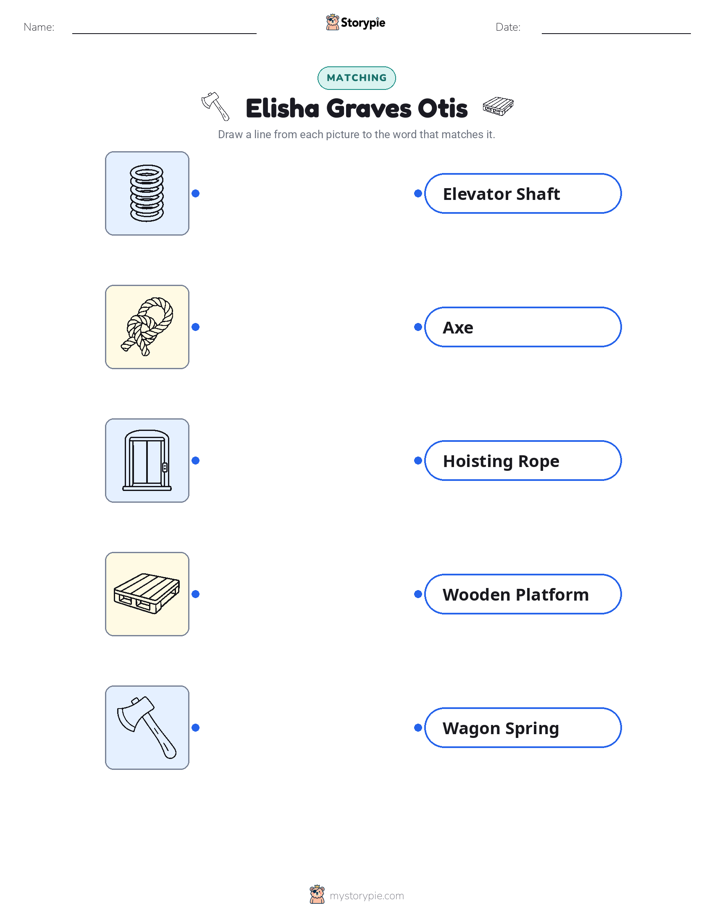
My most famous invention came from a very practical need. In 1852, I was working in Yonkers, New York, managing a factory that needed to be set up. Part of my job was to figure out how to move heavy machinery to the building's upper floors. The common method was to use a hoisting platform, which was basically a wooden deck lifted by a single rope. I was deeply concerned about the safety of this system. I knew that if the rope frayed and snapped, the platform and all its expensive cargo—or worse, the workers—would come crashing down. I refused to expose my workers to that kind of danger. I was determined to create a safer way to lift heavy loads. I spent my spare time thinking and sketching. My idea was simple but effective: I designed an automatic safety brake using a tough wagon spring. If the hoisting rope broke, the tension would be released, causing the spring to snap outward and catch onto notched guide rails running up the sides of the elevator shaft, stopping the platform in its tracks.
Having a great invention is one thing, but convincing people to trust it is another. In 1853, I started my own company to manufacture my “safety hoister,” but sales were slow. People were still too afraid of riding on a platform lifted by a rope. I knew I needed to do something dramatic to prove my invention worked. My big opportunity came in 1854 at the Exhibition of the Industry of All Nations, a world's fair held in New York City. In the center of the main hall, I built an open elevator shaft. I stood on the platform myself and had it raised high above the heads of a large, curious crowd. Then, I gave a signal. A man standing on a beam above me swung an axe and cut the thick hoisting rope. The crowd gasped, expecting a terrible crash. But instead of plummeting, my platform dropped only a few inches before my safety brake engaged with a loud click, stopping it securely. I looked out at the stunned audience, raised my hat, and declared, “All safe, gentlemen!”.
That demonstration changed everything. After seeing my safety brake work so perfectly, the public finally began to trust my invention. In 1857, we installed the world's very first passenger elevator in a five-story department store in New York City. This was a major turning point. My invention was no longer just for lifting freight; it was for people. This innovation had an effect I could have never fully imagined. Before my safety elevator, buildings were rarely taller than a few stories because no one wanted to climb endless flights of stairs. With a safe and reliable way to move people between floors, architects were suddenly free to design buildings that could reach for the sky. My invention paved the way for the modern skyscraper, completely transforming city skylines all over the world.
My time on Earth was dedicated to solving problems, but it was shorter than I might have wished. I lived to be 49 years old, passing on in 1861. But my work continued through my sons, Charles and Norton, who grew the Otis Elevator Company into a world leader that it still is today. My legacy is not just in a company name; it is built into the very structure of our modern world. Every time you step into an elevator in a school, an office building, a hospital, or a skyscraper, you are experiencing the result of that one simple idea I had to make lifting things safer. I am proud that my focus on safety helped the world build upward, creating the cities we know today.
Wow facts
About
Elisha Graves Otis was an American industrialist and inventor who created the safety brake for elevators, a crucial innovation that made skyscrapers possible and revolutionized modern architecture.
Take a Quiz
Question 1 of 5
What is the main idea of this story?
Explore next






Want to do even more?
Go beyond exploring. Unlock tools that turn every story into real learning.

Storypie Plus for families
Full stories, quizzes, and printables. Nights and car rides, sorted.
- Unlimited audio stories
- Create Mode: your child stars in the story
- Offline downloads
- Printable worksheets & coloring pages

Why Storypie for Schools
Students engaged. Prep in seconds. Evenings back to you.
- Worksheets & Quizzes
- Classroom Management
- Formative Assessment
- Custom Curriculum & Lesson Plans
- 27 Languages

Why Storypie for Homeschool
Curriculum done. They'll ask for more. Hours back in your day.
- Worksheet Generator
- First-Person Audio Stories
- Built-in Comprehension Quizzes
- Custom Curriculum & Lesson Plans
- Print & Go Activities