English

Frederick Banting
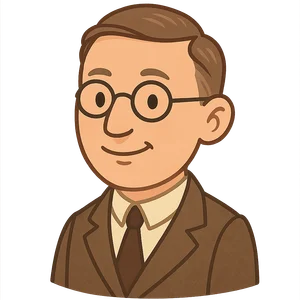
A Canadian medical scientist and doctor who co-discovered insulin, a life-saving treatment for diabetes…
Reads at Grades 6–8 Listens at Grades 4–8
Print & create
Answer keys·No prep·Free with an account
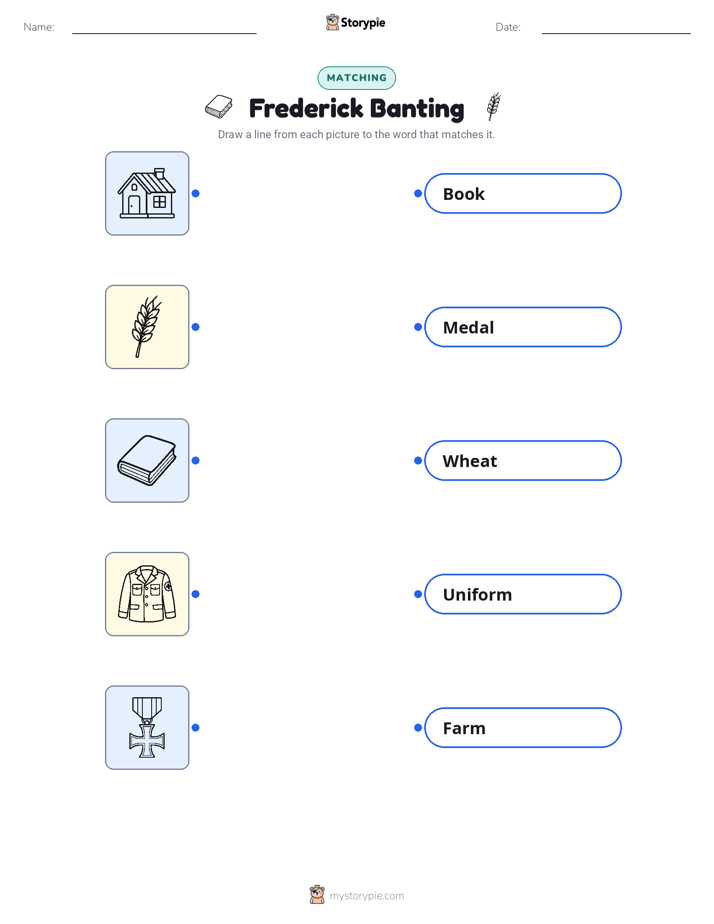
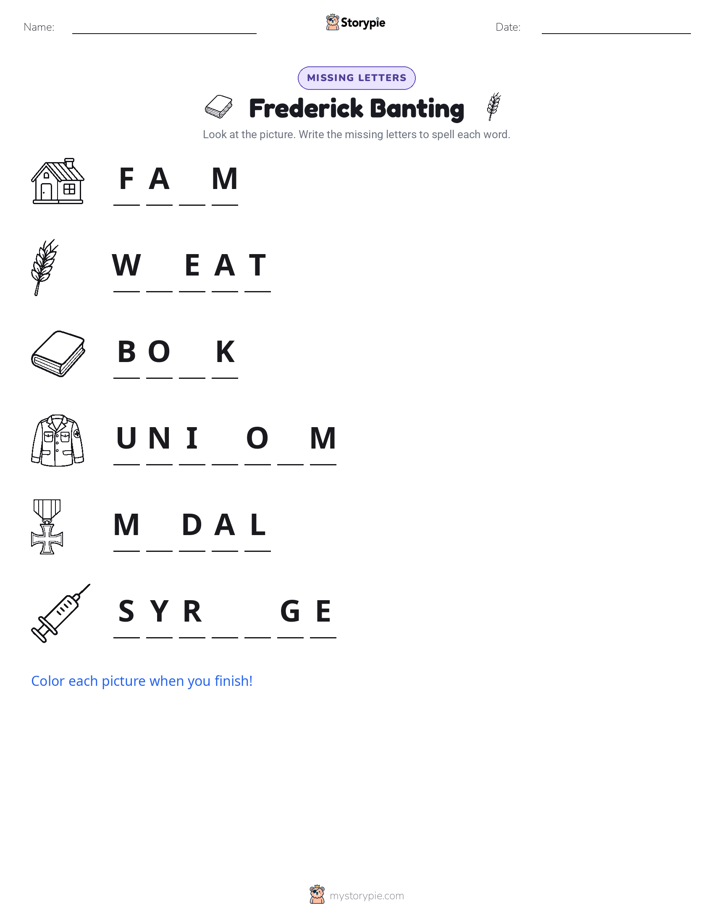
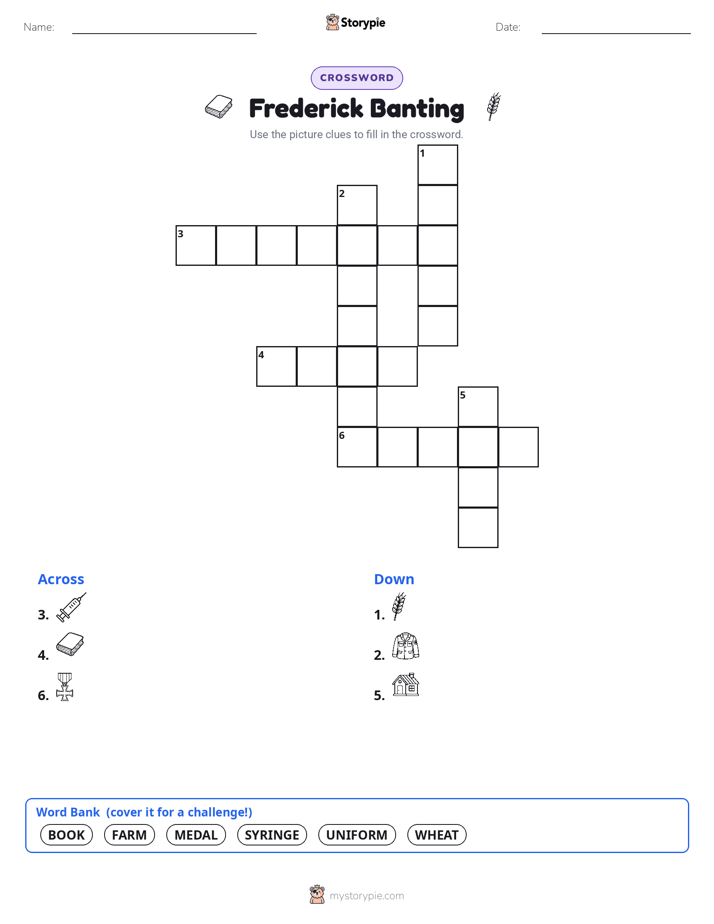
28 worksheets · answer keys · full story · quiz · Ages 10-12 · CEFR B2
Plus adds 164,000+ more stories in 27 languages, audio for every one, and printables for all of them.
Just want Frederick Banting?
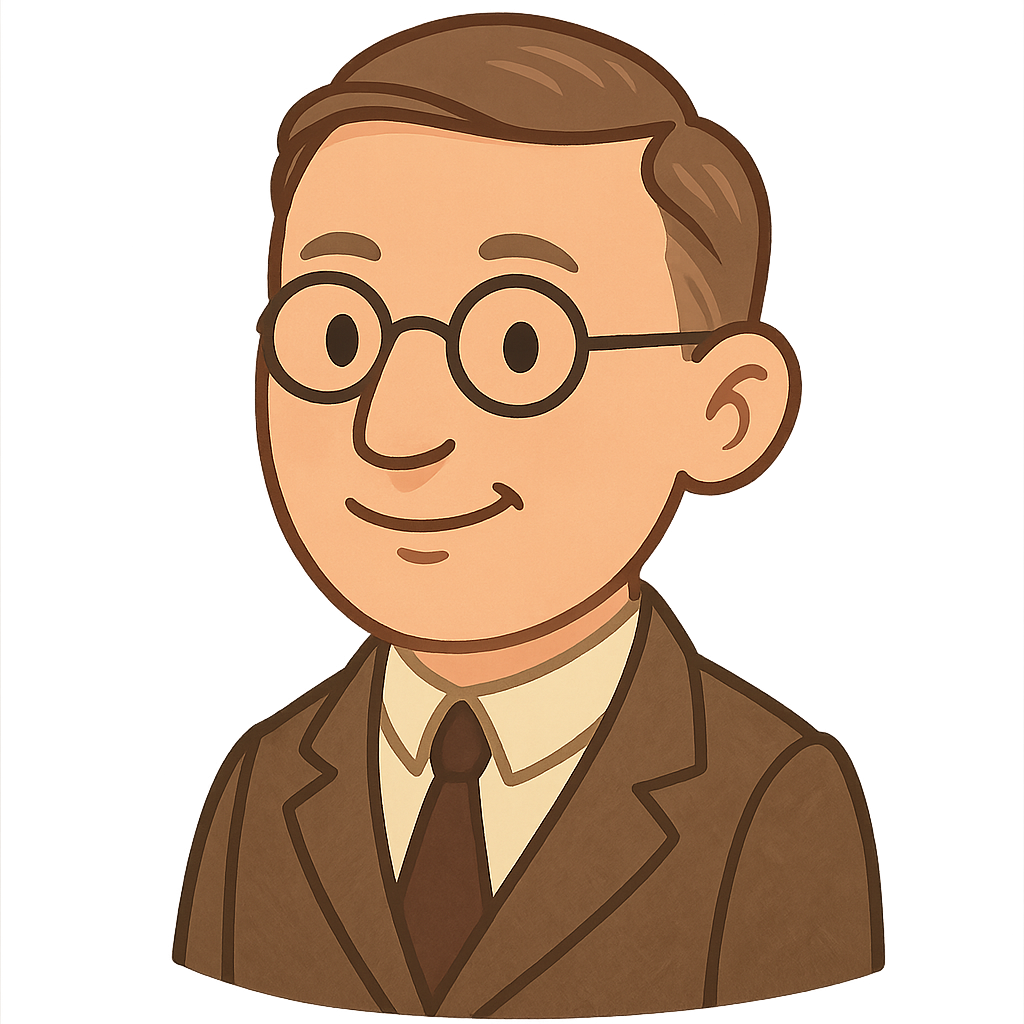
Hello, my name is Frederick Banting, and I want to tell you the story of an idea that changed the world. My life began on a farm in Alliston, Ontario, Canada, where I was born on November 14th, 1891. As the youngest of five children, I grew up surrounded by the hard work of farm life. School wasn't always easy for me, and I had to work very hard to keep up. But I knew from a young age that I wanted to spend my life helping people who were suffering. This strong desire led me to enroll at the University of Toronto to study medicine. I was determined to become a doctor, no matter how challenging the path might be.
My medical education took an unexpected turn when World War I began. The world was in conflict, and I felt a duty to serve my country. In 1916, I graduated early from medical school to join the Canadian Army Medical Corps. I was sent overseas to France, where I worked as a medic on the front lines. The conditions were incredibly difficult, and I saw firsthand the great need for medical care in times of crisis. During the Battle of Cambrai in 1918, I was wounded while tending to other soldiers. For my bravery, I was awarded the Military Cross for heroism. After the war ended, I returned to Canada, ready to begin my career as a doctor, carrying with me the lessons I had learned about courage and persistence.
Back in Canada, I became deeply focused on a disease that was then a death sentence: diabetes. In the early 20th century, people with diabetes had no effective treatment and their lives were tragically short. I couldn't stop thinking about it. Then, on the night of October 31st, 1920, something remarkable happened. I was at home, preparing a lecture for my students, when I woke from my sleep with a sudden, clear idea. I believed that if I could isolate a specific substance from the pancreas, it could be used to control blood sugar. In 1921, I took my theory to Professor John J.R. Macleod at the University of Toronto. He was a leading expert and had his doubts about my idea, but he agreed to give me a chance. He provided me with a small laboratory, some research animals, and a student assistant for the summer to see if my idea could work.
Frederick Banting: A Gift to the World
Hello, my name is Frederick Banting, and I want to tell you the story of an idea that changed the world. My life began on a farm in Alliston, Ontario, Canada, where I was born on November 14th, 1891. As the youngest of five children, I grew up surrounded by the hard work of farm life. School wasn't always easy for me, and I had to work very hard to keep up. But I knew from a young age that I wanted to spend my life helping people who were suffering. This strong desire led me to enroll at the University of Toronto to study medicine. I was determined to become a doctor, no matter how challenging the path might be.
My medical education took an unexpected turn when World War I began. The world was in conflict, and I felt a duty to serve my country. In 1916, I graduated early from medical school to join the Canadian Army Medical Corps. I was sent overseas to France, where I worked as a medic on the front lines. The conditions were incredibly difficult, and I saw firsthand the great need for medical care in times of crisis. During the Battle of Cambrai in 1918, I was wounded while tending to other soldiers. For my bravery, I was awarded the Military Cross for heroism. After the war ended, I returned to Canada, ready to begin my career as a doctor, carrying with me the lessons I had learned about courage and persistence.
Back in Canada, I became deeply focused on a disease that was then a death sentence: diabetes. In the early 20th century, people with diabetes had no effective treatment and their lives were tragically short. I couldn't stop thinking about it. Then, on the night of October 31st, 1920, something remarkable happened. I was at home, preparing a lecture for my students, when I woke from my sleep with a sudden, clear idea. I believed that if I could isolate a specific substance from the pancreas, it could be used to control blood sugar. In 1921, I took my theory to Professor John J.R. Macleod at the University of Toronto. He was a leading expert and had his doubts about my idea, but he agreed to give me a chance. He provided me with a small laboratory, some research animals, and a student assistant for the summer to see if my idea could work.
That summer of 1921 was one of the most intense periods of my life. My assistant was a dedicated young student named Charles Best, and together we worked tirelessly in the sweltering heat of our small lab. Our work was often frustrating, and we faced many failures. We worked with dogs to test my theory, trying to create an extract from their pancreases that would lower their blood sugar levels. Finally, after many attempts, we succeeded. Our extract worked. To make it safe for humans, a skilled biochemist named James Collip joined our team to help purify it. The moment of truth came in January 1922, when our purified extract was given to a 14-year-old boy named Leonard Thompson, who was near death from diabetes. The treatment was a success. It was a turning point for medicine.
Our discovery, which we named insulin, had the power to save millions of lives. Charles and I, along with Professor Macleod and James Collip, knew this was a gift that belonged to the world. We decided to sell the patent for insulin to the University of Toronto for just one dollar. We wanted to ensure it would always be affordable and available to anyone who needed it, not used to make a profit. In 1923, Professor Macleod and I were awarded the Nobel Prize in Physiology or Medicine for our work. I felt strongly that Charles Best deserved equal recognition for his crucial role in the discovery, so I immediately shared my half of the prize money with him. It was a team effort, and it was important to me that his contribution was honored.
I continued my work in medical research for many years and was knighted by the King of England in 1934 for my contributions. When World War II began, I once again felt the call to serve my country. My life came to an end in a plane crash in 1941 while I was on a mission related to the war effort. I lived to be 49 years old. The discovery of insulin transformed diabetes from a fatal disease into a manageable condition. I am incredibly proud that our idea, born in the middle of the night, has given the gift of life and hope to countless people around the globe.
Wow facts
About
A Canadian medical scientist and doctor who co-discovered insulin, a life-saving treatment for diabetes, and was a co-recipient of the 1923 Nobel Prize in Medicine.
Take a Quiz
Question 1 of 5
What major world event interrupted Frederick Banting's medical studies in 1916?
Explore next





Want to do even more?
Go beyond exploring. Unlock tools that turn every story into real learning.

Storypie Plus for families
Full stories, quizzes, and printables. Nights and car rides, sorted.
- Unlimited audio stories
- Create Mode: your child stars in the story
- Offline downloads
- Printable worksheets & coloring pages

Why Storypie for Schools
Students engaged. Prep in seconds. Evenings back to you.
- Worksheets & Quizzes
- Classroom Management
- Formative Assessment
- Custom Curriculum & Lesson Plans
- 27 Languages

Why Storypie for Homeschool
Curriculum done. They'll ask for more. Hours back in your day.
- Worksheet Generator
- First-Person Audio Stories
- Built-in Comprehension Quizzes
- Custom Curriculum & Lesson Plans
- Print & Go Activities