English

Galen of Pergamon
Galen of Pergamon was a Greek physician, surgeon, and philosopher in the Roman Empire.
Reads at Grades 6–8 Listens at Grades 4–8
Print & create
Answer keys·No prep·Free with an account
28 worksheets · answer keys · full story · quiz · Ages 10-12 · CEFR B2
Plus adds 208,000+ more stories in 27 languages, audio for every one, and printables for all of them.
Just want Galen of Pergamon?
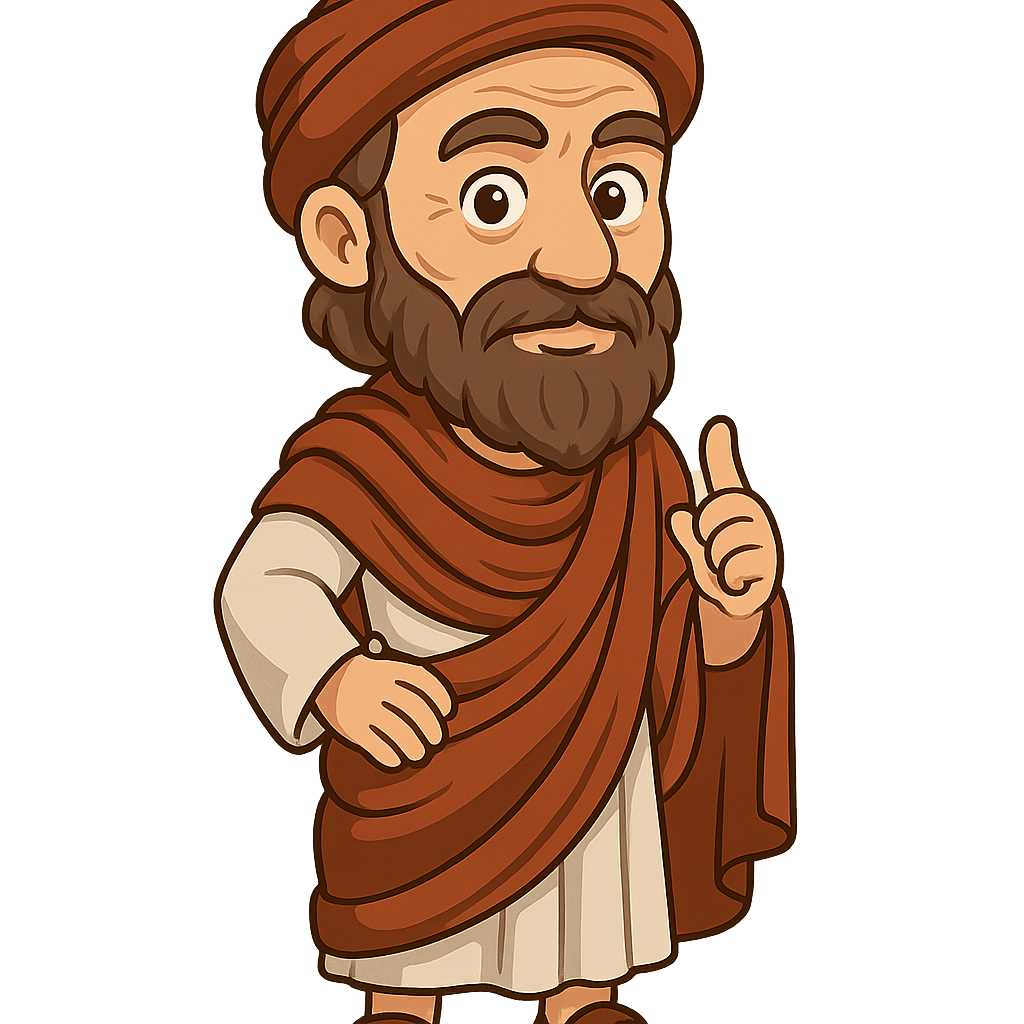
Hello, my name is Galen, and I invite you to hear the story of my life's journey into the fascinating world of medicine. I was born in the year 129 CE in the city of Pergamon, a beautiful and bustling center of learning within the vast Roman Empire. My father, Aelius Nicon, was a respected and wealthy architect, but more than that, he was a scholar. He believed deeply in the power of knowledge and made sure I received the finest education a boy could have. I spent my youth studying philosophy, mathematics, and the art of logic. My future seemed set on a path of intellectual study, but everything changed when I was sixteen years old. One night, my father had a powerful dream. In it, Asclepius, the god of healing and medicine, appeared and told him that I was destined to become a doctor. My father took this divine message seriously, and so did I. From that moment forward, the course of my life was altered, and I dedicated myself entirely to understanding the complexities of the human body.
After beginning my medical training in Pergamon, I knew that to become the best, I had to learn from the best. True knowledge, I believed, could not be found in just one place. Around the year 149 CE, I began a long journey, traveling to the great centers of learning throughout the Roman world. I studied in cities like Smyrna and Corinth, listening to famous teachers and absorbing all they had to offer. My most important destination, however, was the magnificent city of Alexandria in Egypt. At that time, Alexandria was home to the greatest medical school in the world. It was there that I truly began to form my own ideas about medicine. In those days, Roman law forbade the dissection of human bodies, which presented a great challenge for anyone wanting to learn about anatomy. I found a solution by carefully studying animals, particularly Barbary apes, because their internal structure was remarkably similar to ours. This experience solidified my core belief: a true physician must see things with his own eyes and learn through direct observation, not just by reading what others had written in books.
Galen of Pergamon: A Doctor's Journey
Hello, my name is Galen, and I invite you to hear the story of my life's journey into the fascinating world of medicine. I was born in the year 129 CE in the city of Pergamon, a beautiful and bustling center of learning within the vast Roman Empire. My father, Aelius Nicon, was a respected and wealthy architect, but more than that, he was a scholar. He believed deeply in the power of knowledge and made sure I received the finest education a boy could have. I spent my youth studying philosophy, mathematics, and the art of logic. My future seemed set on a path of intellectual study, but everything changed when I was sixteen years old. One night, my father had a powerful dream. In it, Asclepius, the god of healing and medicine, appeared and told him that I was destined to become a doctor. My father took this divine message seriously, and so did I. From that moment forward, the course of my life was altered, and I dedicated myself entirely to understanding the complexities of the human body.
After beginning my medical training in Pergamon, I knew that to become the best, I had to learn from the best. True knowledge, I believed, could not be found in just one place. Around the year 149 CE, I began a long journey, traveling to the great centers of learning throughout the Roman world. I studied in cities like Smyrna and Corinth, listening to famous teachers and absorbing all they had to offer. My most important destination, however, was the magnificent city of Alexandria in Egypt. At that time, Alexandria was home to the greatest medical school in the world. It was there that I truly began to form my own ideas about medicine. In those days, Roman law forbade the dissection of human bodies, which presented a great challenge for anyone wanting to learn about anatomy. I found a solution by carefully studying animals, particularly Barbary apes, because their internal structure was remarkably similar to ours. This experience solidified my core belief: a true physician must see things with his own eyes and learn through direct observation, not just by reading what others had written in books.
Around 157 CE, I returned to my home city of Pergamon, my mind filled with all I had learned on my travels. I was soon offered one of the most remarkable jobs a young doctor could imagine: I became the chief physician to the high priest of the city’s gladiators. This was no ordinary medical practice. The gladiators were brave fighters who often suffered terrible injuries in the arena. Treating their wounds was a constant and demanding challenge, but it was also an invaluable education. My work with them was like having a living window into the human body. Every day, I was able to study muscles, tendons, nerves, and bones in a way that no textbook could ever teach. I developed new surgical techniques and methods for treating wounds. I am proud to say that during my time there, I dramatically reduced the number of gladiator deaths from their injuries, and my reputation as a skilled and effective physician began to spread throughout the region.
My growing success in Pergamon gave me the confidence to seek a greater challenge. Around 162 CE, I moved to the very heart of the empire: the sprawling, chaotic, and magnificent city of Rome. The city was full of doctors, all competing for the attention of wealthy and powerful patients. To make a name for myself, I began giving public lectures and performing anatomical demonstrations, using animals to show the fascinated crowds how the body worked. My approach, which was based on direct evidence and logical reasoning, set me apart. I soon gained a reputation for successfully treating influential patients whom other doctors had failed to help. My fame grew until it reached the highest levels of Roman society. Around 169 CE, I was given the ultimate honor when I was appointed as the personal physician to the wise philosopher-emperor, Marcus Aurelius. I would go on to serve his son Commodus and several later emperors, securing my place as the most famous doctor in the Roman Empire.
Being the emperor's physician was an honor, but my true passion was discovery. I spent my life conducting experiments to challenge old ideas and uncover new truths about the body. For centuries, it was believed that the arteries were filled with air, which was thought to carry the 'vital spirits.' I performed a careful experiment to prove this wrong. I demonstrated that arteries, like veins, are filled with blood, completely changing our understanding of the circulatory system. My work on the nervous system was also groundbreaking. Through careful dissections of animals, I showed how the brain sends messages through the spinal cord and nerves to control specific muscles throughout the body. I was the first to explain the functions of different nerves. I also built upon the existing theory of the Four Humors, linking imbalances in these bodily fluids to a person's temperament and personality. Believing that knowledge must be preserved, I wrote tirelessly. I authored hundreds of books, filling them with everything I had observed and discovered so that future generations of doctors could learn from my work.
I lived a very long and productive life, reaching the age of about 87 years old before my life concluded around the year 216 CE. I am proud that my work and my many books became the foundation of Western medicine for more than 1,300 years after I was gone. For centuries, students learned medicine by reading my texts, and doctors based their treatments on my principles. Though many of my ideas have since been updated by new discoveries and technologies, I hope I am remembered for my endless curiosity. My greatest contribution was my unwavering belief in the power of observation and experiment to unlock the amazing secrets of the human body.
Wow facts
About
Galen of Pergamon was a Greek physician, surgeon, and philosopher in the Roman Empire. His anatomical and medical theories dominated Western medical science for over 1,300 years.
Take a Quiz
Question 1 of 5
In your own words, summarize Galen's journey from his early education to becoming a famous doctor in Rome.
Explore next



Want to do even more?
Go beyond exploring. Unlock tools that turn every story into real learning.

Storypie Plus for families
Full stories, quizzes, and printables. Nights and car rides, sorted.
- Unlimited audio stories
- Create Mode: your child stars in the story
- Offline downloads
- Printable worksheets & coloring pages

Why Storypie for Schools
Students engaged. Prep in seconds. Evenings back to you.
- Worksheets & Quizzes
- Classroom Management
- Formative Assessment
- Custom Curriculum & Lesson Plans
- 27 Languages

Why Storypie for Homeschool
Curriculum done. They'll ask for more. Hours back in your day.
- Worksheet Generator
- First-Person Audio Stories
- Built-in Comprehension Quizzes
- Custom Curriculum & Lesson Plans
- Print & Go Activities