English

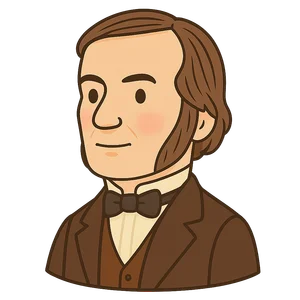
George Boole
George Boole was an English mathematician, philosopher, and logician whose work, particularly Boolean algebra…
Reads at Grades 6–8 Listens at Grades 4–8
Print & create
Answer keys·No prep·Free with an account
28 worksheets · answer keys · full story · quiz · Ages 10-12 · CEFR B2
Plus adds 244,000+ more stories in 27 languages, audio for every one, and printables for all of them.
Just want George Boole?
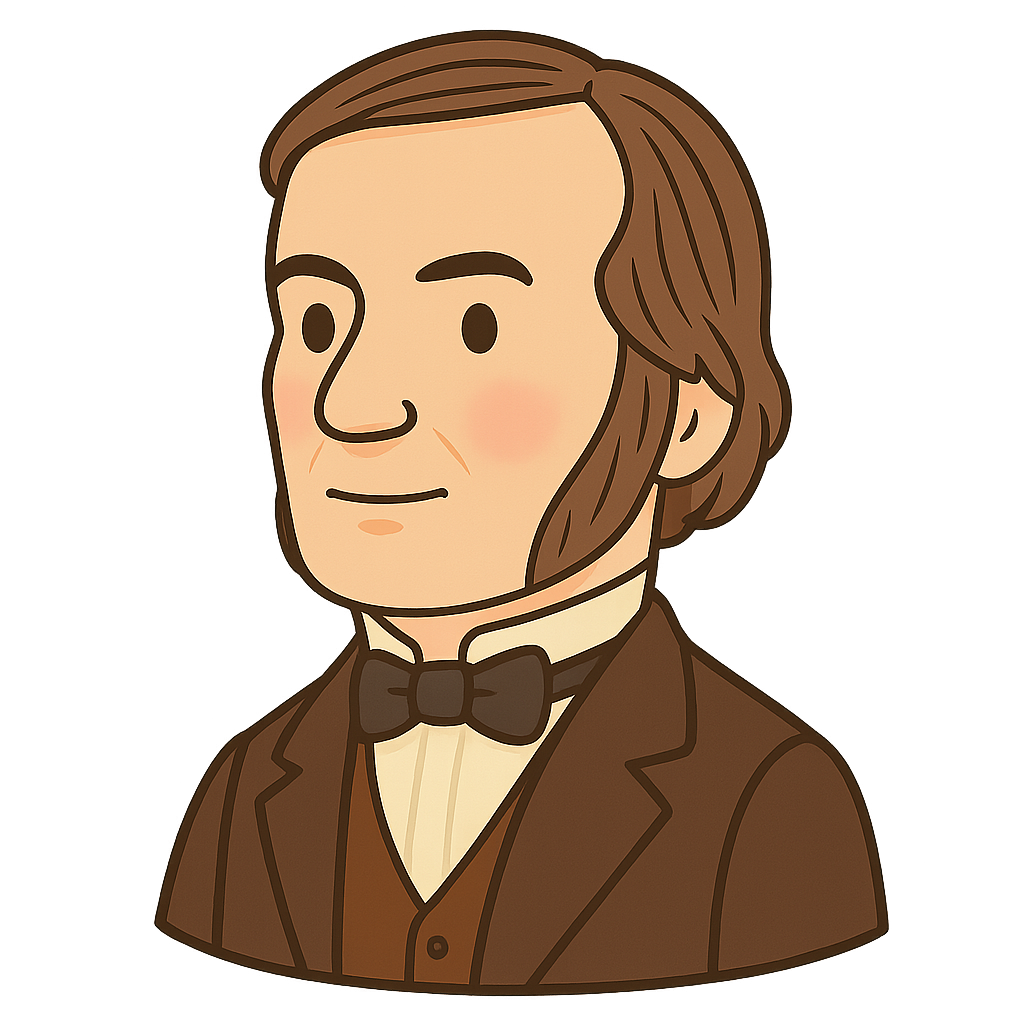
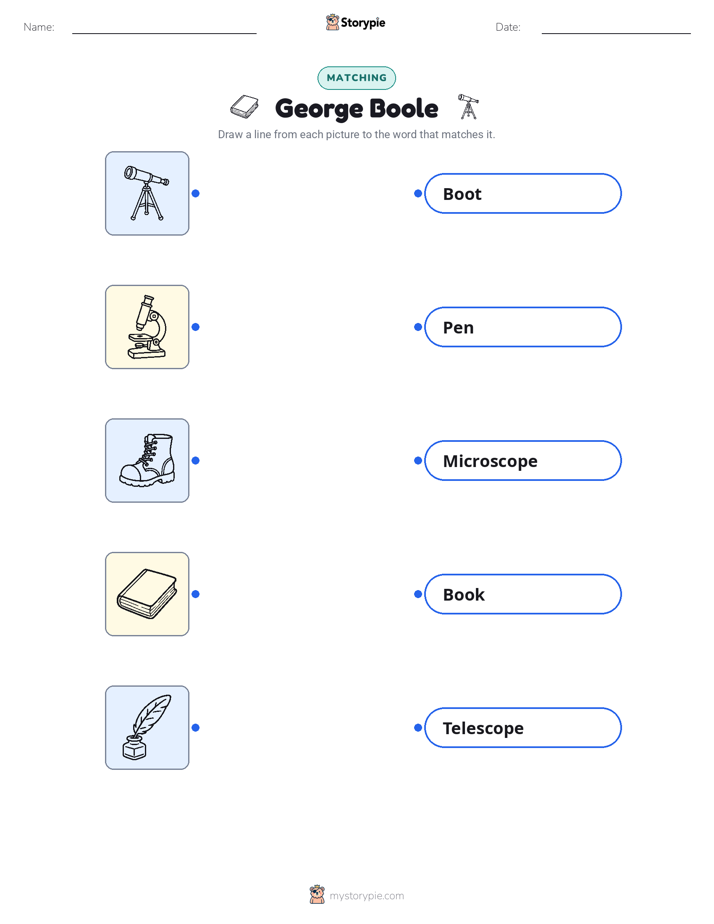
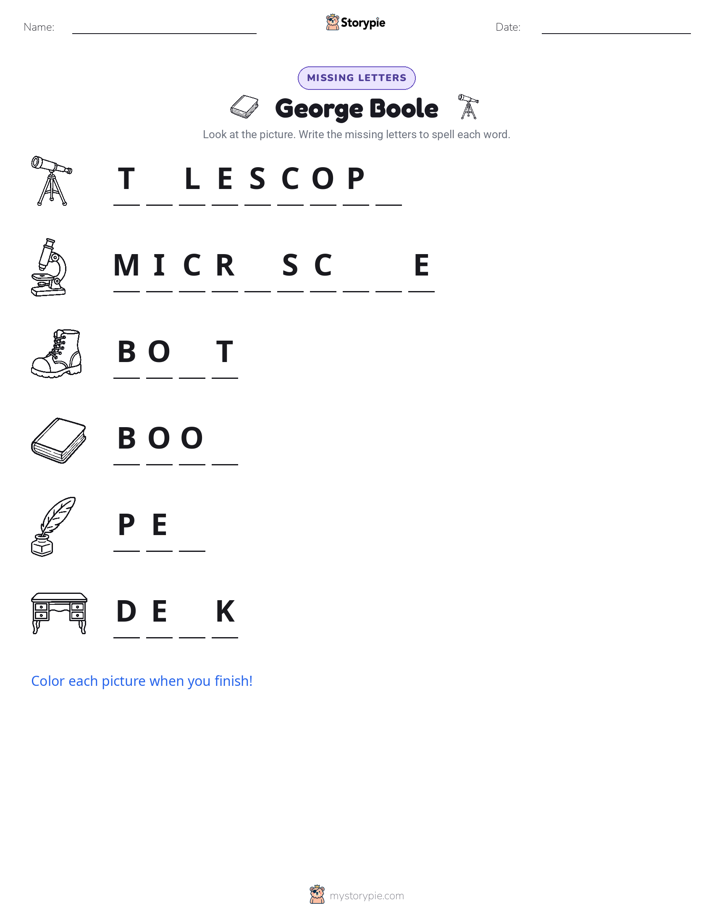
Hello! My name is George Boole. My story begins in a small English city called Lincoln, where I was born on November 2nd, 1815. My father, John, was a shoemaker, but his real passion was science and mathematics. He built his own telescopes and microscopes and taught me to see the world as a wonderful puzzle. We didn't have much money, so I couldn't attend a fancy school, but that never stopped my curiosity. I devoured every book I could find and taught myself languages like Latin, Greek, and French, which was quite unusual for a boy of my background.
To help support my family, I began working as a teacher when I was just sixteen years old, around 1831. By the time I was twenty, in 1835, I opened my own small school. While I was teaching others during the day, I spent my nights teaching myself. I dove into the most advanced mathematics books I could find, studying the works of great minds like Isaac Newton. This was my university. It was during these quiet hours of study that I began to wonder about a very big question: could the way we think, our logic, be described using mathematics?
People use words to reason and make arguments, but words can sometimes be confusing or mean different things. I thought, 'What if I could replace words with symbols, like in algebra?' I imagined a system where any statement could be boiled down to two simple values: 'true' or 'false.' I decided to represent 'true' with the number 1 and 'false' with the number 0. In 1847, I published my ideas in a little book called 'The Mathematical Analysis of Logic.' I showed how you could use simple operations like AND, OR, and NOT to combine these 1s and 0s to solve logical problems, just like solving an equation. It was a brand new way of looking at thought itself.
George Boole
Hello! My name is George Boole. My story begins in a small English city called Lincoln, where I was born on November 2nd, 1815. My father, John, was a shoemaker, but his real passion was science and mathematics. He built his own telescopes and microscopes and taught me to see the world as a wonderful puzzle. We didn't have much money, so I couldn't attend a fancy school, but that never stopped my curiosity. I devoured every book I could find and taught myself languages like Latin, Greek, and French, which was quite unusual for a boy of my background.
To help support my family, I began working as a teacher when I was just sixteen years old, around 1831. By the time I was twenty, in 1835, I opened my own small school. While I was teaching others during the day, I spent my nights teaching myself. I dove into the most advanced mathematics books I could find, studying the works of great minds like Isaac Newton. This was my university. It was during these quiet hours of study that I began to wonder about a very big question: could the way we think, our logic, be described using mathematics?
People use words to reason and make arguments, but words can sometimes be confusing or mean different things. I thought, 'What if I could replace words with symbols, like in algebra?' I imagined a system where any statement could be boiled down to two simple values: 'true' or 'false.' I decided to represent 'true' with the number 1 and 'false' with the number 0. In 1847, I published my ideas in a little book called 'The Mathematical Analysis of Logic.' I showed how you could use simple operations like AND, OR, and NOT to combine these 1s and 0s to solve logical problems, just like solving an equation. It was a brand new way of looking at thought itself.
My work started to get noticed. In 1849, I received a tremendous honor: I was asked to become the first Professor of Mathematics at Queen's College in Cork, Ireland. It was amazing to think that I, a mostly self-taught man, was now a university professor! It was in Ireland that I wrote my most important book, which I published in 1854. I called it 'An Investigation of the Laws of Thought.' In it, I fully developed my system, which people later started calling 'Boolean Algebra.' I explained how this simple system of 1s and 0s could form the foundation for all logical reasoning. I also started a family, marrying Mary Everest in 1855, and we had five wonderful daughters.
One rainy day in 1864, I walked a long way in a downpour to give a lecture and became very ill afterward. I lived to be 49 years old. For many years after I was gone, my work was mostly known only to other mathematicians. But nearly a century later, a brilliant engineer realized that my system of 1s and 0s was the perfect language for electronic switches, which can be either 'on' or 'off.' My Boolean logic became the building block for all digital computers. Today, every time you search the internet, use a smartphone, or play a video game, you are using the 'laws of thought' I first imagined in my little schoolhouse. My ideas helped create the digital world we all live in today.
Wow facts
About
George Boole was an English mathematician, philosopher, and logician whose work, particularly Boolean algebra, became the foundation for the information age and digital electronics.
Take a Quiz
Question 1 of 5
In your own words, what main challenge did George Boole face in his early life, and how did he overcome it?
Explore next






Want to do even more?
Go beyond exploring. Unlock tools that turn every story into real learning.

Storypie Plus for families
Full stories, quizzes, and printables. Nights and car rides, sorted.
- Unlimited audio stories
- Create Mode: your child stars in the story
- Offline downloads
- Printable worksheets & coloring pages

Why Storypie for Schools
Students engaged. Prep in seconds. Evenings back to you.
- Worksheets & Quizzes
- Classroom Management
- Formative Assessment
- Custom Curriculum & Lesson Plans
- 27 Languages

Why Storypie for Homeschool
Curriculum done. They'll ask for more. Hours back in your day.
- Worksheet Generator
- First-Person Audio Stories
- Built-in Comprehension Quizzes
- Custom Curriculum & Lesson Plans
- Print & Go Activities