English

Gottfried Wilhelm Leibniz
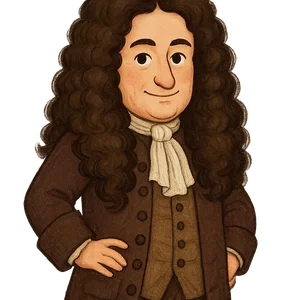
Gottfried Wilhelm Leibniz was a German polymath, philosopher…
Reads at Grades 6–8 Listens at Grades 4–8
Print & create
Answer keys·No prep·Free with an account
28 worksheets · answer keys · full story · quiz · Ages 10-12 · CEFR B2
Plus adds 164,000+ more stories in 27 languages, audio for every one, and printables for all of them.
Just want Gottfried Wilhelm Leibniz?
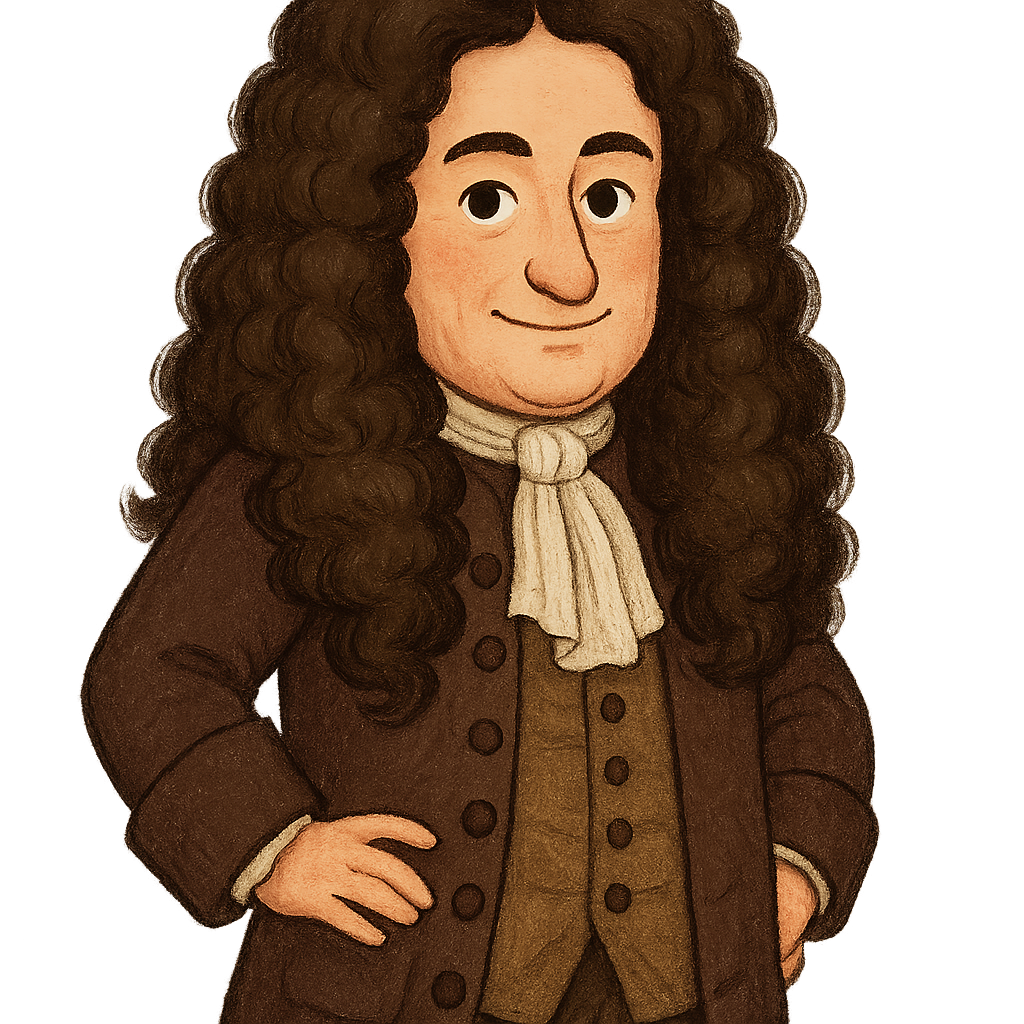
Hello, my name is Gottfried Wilhelm Leibniz, and I was a philosopher, mathematician, and inventor who saw the world as a giant, connected puzzle. My story begins on July 1st, 1646, in the city of Leipzig, which was then part of a vast territory known as the Holy Roman Empire. My father was a professor, and our home was filled with books. Sadly, he passed away when I was only six years old. While this was a great loss, it led me to a wonderful discovery: his personal library. The room was my playground and my school. It was filled with books on every subject imaginable, many written in languages I didn't yet understand. So, I decided to teach myself. I spent countless hours surrounded by towering shelves of leather-bound volumes. By the time I was a young teenager, I had taught myself to read both Latin and Greek fluently. These books weren't just words on a page; they were gateways to the greatest ideas in history, and they sparked a curiosity in me that would last my entire life. I learned that knowledge was a grand adventure, and I wanted to explore every part of it.
My hunger for knowledge led me to enroll at the University of Leipzig in 1661, when I was just fifteen years old. It was an exciting time, and my mind was always buzzing with questions. I studied law and philosophy, but I was interested in everything from logic and physics to history and politics. I loved debating ideas and trying to find the connections between different fields of study. I worked very hard and completed my studies quickly, earning my doctorate in law in 1667. I was offered a position as a professor, which would have meant a quiet, stable life of teaching and research. However, I felt a strong pull toward the world of action. I wanted to use my ideas to solve real-world problems. So, I turned down the academic life and began working for important political figures and diplomats. This career choice allowed me to travel all across Europe. I journeyed to major cities, met some of the most brilliant thinkers of my time, and worked on projects that had a real impact on society. It was the perfect path for someone who wanted to both think and do.
Gottfried Wilhelm Leibniz: A Universe of Ideas
Hello, my name is Gottfried Wilhelm Leibniz, and I was a philosopher, mathematician, and inventor who saw the world as a giant, connected puzzle. My story begins on July 1st, 1646, in the city of Leipzig, which was then part of a vast territory known as the Holy Roman Empire. My father was a professor, and our home was filled with books. Sadly, he passed away when I was only six years old. While this was a great loss, it led me to a wonderful discovery: his personal library. The room was my playground and my school. It was filled with books on every subject imaginable, many written in languages I didn't yet understand. So, I decided to teach myself. I spent countless hours surrounded by towering shelves of leather-bound volumes. By the time I was a young teenager, I had taught myself to read both Latin and Greek fluently. These books weren't just words on a page; they were gateways to the greatest ideas in history, and they sparked a curiosity in me that would last my entire life. I learned that knowledge was a grand adventure, and I wanted to explore every part of it.
My hunger for knowledge led me to enroll at the University of Leipzig in 1661, when I was just fifteen years old. It was an exciting time, and my mind was always buzzing with questions. I studied law and philosophy, but I was interested in everything from logic and physics to history and politics. I loved debating ideas and trying to find the connections between different fields of study. I worked very hard and completed my studies quickly, earning my doctorate in law in 1667. I was offered a position as a professor, which would have meant a quiet, stable life of teaching and research. However, I felt a strong pull toward the world of action. I wanted to use my ideas to solve real-world problems. So, I turned down the academic life and began working for important political figures and diplomats. This career choice allowed me to travel all across Europe. I journeyed to major cities, met some of the most brilliant thinkers of my time, and worked on projects that had a real impact on society. It was the perfect path for someone who wanted to both think and do.
One of my greatest passions was creating tools that could help the human mind. In 1673, I traveled to London and presented an invention I was very proud of to the Royal Society, a famous group of scientists. It was a mechanical calculator I called the 'Stepped Reckoner.' Unlike other machines that could only add and subtract, mine could also multiply, divide, and find square roots. It was a step toward automating the difficult work of calculation. My mind was also working on a much bigger idea. Around 1675, I developed a new and powerful form of mathematics. Today, you know it as calculus. It is a system for understanding change—how a planet moves through space, how a plant grows, or how fast something is moving at any given instant. I should mention that another brilliant mathematician, Isaac Newton, was independently developing similar ideas at the same time. For a while there was a debate over who was first, but today we are both recognized as co-discoverers. A few years later, in 1679, I perfected another idea that seemed simple but was incredibly powerful: the binary system. I realized that any number could be represented using only two digits: 0 and 1. This system wasn't widely used in my time, but I suspected it would one day be very useful for machines.
My work wasn't limited to just mathematics and inventions. For much of my career, I served as a librarian and the official historian for a noble family, the House of Hanover. This role gave me the freedom to pursue my many interests. One of my favorite ways to learn and share ideas was through writing letters. Over the decades, I wrote thousands of letters to more than 1,000 different people. My correspondents included scientists, philosophers, engineers, and even kings and queens all across Europe. This network of letters was like an early version of the internet, allowing us to debate theories, share discoveries, and build knowledge together. In my philosophical writings, I explored deep questions about the nature of the universe. I developed the idea that our world is the 'best of all possible worlds.' This didn't mean it was perfect, but that it was the best-balanced world that a perfect God could create, where every element, even the things that seem bad, fit into a logical and harmonious plan. I hoped this idea would help people find reason and purpose in the world around them.
I lived a long life dedicated to connecting ideas and pushing the boundaries of human knowledge. I lived to be 70 years old, passing away in the year 1716. My funeral was a small, quiet affair, not attended by many of the courtiers I had served. However, the ideas I had worked on and shared in my thousands of letters lived on and continued to influence others. One of my biggest dreams was to create a universal language based on reason and logic, which I believed could help people solve disagreements peacefully. While that dream was never fully realized, my work left its mark in many other ways. I am remembered today for my contributions to philosophy and, of course, for co-inventing calculus. And that binary code of 0s and 1s that I perfected back in 1679? It became the fundamental language of computers, powering the digital world you live in today. I hope my story encourages you to always stay curious and to look for the amazing connections between different ideas.
Wow facts
About
Gottfried Wilhelm Leibniz was a German polymath, philosopher, and mathematician who independently developed calculus and created the binary system, which is the foundation of all modern digital computers.
Take a Quiz
Question 1 of 5
In your own words, describe why Gottfried Wilhelm Leibniz's childhood was so important for his future work.
Explore next






Want to do even more?
Go beyond exploring. Unlock tools that turn every story into real learning.

Storypie Plus for families
Full stories, quizzes, and printables. Nights and car rides, sorted.
- Unlimited audio stories
- Create Mode: your child stars in the story
- Offline downloads
- Printable worksheets & coloring pages

Why Storypie for Schools
Students engaged. Prep in seconds. Evenings back to you.
- Worksheets & Quizzes
- Classroom Management
- Formative Assessment
- Custom Curriculum & Lesson Plans
- 27 Languages

Why Storypie for Homeschool
Curriculum done. They'll ask for more. Hours back in your day.
- Worksheet Generator
- First-Person Audio Stories
- Built-in Comprehension Quizzes
- Custom Curriculum & Lesson Plans
- Print & Go Activities