English

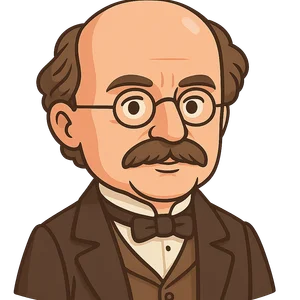
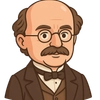
Hermann von Helmholtz
A German physician and physicist who made foundational contributions to physiology, optics, acoustics…
Reads at Grades 6–8 Listens at Grades 4–8
Print & create
Answer keys·No prep·Free with an account
28 worksheets · answer keys · full story · quiz · Ages 10-12 · CEFR B2
Plus adds 244,000+ more stories in 27 languages, audio for every one, and printables for all of them.
Just want Hermann von Helmholtz?
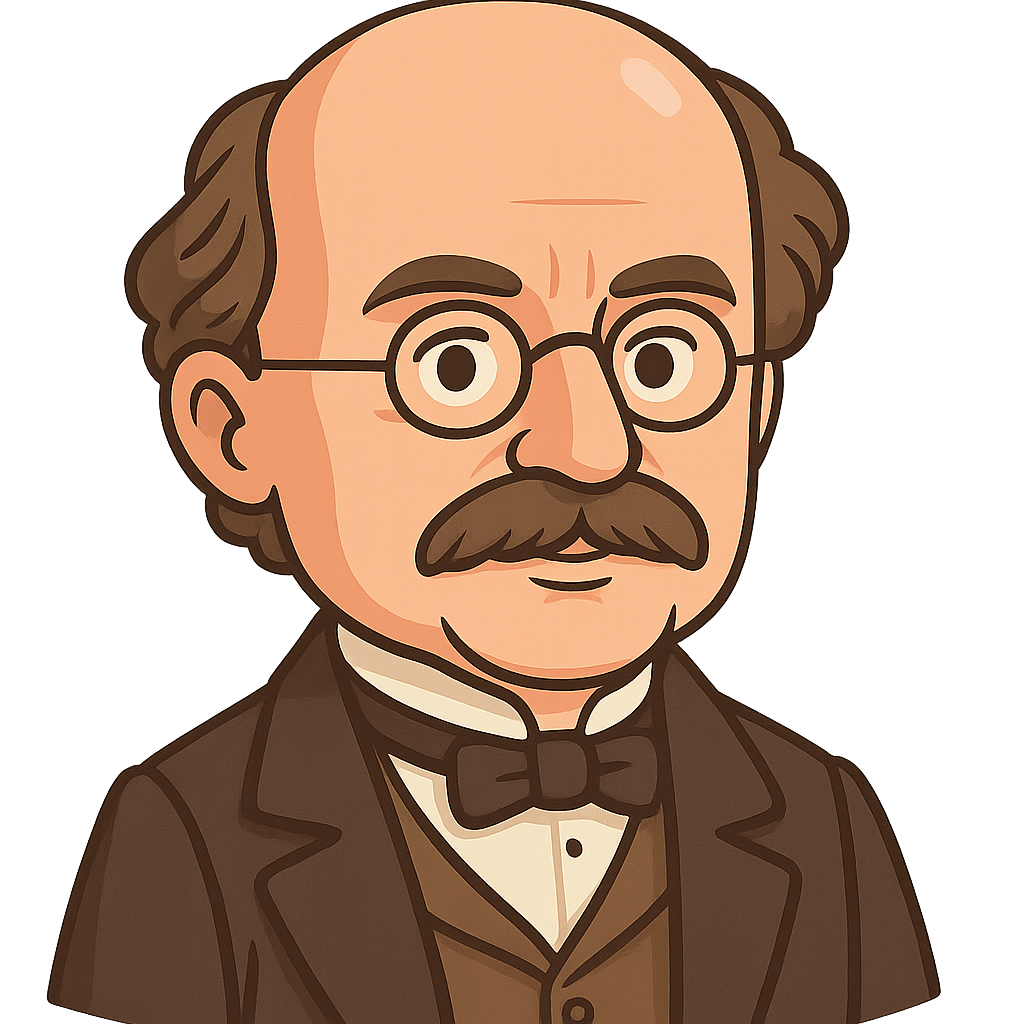
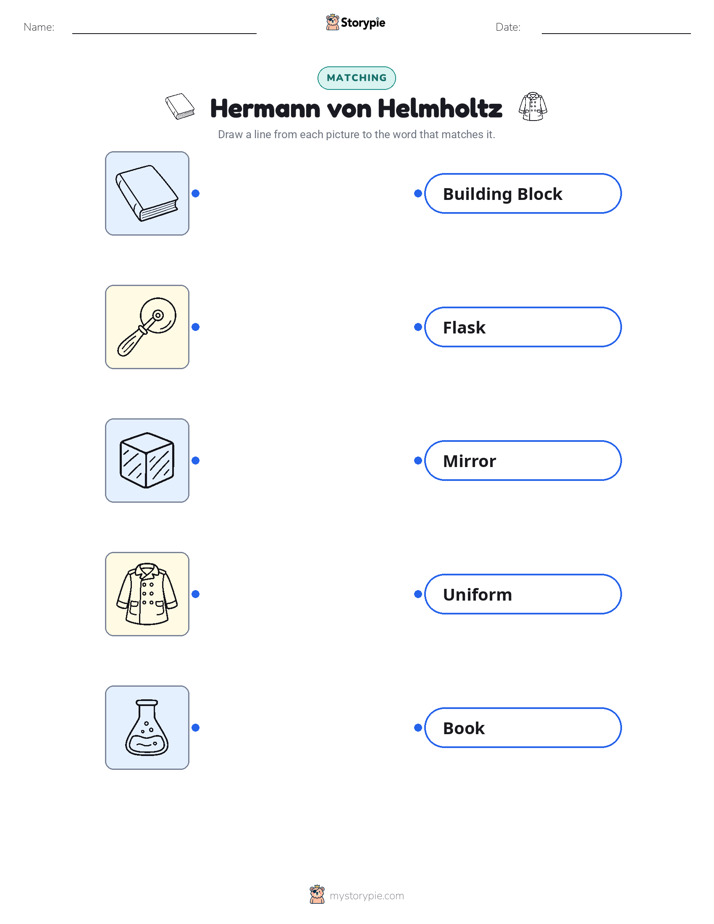
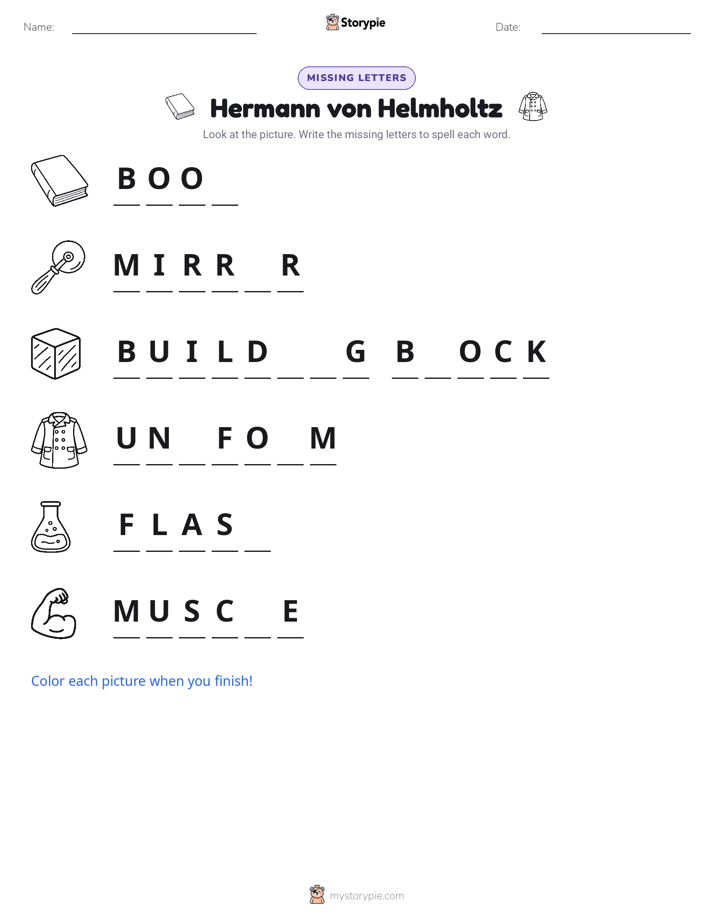
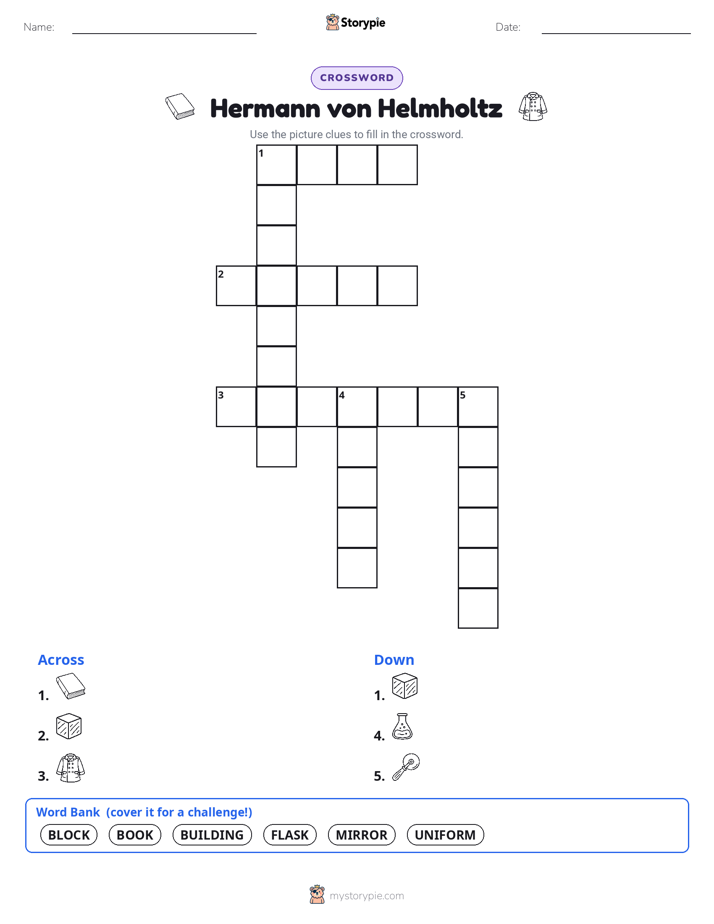
Hello, my name is Hermann von Helmholtz. My story begins on August 31st, 1821, in a town called Potsdam, in what is now Germany. My father was a teacher who filled our home with books and ideas, sparking my curiosity from a very young age. I was often sick as a child, which meant I spent a lot of time indoors, observing the world around me. I loved figuring out how things worked, from the way light reflected in a mirror to the geometry of building blocks. While my father encouraged my interest in philosophy and languages, my heart truly belonged to science and mathematics, and I knew that was the path I wanted to follow.
My family didn't have much money, so when it was time for university in 1838, I accepted a government scholarship to study medicine at the Friedrich Wilhelm Medical Institute in Berlin. The agreement was that I would become an army surgeon after I graduated. I finished my medical studies in 1842 and spent several years serving as a doctor in the army. But even while I was treating soldiers, my mind was always buzzing with questions about physics. I set up a small laboratory wherever I was stationed and spent my free time studying everything from muscle contractions to heat. I was especially fascinated by the idea of 'force' and how energy worked in the world.
One of the biggest questions in science at the time was about energy. Could it be created from nothing? Could it be destroyed? I didn't think so. Based on my experiments and mathematical calculations, I came to a powerful conclusion about this mystery. In 1847, I published a paper called 'On the Conservation of Force,' where I explained my idea. It is now known as the principle of conservation of energy. This principle states that energy can't be created or destroyed; it just changes from one form to another, like how the chemical energy in food becomes the energy that lets you run and play. This idea became a fundamental law of physics.
Hermann von Helmholtz: A Journey Through Science
Hello, my name is Hermann von Helmholtz. My story begins on August 31st, 1821, in a town called Potsdam, in what is now Germany. My father was a teacher who filled our home with books and ideas, sparking my curiosity from a very young age. I was often sick as a child, which meant I spent a lot of time indoors, observing the world around me. I loved figuring out how things worked, from the way light reflected in a mirror to the geometry of building blocks. While my father encouraged my interest in philosophy and languages, my heart truly belonged to science and mathematics, and I knew that was the path I wanted to follow.
My family didn't have much money, so when it was time for university in 1838, I accepted a government scholarship to study medicine at the Friedrich Wilhelm Medical Institute in Berlin. The agreement was that I would become an army surgeon after I graduated. I finished my medical studies in 1842 and spent several years serving as a doctor in the army. But even while I was treating soldiers, my mind was always buzzing with questions about physics. I set up a small laboratory wherever I was stationed and spent my free time studying everything from muscle contractions to heat. I was especially fascinated by the idea of 'force' and how energy worked in the world.
One of the biggest questions in science at the time was about energy. Could it be created from nothing? Could it be destroyed? I didn't think so. Based on my experiments and mathematical calculations, I came to a powerful conclusion about this mystery. In 1847, I published a paper called 'On the Conservation of Force,' where I explained my idea. It is now known as the principle of conservation of energy. This principle states that energy can't be created or destroyed; it just changes from one form to another, like how the chemical energy in food becomes the energy that lets you run and play. This idea became a fundamental law of physics.
My medical training and my love for physics often came together in my work. I was deeply curious about how our senses worked, especially our eyes. One day, I wanted to figure out how to see the inside of a living human eye. Before then, it was a complete mystery. After some experimenting, in 1851, I invented a device I called the ophthalmoscope. It used mirrors and a light source to illuminate the back of the eye, allowing a doctor to see the retina, optic nerve, and blood vessels for the first time. It was a revolutionary invention that completely changed how eye diseases were diagnosed, and doctors still use updated versions of it today.
My invention of the ophthalmoscope was just the beginning of my studies into the senses. I spent years studying the physics and physiology of vision, which I detailed in my 'Handbook of Physiological Optics,' published in parts between 1856 and 1867. I also turned my attention to hearing. I wanted to understand how our ears can tell the difference between a violin and a flute playing the same note. In my 1863 book, 'On the Sensations of Tone as a Physiological Basis for the Theory of Music,' I explored the physics of sound waves and the physiology of the ear. I was building a bridge between the physical world and our experience of it, connecting science directly to the art of music.
I spent the rest of my life teaching at universities and exploring new scientific questions, from weather patterns to the foundations of geometry. I lived to be 73 years old, and my life was filled with the joy of discovery. Today, I am remembered as a scientist who saw connections everywhere—between medicine and physics, art and science, the world outside and the world within our minds. My work on energy, sight, and sound helped lay the groundwork for modern science, and I hope my story inspires you to stay curious and ask big questions about the world around you.
Wow facts
About
A German physician and physicist who made foundational contributions to physiology, optics, acoustics, and thermodynamics. He is celebrated for formulating the principle of conservation of energy and for inventing the ophthalmoscope.
Take a Quiz
Question 1 of 5
What was the primary motivation for Hermann von Helmholtz to study medicine instead of physics at the university?
Explore next




Want to do even more?
Go beyond exploring. Unlock tools that turn every story into real learning.

Storypie Plus for families
Full stories, quizzes, and printables. Nights and car rides, sorted.
- Unlimited audio stories
- Create Mode: your child stars in the story
- Offline downloads
- Printable worksheets & coloring pages

Why Storypie for Schools
Students engaged. Prep in seconds. Evenings back to you.
- Worksheets & Quizzes
- Classroom Management
- Formative Assessment
- Custom Curriculum & Lesson Plans
- 27 Languages

Why Storypie for Homeschool
Curriculum done. They'll ask for more. Hours back in your day.
- Worksheet Generator
- First-Person Audio Stories
- Built-in Comprehension Quizzes
- Custom Curriculum & Lesson Plans
- Print & Go Activities