

 English


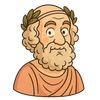
Herodotus
A Greek historian from the 5th century BCE…
Reads at Grades 3–5 Listens at Grades 1–5
Herodotus: The Father of History
Hello, I am Herodotus. My story begins a very long time ago, around the year 484 BCE, in a busy city called Halicarnassus. My home was a special place where people from different parts of the world met. It was a crossroads for Greek and Persian cultures, and you could hear many languages in the marketplaces. Seeing all these different people living and trading together made me incredibly curious. I loved to sit by the harbor and listen to the amazing stories told by sailors and merchants who had traveled to faraway lands. With every tale I heard, I would always ask questions. My favorite question was, 'Why did that happen?'. I wanted to understand the reasons behind everything, from big battles to small customs. This deep curiosity about the world and its people would guide me for the rest of my life and lead me on the greatest adventure I could imagine.
When I was a young man, my family had to leave my home city of Halicarnassus around 457 BCE. Instead of being sad, I saw it as an opportunity. I decided to set out on a great journey to explore the known world and find answers to my many questions. My travels took me to incredible places. I sailed to Egypt, where I stood in awe of the giant pyramids that touched the sky. I walked through the grand city of Babylon in a land called Mesopotamia. During my travels, I developed a special way of learning that I called 'historia,' which is a Greek word for 'inquiry.' For me, learning wasn't about sitting alone and reading old scrolls. I believed the best way to understand the past was to talk to the people who lived it. So everywhere I went, I spoke with everyone I could find—priests in their temples, soldiers who had fought in wars, and local people in their villages. I listened carefully, collecting their stories and learning all about their history and customs.
After many years of traveling and collecting stories, I began the biggest project of my life: writing my book, which is known as 'The Histories.' My main reason for writing it was to tell the story of the great wars that had been fought between the Greek city-states and the powerful Persian Empire. I wanted to make sure that the amazing events and the brave actions of the people on both sides would never be forgotten. My book wasn't just about soldiers and battles, though. It was filled with everything I had learned on my journeys—descriptions of different lands, the beliefs of various peoples, and the interesting customs I had observed. Around the 440s BCE, I would travel to cities like Athens and perform public readings of my work. People would gather to listen to the stories I had collected, eager to learn about the world beyond their own homes.
I spent the later years of my life in a Greek colony in what is now Italy, a place called Thurii. I lived a full life of adventure and inquiry, and my journey came to an end around the year 425 BCE. Long after I was gone, people gave me a special nickname: the 'Father of History.' They called me this because I was one of the first people to try to record the past by gathering evidence and telling it as an interesting and accurate story, rather than just repeating myths and legends. My book, 'The Histories,' is still read by people all over the world today. It reminds everyone that our past is filled with amazing stories and that by asking 'Why?', we can learn so much about ourselves.
Wow facts
About
A Greek historian from the 5th century BCE, widely known as the 'Father of History' for his work 'The Histories', which documents the Greco-Persian Wars and the cultures of the ancient world.
Take a Quiz
Question 1 of 5
In the story, I say my method of learning was called 'historia'. What does 'historia' mean in Greek?
Explore next



Want to do even more?
Go beyond exploring. Unlock tools that turn every story into real learning.

Storypie Plus for families
Full stories, quizzes, and printables. Nights and car rides, sorted.
- Unlimited audio stories
- Create Mode: your child stars in the story
- Offline downloads
- Printable worksheets & coloring pages

Why Storypie for Schools
Students engaged. Prep in seconds. Evenings back to you.
- Worksheets & Quizzes
- Classroom Management
- Formative Assessment
- Custom Curriculum & Lesson Plans
- 27 Languages

Why Storypie for Homeschool
Curriculum done. They'll ask for more. Hours back in your day.
- Worksheet Generator
- First-Person Audio Stories
- Built-in Comprehension Quizzes
- Custom Curriculum & Lesson Plans
- Print & Go Activities

