English


Ibn al-Haytham
A pioneering Arab scientist and mathematician from the Islamic Golden Age…
Reads at Grades 6–8 Listens at Grades 4–8
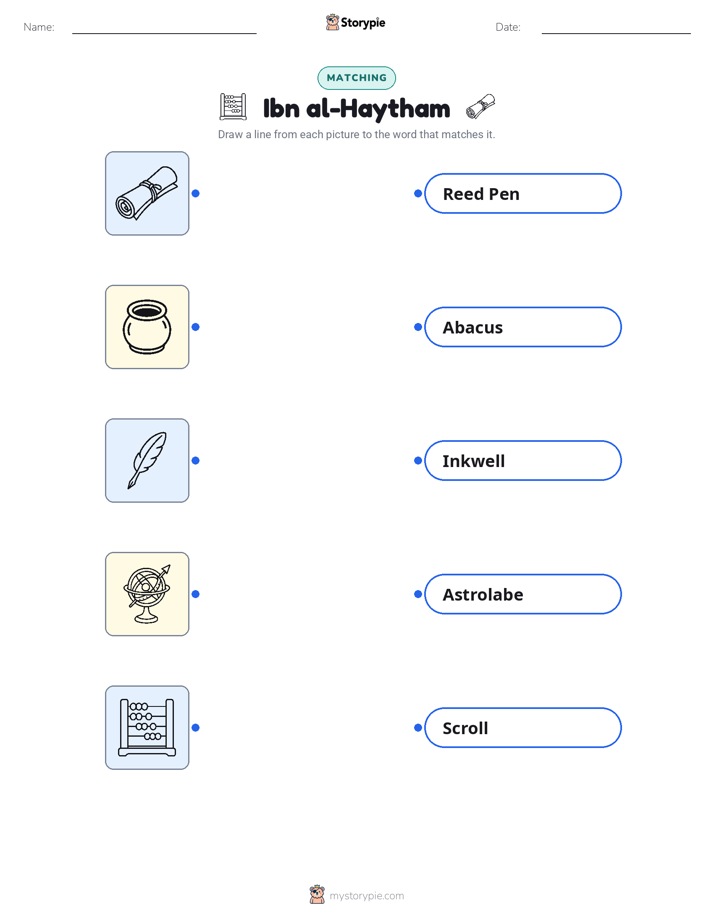
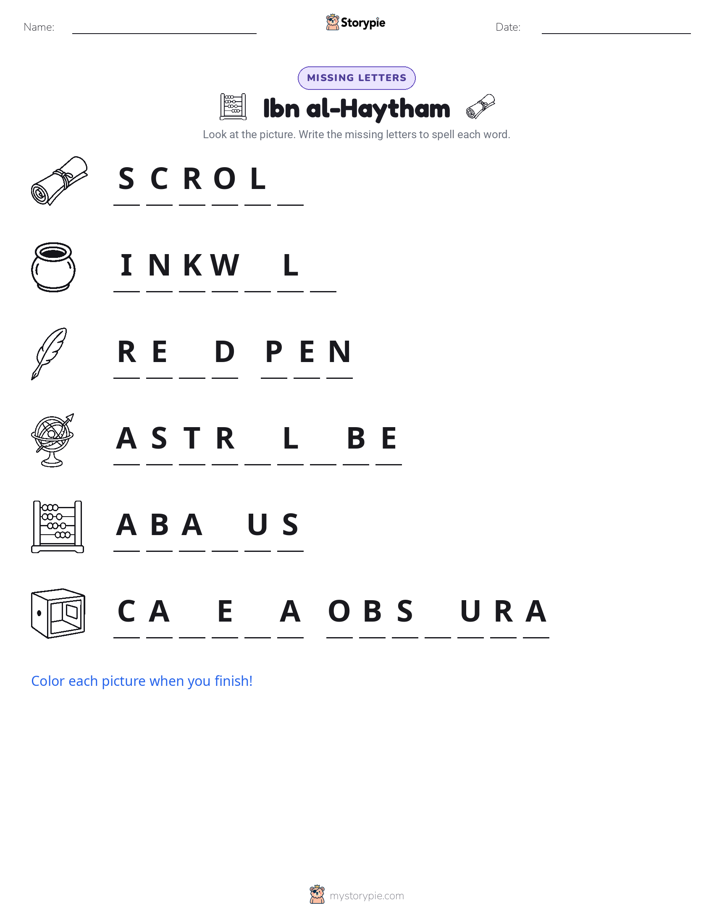
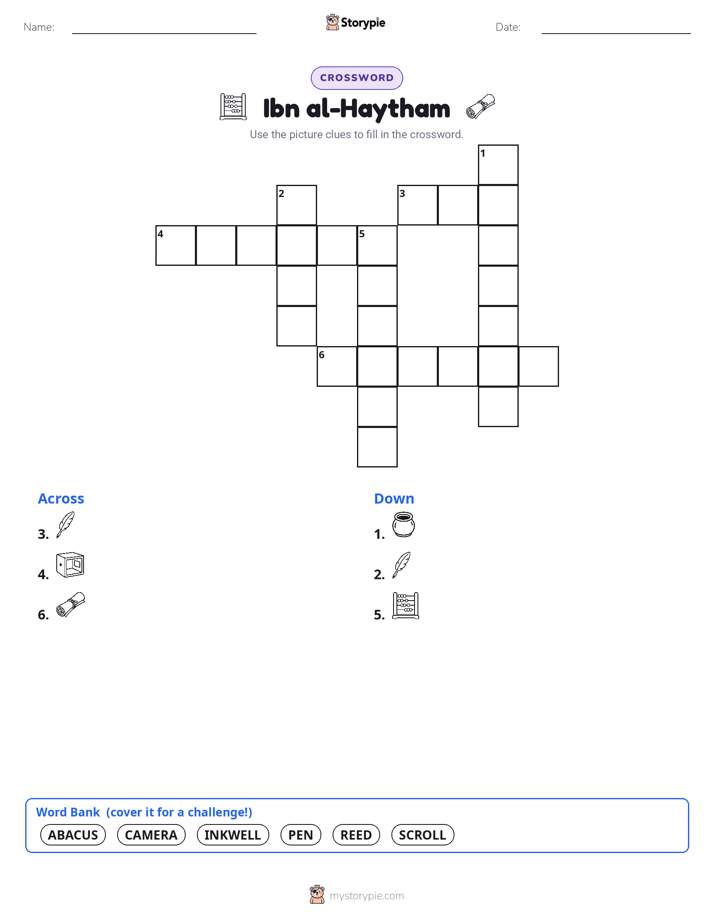
Print & create
Answer keys·No prep·Free with an account
28 worksheets · answer keys · full story · quiz · Ages 10-12 · CEFR B2
Plus adds 164,000+ more stories in 27 languages, audio for every one, and printables for all of them.
Just want Ibn al-Haytham?

Hello, my name is Ibn al-Haytham, though in later centuries I would also be known by the name Alhazen. My story begins in a remarkable time and place. I was born around the year 965 in the bustling city of Basra, which is in modern-day Iraq. This period was the Islamic Golden Age, a time of incredible discovery and intellectual curiosity. From a young age, I was filled with a deep passion for learning. The world of numbers and the stars fascinated me, and I devoted myself to the study of mathematics and astronomy. I read the works of the great ancient Greek thinkers who came before me, but I carried a core belief that shaped my entire life: one must question everything to truly find the truth. I did not believe in simply accepting old ideas without testing them for myself. This principle of questioning and seeking proof would become the foundation of all my work.
As I grew older, my reputation as a knowledgeable scholar spread far and wide. Around the year 1010, my work caught the attention of the powerful ruler of Egypt, Caliph al-Hakim. He sent me an invitation with a monumental task: he wanted me to find a way to build a dam on the great Nile River to control its annual floods. It was a challenge that could bring great prosperity to his people, and I was honored by the request. I traveled to Cairo, the magnificent capital of Egypt, and began my survey of the river. I studied its powerful currents and the vastness of the landscape. After careful analysis, I came to a difficult conclusion. With the tools and technology available in the 11th century, building a dam on a river as mighty as the Nile was simply impossible. I knew that delivering this news to the famously unpredictable Caliph al-Hakim was dangerous. I feared his anger and the severe punishment that might follow. To protect myself, I devised a clever and desperate plan. I pretended to be mad, hoping that the Caliph would spare a man who had lost his mind. My plan worked, but it came at a cost. I was placed under house arrest, confined to my home for what would become the next decade of my life.
Ibn al-Haytham: The Father of Optics
Hello, my name is Ibn al-Haytham, though in later centuries I would also be known by the name Alhazen. My story begins in a remarkable time and place. I was born around the year 965 in the bustling city of Basra, which is in modern-day Iraq. This period was the Islamic Golden Age, a time of incredible discovery and intellectual curiosity. From a young age, I was filled with a deep passion for learning. The world of numbers and the stars fascinated me, and I devoted myself to the study of mathematics and astronomy. I read the works of the great ancient Greek thinkers who came before me, but I carried a core belief that shaped my entire life: one must question everything to truly find the truth. I did not believe in simply accepting old ideas without testing them for myself. This principle of questioning and seeking proof would become the foundation of all my work.
As I grew older, my reputation as a knowledgeable scholar spread far and wide. Around the year 1010, my work caught the attention of the powerful ruler of Egypt, Caliph al-Hakim. He sent me an invitation with a monumental task: he wanted me to find a way to build a dam on the great Nile River to control its annual floods. It was a challenge that could bring great prosperity to his people, and I was honored by the request. I traveled to Cairo, the magnificent capital of Egypt, and began my survey of the river. I studied its powerful currents and the vastness of the landscape. After careful analysis, I came to a difficult conclusion. With the tools and technology available in the 11th century, building a dam on a river as mighty as the Nile was simply impossible. I knew that delivering this news to the famously unpredictable Caliph al-Hakim was dangerous. I feared his anger and the severe punishment that might follow. To protect myself, I devised a clever and desperate plan. I pretended to be mad, hoping that the Caliph would spare a man who had lost his mind. My plan worked, but it came at a cost. I was placed under house arrest, confined to my home for what would become the next decade of my life.
What seemed like a terrible fate—being a prisoner in my own home—turned into an unexpected and priceless opportunity. Stripped of my freedom to move about the city, I was given the freedom to think without distraction. My confinement lasted for about ten years, until around 1021. During this time, I turned a room in my house into a laboratory for my greatest investigations. I focused my curiosity on the nature of light and vision. I conducted experiments using a device known as a 'camera obscura,' which is Latin for 'dark room.' I created a dark space and allowed light to enter through a single tiny hole. On the opposite wall, I saw an amazing thing: a clear, upside-down image of the world outside was projected. Watching this phenomenon over and over, I began to question the long-held belief about how we see. For centuries, thinkers had taught that our eyes sent out invisible rays to sense objects. But my experiments showed the opposite. My revolutionary conclusion was that vision works because light travels from objects and enters our eyes. The image in the dark room was proof that light carried information from the outside world inward.
During those years of focused study, I poured all of my findings into my most important work, a seven-volume collection called the 'Book of Optics,' or 'Kitāb al-Manāẓir' in Arabic. In this massive work, I explained my theories about light, reflection, refraction, and how the eye functions as a lens to receive light. But I did more than just present my conclusions; I carefully described how I reached them. I outlined a new and systematic way to gain knowledge. I explained that to understand the world, one must first form a hypothesis, or a testable idea. Next, one must rigorously test that hypothesis through carefully designed experiments. Finally, one must analyze the evidence from those experiments to draw a logical conclusion. This methodical process—of questioning, testing, and proving—is what you now call the scientific method. It was my belief that truth could only be found through evidence, not just by accepting the word of past authorities.
After the Caliph's death, I was finally freed around the year 1021 and continued my life's work as a scholar and teacher for many more years. I lived to be about 75 years old. Long after my time, my work found its way to Europe, where the 'Book of Optics' was translated into Latin. It was studied by some of the most famous scientists in history, who built upon my discoveries to shape the future of science. Because of my experiments and my insistence on proof, I am often remembered today as the 'father of modern optics.' The principles I discovered about how light projects an image through a small opening helped pave the way for incredible inventions, including the camera that is so common in your world today. My story is a reminder that even in the darkest of rooms, a curious mind can find the light.
Wow facts
About
A pioneering Arab scientist and mathematician from the Islamic Golden Age, often called the 'father of modern optics' for his revolutionary work on light and vision and for making important contributions to the scientific method by focusing on experiments and evidence.
Take a Quiz
Question 1 of 5
What major problem did Ibn al-Haytham face after realizing he could not dam the Nile River, and how did he resolve it?
Explore next






Want to do even more?
Go beyond exploring. Unlock tools that turn every story into real learning.

Storypie Plus for families
Full stories, quizzes, and printables. Nights and car rides, sorted.
- Unlimited audio stories
- Create Mode: your child stars in the story
- Offline downloads
- Printable worksheets & coloring pages

Why Storypie for Schools
Students engaged. Prep in seconds. Evenings back to you.
- Worksheets & Quizzes
- Classroom Management
- Formative Assessment
- Custom Curriculum & Lesson Plans
- 27 Languages

Why Storypie for Homeschool
Curriculum done. They'll ask for more. Hours back in your day.
- Worksheet Generator
- First-Person Audio Stories
- Built-in Comprehension Quizzes
- Custom Curriculum & Lesson Plans
- Print & Go Activities