English


John Deere
John Deere was an American blacksmith and inventor who founded Deere & Company.
Reads at Grades 6–8 Listens at Grades 4–8
Print & create
Answer keys·No prep·Free with an account
28 worksheets · answer keys · full story · quiz · Ages 10-12 · CEFR B2
Plus adds 244,000+ more stories in 27 languages, audio for every one, and printables for all of them.
Just want John Deere?

Hello! My name is John Deere, and I am known for an invention that changed farming forever. I was born on February 7th, 1804, in the small town of Rutland, Vermont. From a young age, I was fascinated by the work of a blacksmith. I found the smell of the coal fire and the sharp ring of a hammer striking hot metal to be captivating. It was a craft of strength and precision. In 1821, when I was 17 years old, I formally began my journey in this trade by becoming an apprentice blacksmith. I learned to shape iron into all sorts of useful tools for my community, such as sturdy horseshoes and sharp pitchforks. I always took immense pride in my work, making sure to polish my creations until they gleamed brightly.
As I grew older, stories of opportunity on the western frontier reached me. The idea of a new life and new challenges was exciting. In 1836, I made the bold decision to move to Grand Detour, Illinois. This land was a world away from Vermont, with vast, open prairies of rich, black soil that seemed perfect for farming. However, the pioneers who worked this land faced a significant and frustrating challenge. The soil was so thick and heavy that it would cling to their cast-iron plows like thick glue. Every few steps, they had to stop their work, lift the heavy plow, and scrape off the sticky mud. This made plowing incredibly slow and exhausting, and I knew there had to be a better way to solve this sticky problem.
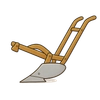
I couldn't stop thinking about the farmers' struggle. My mind kept returning to my blacksmith shop and how polished steel tools always stayed clean and resisted sticking. Then, in 1837, an idea struck me. I found a broken steel saw blade at a local mill and saw its potential. I brought it back to my shop and began the careful process of shaping it. With heat and my hammer, I bent the durable steel into the curved shape of a plowshare, the part that cuts through the soil. I polished it meticulously until I could see my own reflection in its smooth surface. I took my new creation to a local farm for a demonstration. The farmers gathered around were skeptical, having seen nothing but failure with their own plows. But as my steel plow cut into the earth, the thick soil slid right off its polished surface, just as I had hoped. It was a self-scouring plow, and I knew in that moment it would change farming on the prairies forever.
John Deere
Hello! My name is John Deere, and I am known for an invention that changed farming forever. I was born on February 7th, 1804, in the small town of Rutland, Vermont. From a young age, I was fascinated by the work of a blacksmith. I found the smell of the coal fire and the sharp ring of a hammer striking hot metal to be captivating. It was a craft of strength and precision. In 1821, when I was 17 years old, I formally began my journey in this trade by becoming an apprentice blacksmith. I learned to shape iron into all sorts of useful tools for my community, such as sturdy horseshoes and sharp pitchforks. I always took immense pride in my work, making sure to polish my creations until they gleamed brightly.
As I grew older, stories of opportunity on the western frontier reached me. The idea of a new life and new challenges was exciting. In 1836, I made the bold decision to move to Grand Detour, Illinois. This land was a world away from Vermont, with vast, open prairies of rich, black soil that seemed perfect for farming. However, the pioneers who worked this land faced a significant and frustrating challenge. The soil was so thick and heavy that it would cling to their cast-iron plows like thick glue. Every few steps, they had to stop their work, lift the heavy plow, and scrape off the sticky mud. This made plowing incredibly slow and exhausting, and I knew there had to be a better way to solve this sticky problem.
I couldn't stop thinking about the farmers' struggle. My mind kept returning to my blacksmith shop and how polished steel tools always stayed clean and resisted sticking. Then, in 1837, an idea struck me. I found a broken steel saw blade at a local mill and saw its potential. I brought it back to my shop and began the careful process of shaping it. With heat and my hammer, I bent the durable steel into the curved shape of a plowshare, the part that cuts through the soil. I polished it meticulously until I could see my own reflection in its smooth surface. I took my new creation to a local farm for a demonstration. The farmers gathered around were skeptical, having seen nothing but failure with their own plows. But as my steel plow cut into the earth, the thick soil slid right off its polished surface, just as I had hoped. It was a self-scouring plow, and I knew in that moment it would change farming on the prairies forever.
News of my invention traveled fast. Soon, farmers from all over the region wanted one of my steel plows. To meet the demand, I started a small business in 1838. As orders poured in, I knew I needed to expand. In 1848, I moved my entire operation to Moline, Illinois, a strategic location on the banks of the mighty Mississippi River. The river was a perfect resource, providing water power for my factory and a natural highway to ship my plows to farmers far and wide. My company, Deere & Company, grew rapidly. By 1855, we were producing more than 10,000 plows a year. Beyond my business, I felt a deep connection to the city that became my home. I was honored to serve my community when I was elected mayor of Moline in 1873.
I never set out to become a famous inventor; my goal was simply to help my neighbors solve a problem that made their lives difficult. My work helped those hardworking pioneers transform the tough prairie into the fertile farmland that would feed our growing nation. I lived to be 82 years old, passing on in the spring of 1886. Today, the company that bears my name, Deere & Company, is recognized around the world by its iconic leaping deer logo. It continues to make equipment that helps farmers everywhere, carrying on the spirit of innovation that began in a small blacksmith shop so many years ago.
Wow facts
About
John Deere was an American blacksmith and inventor who founded Deere & Company. In 1837, he invented the first commercially successful self-scouring steel plow, which revolutionized farming on the American prairie.
Take a Quiz
Question 1 of 5
What was the 'sticky problem' farmers faced in Illinois, and how did I solve it?
Explore next





Want to do even more?
Go beyond exploring. Unlock tools that turn every story into real learning.

Storypie Plus for families
Full stories, quizzes, and printables. Nights and car rides, sorted.
- Unlimited audio stories
- Create Mode: your child stars in the story
- Offline downloads
- Printable worksheets & coloring pages

Why Storypie for Schools
Students engaged. Prep in seconds. Evenings back to you.
- Worksheets & Quizzes
- Classroom Management
- Formative Assessment
- Custom Curriculum & Lesson Plans
- 27 Languages

Why Storypie for Homeschool
Curriculum done. They'll ask for more. Hours back in your day.
- Worksheet Generator
- First-Person Audio Stories
- Built-in Comprehension Quizzes
- Custom Curriculum & Lesson Plans
- Print & Go Activities