English

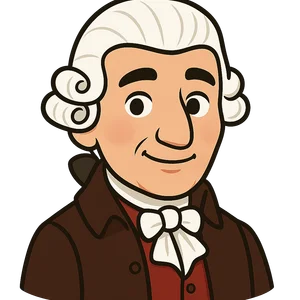
Joseph Haydn
An Austrian composer of the Classical period…
Reads at Grades 6–8 Listens at Grades 4–8
The Story of Joseph Haydn
Hello! My name is Joseph Haydn, and I want to tell you the story of my life in music. I was born in a small Austrian village called Rohrau on March 31st, 1732. Even as a little boy, I loved music more than anything. I didn't have real instruments, so I would pretend to play the violin with two sticks! My singing voice was my real gift. When I was about six years old, a relative heard me sing and recognized my talent. He took me to the nearby town of Hainburg to study music formally. Then, in 1740, an incredible opportunity came my way: I was accepted as a choirboy at the famous St. Stephen's Cathedral in Vienna, which was the grand capital of music in Europe.
Life in the choir was exciting and full of music, but it didn't last forever. In 1749, when I was 17, my voice changed as all boys' voices do. I could no longer sing the high notes required for the choir, and I was suddenly dismissed. I found myself on the streets of Vienna with no money and nowhere to go. Those were very difficult years. I managed to find a chilly attic room to live in and scraped by giving music lessons to children and playing my violin at parties to earn a little money. But I never gave up on my dream. Every spare moment I had, I spent studying music books and practicing, teaching myself the complex art of composition. I was determined to become a great composer.
My hard work and determination began to pay off. Around 1757, I secured my first steady job working for a nobleman named Count Morzin, which gave me valuable experience. However, my most important job began in 1761 when I was hired by the Esterházys, one of the wealthiest and most powerful families in the Austrian empire. For nearly 30 years, I served as their Kapellmeister, or music director. My main patron was Prince Nikolaus Esterházy, who loved music dearly and was a great supporter of my work. He built a magnificent palace called Esterháza, which was like a fairytale castle with its own orchestra and opera house. It was my job to write all the music, rehearse the musicians, and put on concerts for the prince and his guests. The prince always wanted to hear something new, so I had to be very creative and productive.
Working at Esterháza was like being in a musical laboratory. With an entire orchestra at my disposal, I could experiment with sounds and ideas every single day. The musicians in my orchestra became like my family, and they kindly gave me the nickname 'Papa Haydn' because I always looked out for them and treated them with care. During this incredibly productive time, I helped shape two very important types of music. I wrote over 100 symphonies, helping to create the four-movement structure that composers still use today. I also developed the string quartet—an intimate conversation between four instruments: two violins, a viola, and a cello. In the 1780s, I made a wonderful friend in Vienna, a brilliant young composer named Wolfgang Amadeus Mozart. We admired each other's music greatly and learned so much from one another during our time together.
After my dear Prince Nikolaus passed away in 1790, his son was not as interested in music and allowed me to travel. An English musician and concert promoter invited me to London, and I eagerly accepted the offer. I made two long trips there, the first from 1791 to 1792, and the second from 1794 to 1795. London was the biggest and most exciting city I had ever seen! I was treated like a celebrity, and the concerts of my music were held in huge halls filled with cheering crowds. For these trips, I wrote a set of twelve new symphonies, which are now famously called my 'London Symphonies.' One of them, No. 94, is nicknamed the 'Surprise' Symphony because of a sudden loud chord I put in the slow movement to wake up anyone who might be dozing off during the performance!
Inspired by the grand musical performances I heard in England, I returned to Vienna to write my biggest and most famous works. These were large pieces for orchestra, choir, and singers called oratorios. The first, 'The Creation,' which premiered in 1798, tells the biblical story of the creation of the world in a powerful and beautiful way. My other great oratorio was 'The Seasons,' which painted pictures of country life throughout the year. Around this time, in 1797, I also composed a patriotic song for the Austrian emperor, 'Gott erhalte Franz den Kaiser' ('God Save Emperor Francis'), which became the country's national anthem for many years. For a while, I even had a very talented, but sometimes grumpy, student named Ludwig van Beethoven, who would go on to become a musical giant himself.
I lived a long and very full life, dedicated entirely to music. I passed away in Vienna on May 31st, 1809, during a time of great turmoil when Napoleon's army was occupying the city. I lived to be 77 years old. I wrote so much music that I couldn't possibly count it all. Today, people remember me as the 'Father of the Symphony' and the 'Father of the String Quartet' for helping to establish those important musical forms. My greatest hope was that my music would bring joy and comfort to people, and I am so happy that it is still played and loved all over the world.
Wow facts
About
An Austrian composer of the Classical period, Joseph Haydn is known as the 'Father of the Symphony' and the 'Father of the String Quartet' for his pioneering work in these musical forms.
Take a Quiz
Question 1 of 5
What is the main reason Joseph Haydn is known as the 'Father of the Symphony'?
Explore next



Want to do even more?
Go beyond exploring. Unlock tools that turn every story into real learning.

Storypie Plus for families
Full stories, quizzes, and printables. Nights and car rides, sorted.
- Unlimited audio stories
- Create Mode: your child stars in the story
- Offline downloads
- Printable worksheets & coloring pages

Why Storypie for Schools
Students engaged. Prep in seconds. Evenings back to you.
- Worksheets & Quizzes
- Classroom Management
- Formative Assessment
- Custom Curriculum & Lesson Plans
- 27 Languages

Why Storypie for Homeschool
Curriculum done. They'll ask for more. Hours back in your day.
- Worksheet Generator
- First-Person Audio Stories
- Built-in Comprehension Quizzes
- Custom Curriculum & Lesson Plans
- Print & Go Activities