English

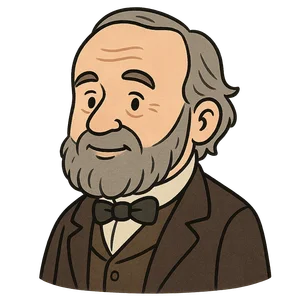
Karl Weierstrass
Karl Weierstrass was a German mathematician often referred to as the 'father of modern analysis' for his…
Reads at Grades 6–8 Listens at Grades 4–8
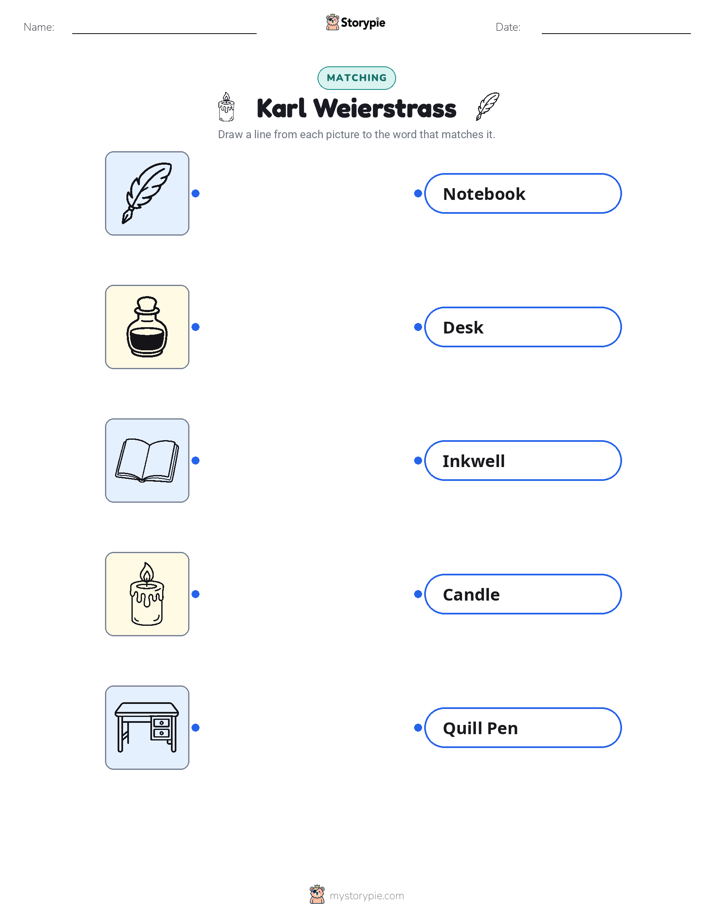
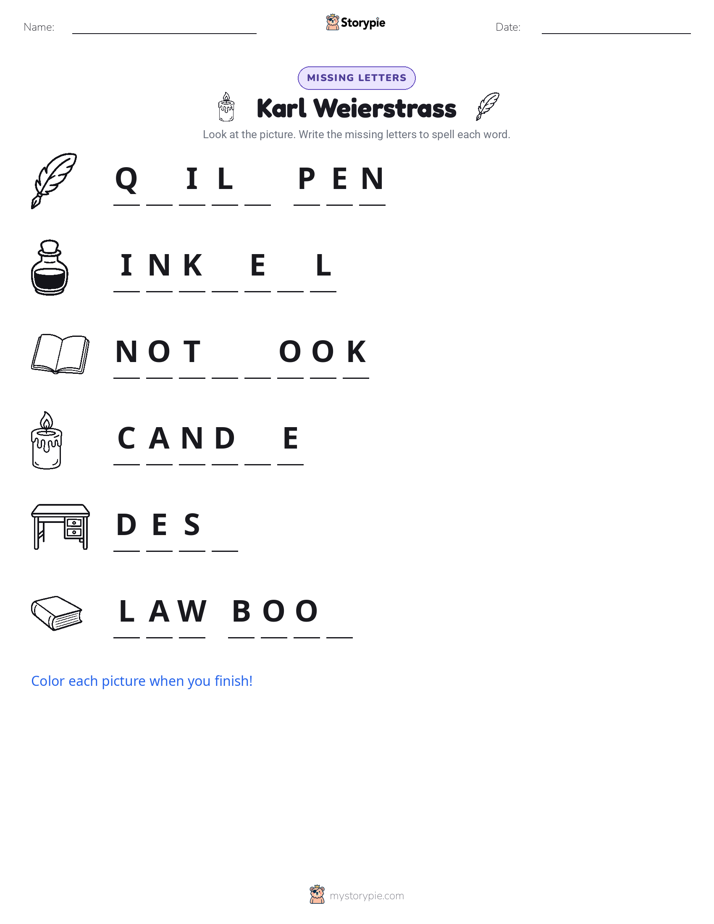
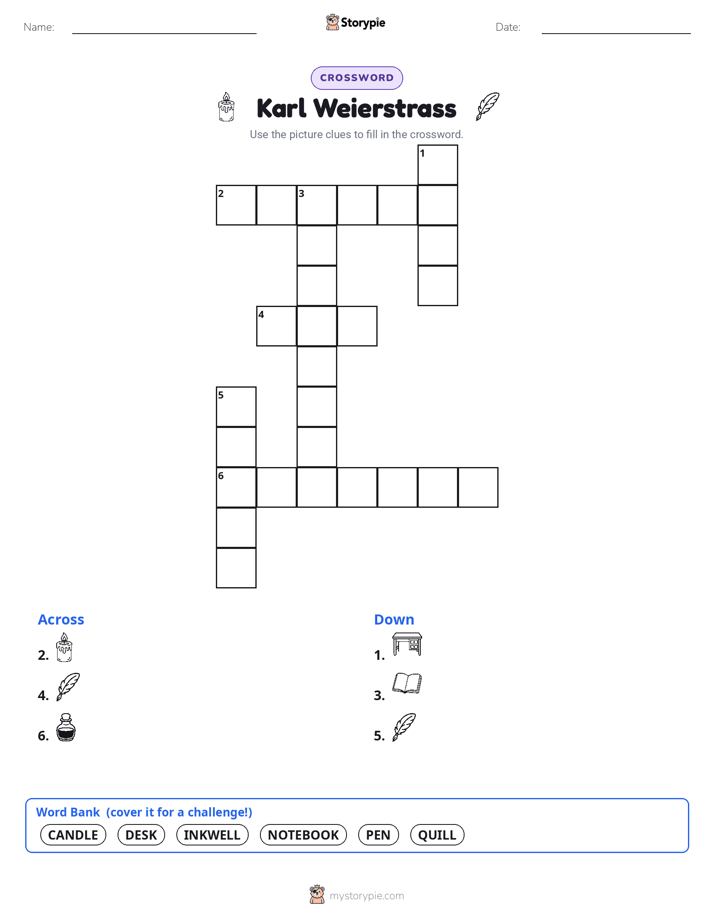
Print & create
Answer keys·No prep·Free with an account
28 worksheets · answer keys · full story · quiz · Ages 10-12 · CEFR B2
Plus adds 244,000+ more stories in 27 languages, audio for every one, and printables for all of them.
Just want Karl Weierstrass?
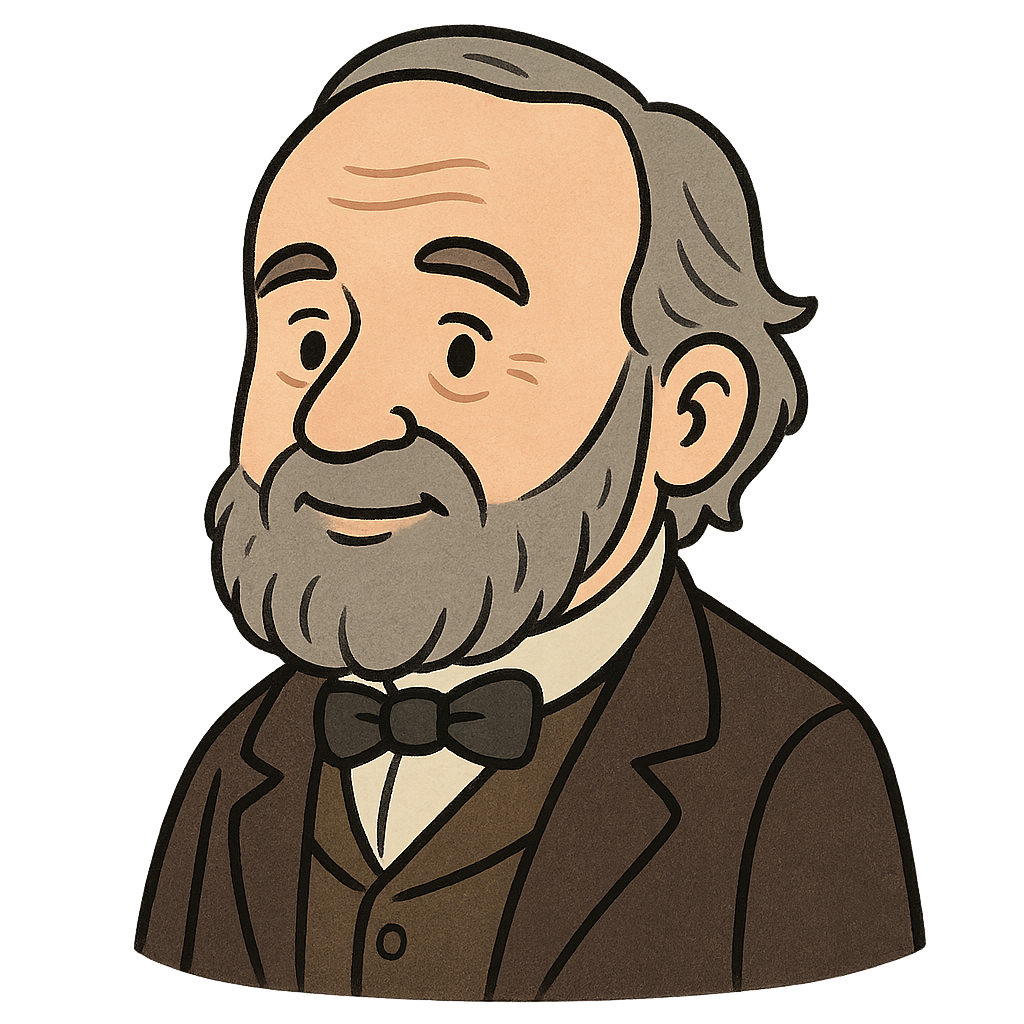
Hello, my name is Karl Weierstrass, and I am known for bringing a new level of precision and logic to the world of mathematics. My story begins on October 31st, 1815, in a part of the world that was then called Prussia. From a young age, my father had a very specific career path planned for me. He wanted me to study law and finance, believing it would lead to a stable and successful life. In 1834, I followed his wishes and enrolled at the University of Bonn. However, while I was supposed to be attending lectures on law, my mind was elsewhere. I found myself completely captivated by the beauty and certainty of mathematics. I spent most of my time in the library, reading the works of great mathematicians and exploring complex ideas on my own. I knew I was disappointing my father by ignoring the subjects he had chosen for me, but my passion for numbers and logic was too strong to ignore. This created a difficult situation for me, as I was torn between my family's expectations and my own intellectual curiosity.
After four years, I left the University of Bonn without a degree, realizing I could not continue down a path that wasn't my own. I decided to pursue mathematics formally, and in 1839, I began studying at the Academy of Münster. It was there that I met a wonderful professor named Christoph Gudermann, who recognized my talent and encouraged my advanced studies. To support myself, I took a job as a schoolteacher, a position I held in various small towns from 1841 until 1855. My life was far from that of a university academic. I taught a wide range of subjects to my students, including physics, botany, and even gymnastics. I was completely cut off from the leading mathematical minds of Europe, with no one to discuss my ideas with. My days were filled with teaching, but my nights were reserved for my true passion. After my students were asleep and the town was quiet, I would stay up late, working by candlelight on my own mathematical theories. I filled countless notebooks with complex proofs and revolutionary ideas, all in complete isolation.
Karl Weierstrass: The Teacher Who Changed Mathematics
Hello, my name is Karl Weierstrass, and I am known for bringing a new level of precision and logic to the world of mathematics. My story begins on October 31st, 1815, in a part of the world that was then called Prussia. From a young age, my father had a very specific career path planned for me. He wanted me to study law and finance, believing it would lead to a stable and successful life. In 1834, I followed his wishes and enrolled at the University of Bonn. However, while I was supposed to be attending lectures on law, my mind was elsewhere. I found myself completely captivated by the beauty and certainty of mathematics. I spent most of my time in the library, reading the works of great mathematicians and exploring complex ideas on my own. I knew I was disappointing my father by ignoring the subjects he had chosen for me, but my passion for numbers and logic was too strong to ignore. This created a difficult situation for me, as I was torn between my family's expectations and my own intellectual curiosity.
After four years, I left the University of Bonn without a degree, realizing I could not continue down a path that wasn't my own. I decided to pursue mathematics formally, and in 1839, I began studying at the Academy of Münster. It was there that I met a wonderful professor named Christoph Gudermann, who recognized my talent and encouraged my advanced studies. To support myself, I took a job as a schoolteacher, a position I held in various small towns from 1841 until 1855. My life was far from that of a university academic. I taught a wide range of subjects to my students, including physics, botany, and even gymnastics. I was completely cut off from the leading mathematical minds of Europe, with no one to discuss my ideas with. My days were filled with teaching, but my nights were reserved for my true passion. After my students were asleep and the town was quiet, I would stay up late, working by candlelight on my own mathematical theories. I filled countless notebooks with complex proofs and revolutionary ideas, all in complete isolation.
For more than a decade, I continued this double life—a dedicated teacher by day and a secret mathematician by night. No one in the wider academic world knew I even existed. Then, in 1854, I felt confident enough in my work to publish a paper on a complex topic known as Abelian functions. I submitted it to a well-known mathematics journal, hoping someone might notice it. The result was more than I could have ever imagined. The mathematical community across Europe was electrified. Famous professors read my work with astonishment, asking one another, 'Who is this Karl Weierstrass, a teacher in a small, unknown town, and how did he create such brilliant work?' The paper was so groundbreaking that it changed my life almost overnight. In recognition of my achievement, I was awarded an honorary doctorate from the University of Königsberg. By 1856, my life of obscurity was officially over when I was offered a prestigious professorship at the University of Berlin. I finally had a place where I could dedicate all my time to mathematics.
My new position at the University of Berlin gave me the platform I had always dreamed of. I was finally able to share the wealth of ideas I had secretly developed during my years as a teacher. My lectures quickly became famous, attracting bright and eager students from all over the world who came to learn my new approach to mathematics. My central mission was to introduce 'rigor' into the field, especially into the area of calculus. I wanted to ensure that every mathematical concept was built on a foundation of pure, unshakeable logic, like a perfectly constructed tower with no weak bricks. I worked to create precise, formal definitions for fundamental ideas like limits and continuity, which form the very core of modern analysis. My work led to important results like the Bolzano-Weierstrass theorem and the creation of the curious Weierstrass function, a function that is continuous everywhere but differentiable nowhere. One of my greatest joys was teaching, and I was incredibly proud to mentor gifted students like Sofia Kovalevskaya, who went on to become one of the most important female mathematicians in history.
I continued to teach and conduct research at the university for many years, contributing to the field I loved. However, my health began to decline in my later years. After 1894, I was often confined to a wheelchair, though my mind remained sharp. I lived to be 81 years old. Today, many people refer to me as the 'father of modern analysis' because of my focus on logical precision. My insistence that every mathematical statement must be proven with absolute certainty helped shape the standards of modern mathematics. I showed the world that even the most complex ideas are clear and trustworthy when they are built upon a strong foundation of careful, logical steps, a principle that guides mathematicians to this day.
Wow facts
About
Karl Weierstrass was a German mathematician often referred to as the 'father of modern analysis' for his rigorous work on the foundations of calculus.
Take a Quiz
Question 1 of 5
Retell the story of how I went from being an unknown teacher to a famous professor in your own words.
Explore next



Want to do even more?
Go beyond exploring. Unlock tools that turn every story into real learning.

Storypie Plus for families
Full stories, quizzes, and printables. Nights and car rides, sorted.
- Unlimited audio stories
- Create Mode: your child stars in the story
- Offline downloads
- Printable worksheets & coloring pages

Why Storypie for Schools
Students engaged. Prep in seconds. Evenings back to you.
- Worksheets & Quizzes
- Classroom Management
- Formative Assessment
- Custom Curriculum & Lesson Plans
- 27 Languages

Why Storypie for Homeschool
Curriculum done. They'll ask for more. Hours back in your day.
- Worksheet Generator
- First-Person Audio Stories
- Built-in Comprehension Quizzes
- Custom Curriculum & Lesson Plans
- Print & Go Activities