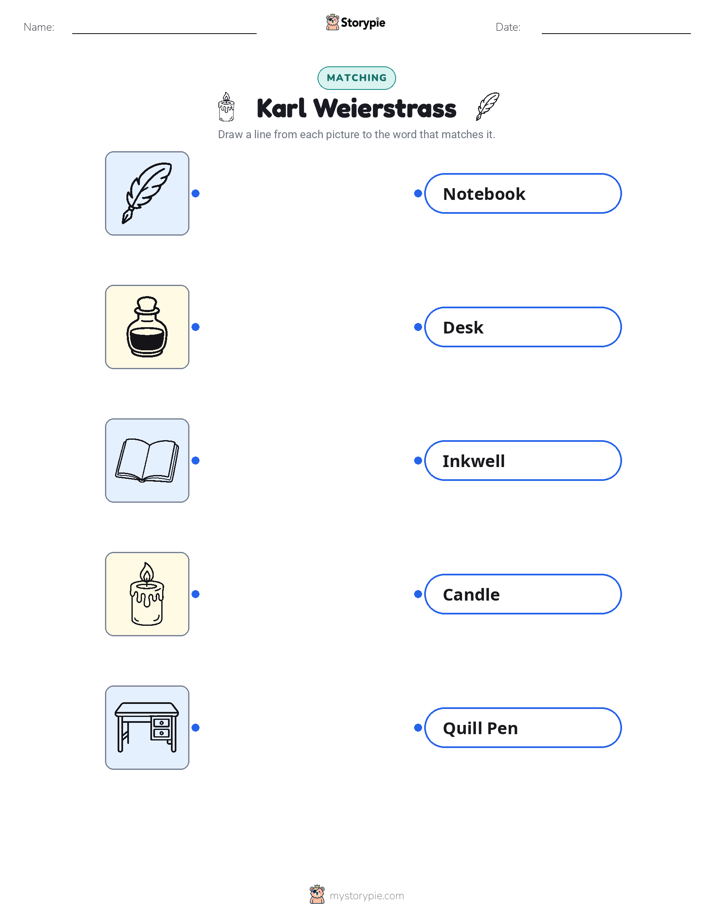
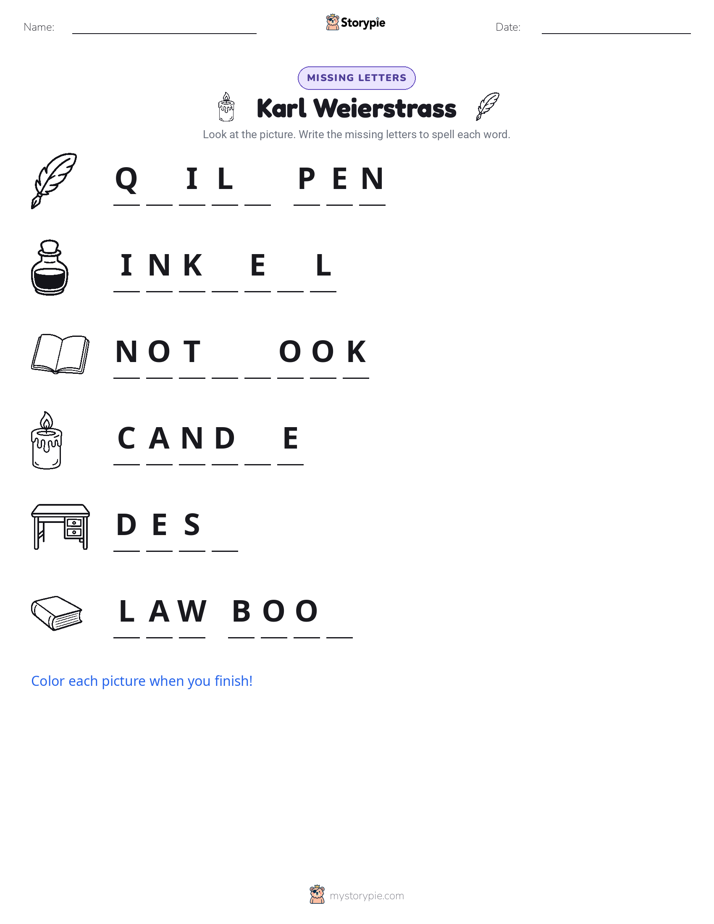
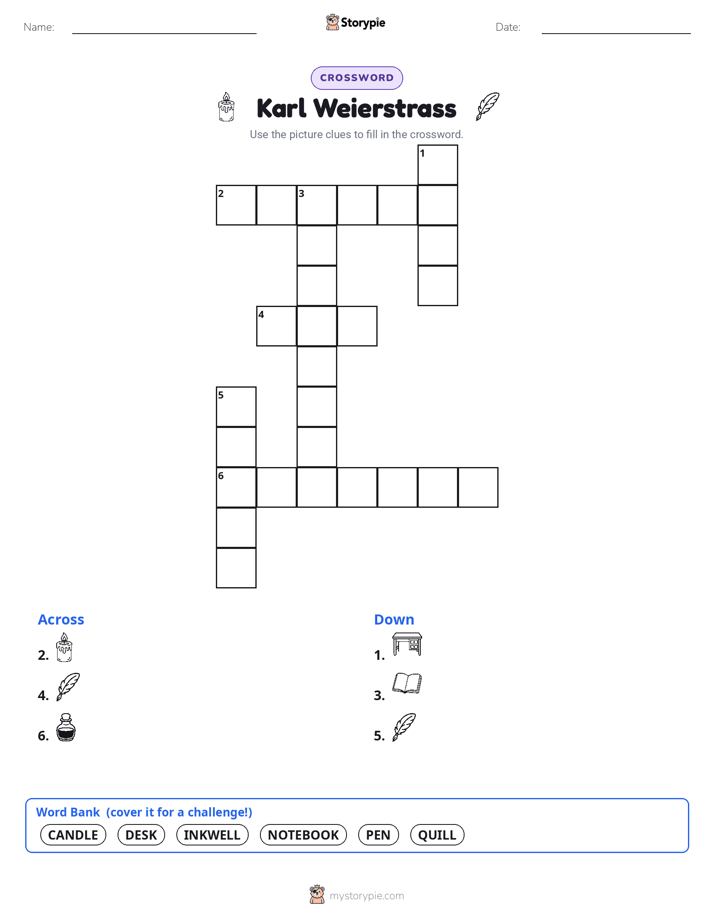
English

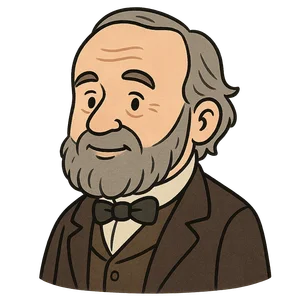
Karl Weierstrass
Karl Weierstrass was a German mathematician often referred to as the 'father of modern analysis' for his…
Reads at Grades 3–5 Listens at Grades 1–5
Print & create
Answer keys·No prep·Free with an account
28 worksheets · answer keys · full story · quiz · Ages 8-10 · CEFR B1
Plus adds 244,000+ more stories in 27 languages, audio for every one, and printables for all of them.
Just want Karl Weierstrass?
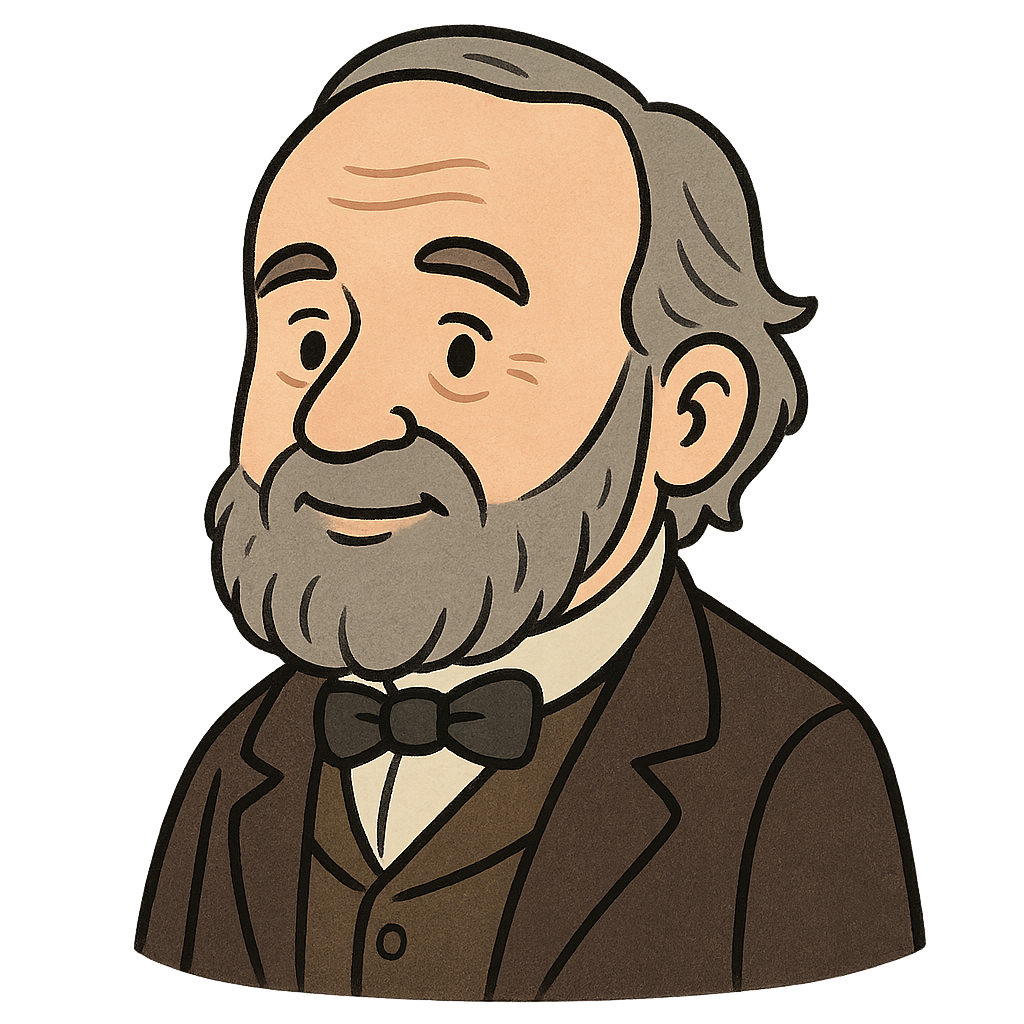
Hello, my name is Karl Weierstrass, and I am a mathematician who found great beauty in the world of numbers. I was born on October 31st, 1815, in a small village in Prussia called Ostenfelde. My father was a government official, and he had a practical plan for my life. He wanted me to study law or finance, subjects he believed would lead to a good career. While I was good with numbers and even helped my mother's family with the bookkeeping at their tavern, my true passion was a secret. In my free time, I would find any math book I could and study it all by myself. I was fascinated by the patterns, shapes, and logic that numbers held within them.
In 1834, to make my father happy, I went to the University of Bonn to begin my studies in law. But my heart wasn't in it. Instead of listening to lectures about rules and regulations, I found myself spending more and more time reading my math books in secret. The world of mathematics felt like my true home. After four years of trying to follow a path that wasn't mine, I made a very difficult decision. I left the university without earning a degree. It was a choice that disappointed my family, but I knew I had to follow my dream. Soon after, I enrolled at the Academy of Münster, where I could finally dedicate all my time to studying the subject I loved.
After I finished my studies in 1841, I began a new chapter of my life as a teacher in small, quiet towns. For the next fifteen years, I taught all sorts of subjects to my students—not just mathematics, but also physics, botany, and even gymnastics. I enjoyed being a teacher, but my deepest work happened after the school day ended. Every evening, I would stay up late, working by candlelight on my own complex mathematical problems. During these quiet hours, I was developing new ideas in a field called 'analysis,' which is the part of math that makes calculus perfectly logical and clear. I did this important work completely on my own, in isolation, without anyone in the greater world of mathematics knowing what I was discovering.
Karl Weierstrass: The Father of Modern Analysis
Hello, my name is Karl Weierstrass, and I am a mathematician who found great beauty in the world of numbers. I was born on October 31st, 1815, in a small village in Prussia called Ostenfelde. My father was a government official, and he had a practical plan for my life. He wanted me to study law or finance, subjects he believed would lead to a good career. While I was good with numbers and even helped my mother's family with the bookkeeping at their tavern, my true passion was a secret. In my free time, I would find any math book I could and study it all by myself. I was fascinated by the patterns, shapes, and logic that numbers held within them.
In 1834, to make my father happy, I went to the University of Bonn to begin my studies in law. But my heart wasn't in it. Instead of listening to lectures about rules and regulations, I found myself spending more and more time reading my math books in secret. The world of mathematics felt like my true home. After four years of trying to follow a path that wasn't mine, I made a very difficult decision. I left the university without earning a degree. It was a choice that disappointed my family, but I knew I had to follow my dream. Soon after, I enrolled at the Academy of Münster, where I could finally dedicate all my time to studying the subject I loved.
After I finished my studies in 1841, I began a new chapter of my life as a teacher in small, quiet towns. For the next fifteen years, I taught all sorts of subjects to my students—not just mathematics, but also physics, botany, and even gymnastics. I enjoyed being a teacher, but my deepest work happened after the school day ended. Every evening, I would stay up late, working by candlelight on my own complex mathematical problems. During these quiet hours, I was developing new ideas in a field called 'analysis,' which is the part of math that makes calculus perfectly logical and clear. I did this important work completely on my own, in isolation, without anyone in the greater world of mathematics knowing what I was discovering.
My life changed completely in 1854. After years of working in secret, I decided to publish one of my research papers. It was on a very advanced topic called 'Abelian functions.' I sent it to a mathematical journal, hoping someone might find it interesting. The reaction was more than I could have ever imagined. When the most important mathematicians across Europe read my work, they were stunned. They could not believe that a schoolteacher from a small town had made such incredible breakthroughs. Suddenly, I wasn't an unknown teacher anymore. I became famous in the world of mathematics! The University of Königsberg awarded me an honorary doctorate, and in 1856, I was offered a job as a professor at the prestigious University of Berlin. My days of working in isolation were finally over.
As a professor in Berlin, I was finally able to share my love for mathematics with the world. My classes became very popular, and students traveled from all over to learn from me. My most important lesson was that mathematics had to be built on a perfectly solid and logical foundation, where every step was proven with absolute certainty. This focus on making everything precise is called 'rigor.' I helped improve parts of calculus that had always been a little confusing, making them clear and strong. Because of my dedication to this idea, many people began to call me the 'father of modern analysis.' I also introduced new and amazing concepts, like the 'Weierstrass function'—a line that is connected everywhere but has no smooth parts at all, like a coastline that is craggy no matter how closely you look. It was a joy to spend my days exploring the beauty of math with so many bright students.
I taught and researched for many years in Berlin. As I grew older, my health began to fail, and in my last few years, I used a wheelchair to get around, but my mind remained sharp and busy with numbers. I lived to be 81 years old. Today, I am remembered for bringing a new level of clarity and rigor to mathematics. The careful, logical methods I insisted on are still the foundation of how mathematicians and scientists work. My work helps ensure that the amazing discoveries of the future are always built on solid ground.
Wow facts
About
Karl Weierstrass was a German mathematician often referred to as the 'father of modern analysis' for his rigorous work on the foundations of calculus.
Take a Quiz
Question 1 of 5
In the story, Karl Weierstrass did his most important work 'in isolation.' What does 'isolation' mean in this sentence?
Explore next




Want to do even more?
Go beyond exploring. Unlock tools that turn every story into real learning.

Storypie Plus for families
Full stories, quizzes, and printables. Nights and car rides, sorted.
- Unlimited audio stories
- Create Mode: your child stars in the story
- Offline downloads
- Printable worksheets & coloring pages

Why Storypie for Schools
Students engaged. Prep in seconds. Evenings back to you.
- Worksheets & Quizzes
- Classroom Management
- Formative Assessment
- Custom Curriculum & Lesson Plans
- 27 Languages

Why Storypie for Homeschool
Curriculum done. They'll ask for more. Hours back in your day.
- Worksheet Generator
- First-Person Audio Stories
- Built-in Comprehension Quizzes
- Custom Curriculum & Lesson Plans
- Print & Go Activities