English

Lumière brothers
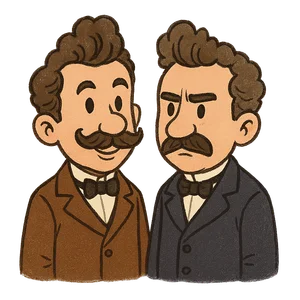
Auguste (1862-1954) and Louis (1864-1948) Lumière were French inventors and early filmmakers who created the…
Reads at Grades 3–5 Listens at Grades 1–5
Print & create
Answer keys·No prep·Free with an account
28 worksheets · answer keys · full story · quiz · Ages 8-10 · CEFR B1
Plus adds 164,000+ more stories in 27 languages, audio for every one, and printables for all of them.
Just want Lumière brothers?
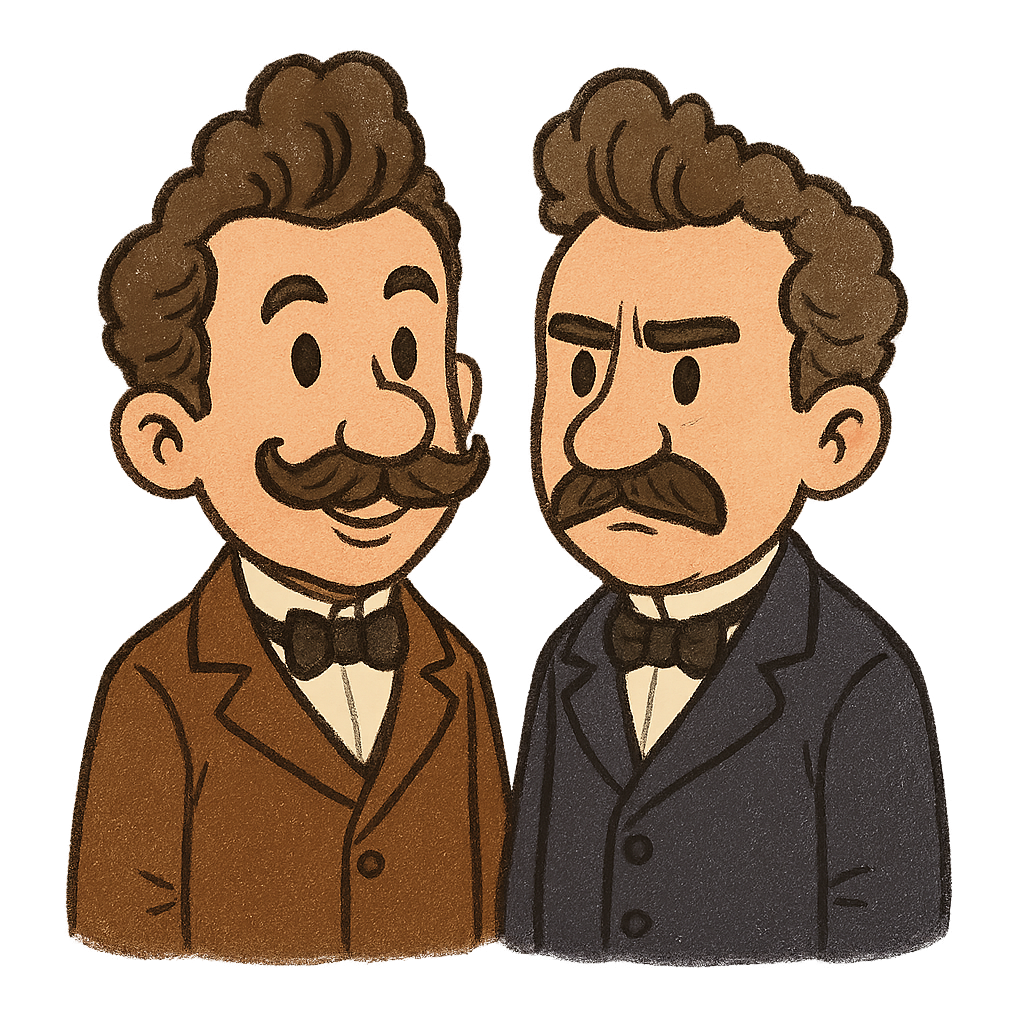
Bonjour! We are the Lumière brothers, Auguste and Louis. You might know us for making the world's first movies! Our story starts in France, where I, Auguste, was born in 1862, and my brother Louis was born two years later in 1864. Our father, Antoine, was a fantastic photographer, and we grew up surrounded by cameras and pictures in his studio in the city of Lyon. We loved science and were always curious. We would spend hours helping our father in his workshop, learning all about how to capture an image. This love for photography sparked an idea that would change the world forever.
One day in 1894, our father came home very excited. He had seen a new invention in Paris called the Kinetoscope, created by the American inventor Thomas Edison. It was a big box you had to peek into to see a short film move, but only one person could watch at a time. Our father saw its potential but thought it could be better. He gathered us together and said, 'Boys, you must find a way to get the picture out of the box! Project it onto a screen so everyone can see it together!' We looked at each other and knew this was a challenge we had to accept.
My brother Louis was the main brain behind our new machine. He worked day and night, and one night, he woke up with the perfect idea. We created a device that was much smaller and lighter than Mr. Edison's camera. We called it the Cinématographe—that's French for 'writing in movement.' Our invention was special because it was three machines in one! It could record the moving pictures, develop the film, and then project them onto a big screen for an audience to see. It was portable, so we could take it anywhere. We were so proud that we officially patented our Cinématographe on February 13th, 1895. We were ready to show our invention to the world.
The Lumière Brothers: Making Pictures Move
Bonjour! We are the Lumière brothers, Auguste and Louis. You might know us for making the world's first movies! Our story starts in France, where I, Auguste, was born in 1862, and my brother Louis was born two years later in 1864. Our father, Antoine, was a fantastic photographer, and we grew up surrounded by cameras and pictures in his studio in the city of Lyon. We loved science and were always curious. We would spend hours helping our father in his workshop, learning all about how to capture an image. This love for photography sparked an idea that would change the world forever.
One day in 1894, our father came home very excited. He had seen a new invention in Paris called the Kinetoscope, created by the American inventor Thomas Edison. It was a big box you had to peek into to see a short film move, but only one person could watch at a time. Our father saw its potential but thought it could be better. He gathered us together and said, 'Boys, you must find a way to get the picture out of the box! Project it onto a screen so everyone can see it together!' We looked at each other and knew this was a challenge we had to accept.
My brother Louis was the main brain behind our new machine. He worked day and night, and one night, he woke up with the perfect idea. We created a device that was much smaller and lighter than Mr. Edison's camera. We called it the Cinématographe—that's French for 'writing in movement.' Our invention was special because it was three machines in one! It could record the moving pictures, develop the film, and then project them onto a big screen for an audience to see. It was portable, so we could take it anywhere. We were so proud that we officially patented our Cinématographe on February 13th, 1895. We were ready to show our invention to the world.
The big day was December 28th, 1895. We rented a basement room called the Salon Indien du Grand Café in Paris. We were nervous—would anyone even come? Only about 30 people showed up for the first screening. We showed ten short films, each about a minute long. One showed workers leaving our factory, another showed a baby being fed, and one showed us playing cards. But the most famous one was 'The Arrival of a Train at La Ciotat Station.' When the train on the screen came right towards the audience, people screamed and ducked out of the way! They had never seen anything like it. They thought a real train was about to burst through the wall! It was magical.
After our first show, moving pictures became a huge sensation! We sent camera operators all over the world to film everyday life in different countries and to show our films to new audiences. People in London, New York, and beyond were amazed by our Cinématographe. It was exciting to see life from far-away places. We thought of our invention as a scientific tool for capturing reality, like a moving photograph. We honestly didn't think it had a future as a way to tell stories. We were more interested in our next big project: creating color photography.
We did go on to invent one of the first successful color photography processes, called the Autochrome Lumière, in 1903. We continued to be inventors for the rest of our lives. My brother Louis lived to be 83 years old, and I, Auguste, lived to be 91. Though we thought movies were just a passing fad, we had accidentally started a brand new art form. Every time you watch a movie at a theater or on a screen, you can remember us, two curious brothers from France who first made pictures move for the whole world to see.
Wow facts
About
Auguste (1862-1954) and Louis (1864-1948) Lumière were French inventors and early filmmakers who created the Cinématographe, a device that could record, develop, and project motion pictures. They held the first public film screening on December 28th, 1895, and are regarded as the fathers of cinema.
Take a Quiz
Question 1 of 5
What was the main difference between the Lumière brothers' Cinématographe and Thomas Edison's Kinetoscope?
Explore next






Want to do even more?
Go beyond exploring. Unlock tools that turn every story into real learning.

Storypie Plus for families
Full stories, quizzes, and printables. Nights and car rides, sorted.
- Unlimited audio stories
- Create Mode: your child stars in the story
- Offline downloads
- Printable worksheets & coloring pages

Why Storypie for Schools
Students engaged. Prep in seconds. Evenings back to you.
- Worksheets & Quizzes
- Classroom Management
- Formative Assessment
- Custom Curriculum & Lesson Plans
- 27 Languages

Why Storypie for Homeschool
Curriculum done. They'll ask for more. Hours back in your day.
- Worksheet Generator
- First-Person Audio Stories
- Built-in Comprehension Quizzes
- Custom Curriculum & Lesson Plans
- Print & Go Activities