English

Lumière brothers
Auguste (1862-1954) and Louis (1864-1948) Lumière were French inventors and early filmmakers who created the…
Reads at Grades 6–8 Listens at Grades 4–8
Print & create
Answer keys·No prep·Free with an account
28 worksheets · answer keys · full story · quiz · Ages 10-12 · CEFR B2
Plus adds 164,000+ more stories in 27 languages, audio for every one, and printables for all of them.
Just want Lumière brothers?
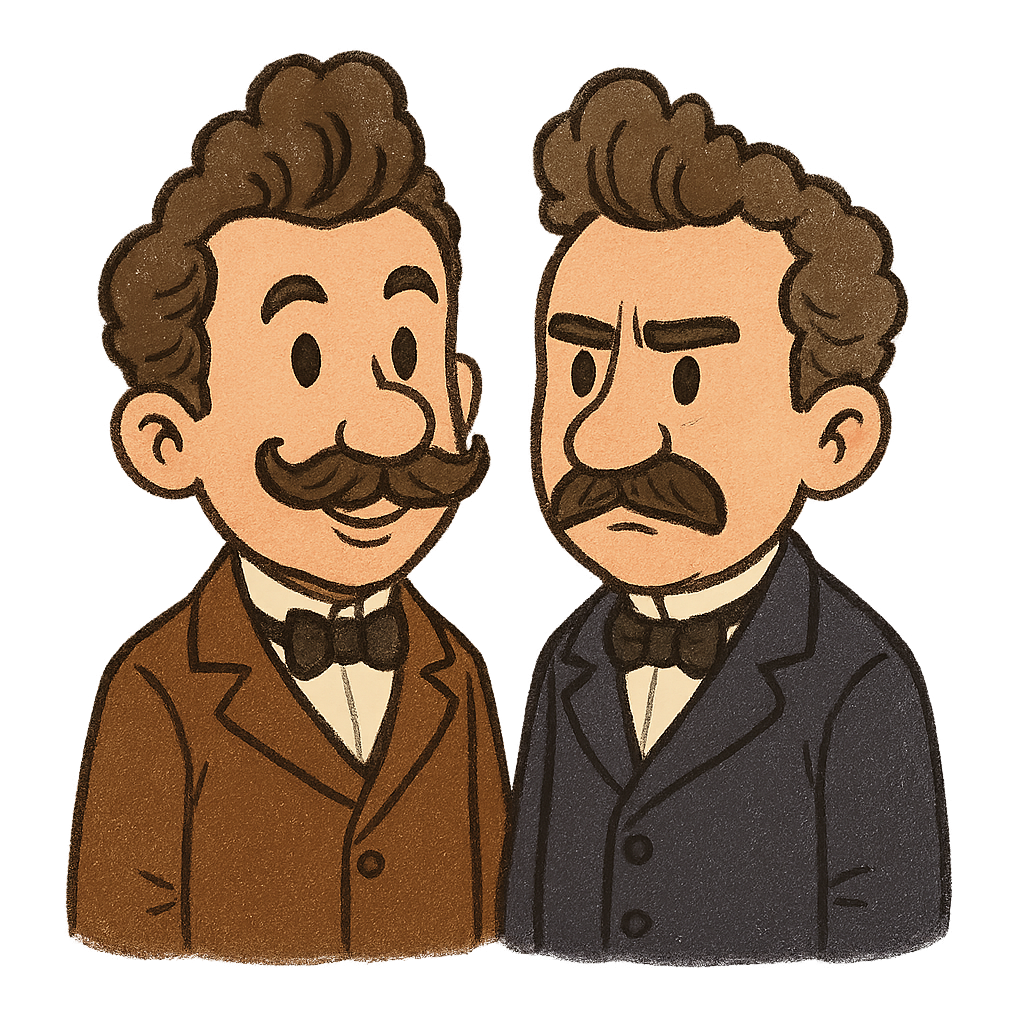
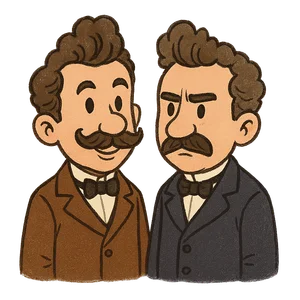
Hello! We are the Lumière brothers, Auguste and Louis. Our story begins in France, where we grew up surrounded by pictures. Our father, Antoine, was a talented photographer, and his studio in the city of Lyon was our playground. I, Auguste, was born in 1862, and my brother Louis followed two years later in 1864. We loved helping our father in his workshop, and it was there that our fascination with science and invention began. In 1881, when I, Louis, was just a teenager, I developed a new kind of photographic plate called a 'dry plate'. This invention made taking pictures much easier and faster than before. It was a huge success and helped our family's business become famous all over France, showing us what we could achieve when we combined science with curiosity.
Even though our photography business was thriving, we were always looking for the next great challenge. The world of science was buzzing with new ideas in the late 1800s, and we wanted to be part of it. In 1894, our father traveled to Paris and saw something that would change our lives forever: Thomas Edison's Kinetoscope. It was a large wooden cabinet that allowed a single person to peek inside and watch a short film loop. He returned to Lyon filled with excitement and gave us a mission. He told us, 'Edison's machine is clever, but the picture is trapped in a box for only one person to see. You must find a way to project the image onto a screen, so a whole room of people can watch together!' This idea sparked our imaginations, and we set out to build a single, lightweight machine that could record, develop, and project moving pictures for everyone to see.
The Lumière Brothers: The First Moving Pictures
Hello! We are the Lumière brothers, Auguste and Louis. Our story begins in France, where we grew up surrounded by pictures. Our father, Antoine, was a talented photographer, and his studio in the city of Lyon was our playground. I, Auguste, was born in 1862, and my brother Louis followed two years later in 1864. We loved helping our father in his workshop, and it was there that our fascination with science and invention began. In 1881, when I, Louis, was just a teenager, I developed a new kind of photographic plate called a 'dry plate'. This invention made taking pictures much easier and faster than before. It was a huge success and helped our family's business become famous all over France, showing us what we could achieve when we combined science with curiosity.
Even though our photography business was thriving, we were always looking for the next great challenge. The world of science was buzzing with new ideas in the late 1800s, and we wanted to be part of it. In 1894, our father traveled to Paris and saw something that would change our lives forever: Thomas Edison's Kinetoscope. It was a large wooden cabinet that allowed a single person to peek inside and watch a short film loop. He returned to Lyon filled with excitement and gave us a mission. He told us, 'Edison's machine is clever, but the picture is trapped in a box for only one person to see. You must find a way to project the image onto a screen, so a whole room of people can watch together!' This idea sparked our imaginations, and we set out to build a single, lightweight machine that could record, develop, and project moving pictures for everyone to see.
We spent months working tirelessly in our factory workshop, experimenting with different designs. The biggest problem we faced was figuring out how to move the film strip through the camera smoothly and precisely. One night, while I, Louis, was home sick and unable to sleep, the solution suddenly came to me. I thought about the way a sewing machine's needle stitches cloth, pulling it forward, pausing, and then pulling again. We realized we could apply the same principle to film. We designed a mechanism with small claws that would grip the film, pull it in front of the lens, hold it still for a fraction of a second to capture an image, and then pull it down to the next frame. It worked perfectly. We called our invention the Cinématographe because it was a camera, a film developer, and a projector all in one small, portable box. We filed the patent for it on February 13th, 1895, and that spring, we filmed our very first movie, Workers Leaving the Lumière Factory, right outside our factory doors. Seeing real life move on a screen felt like pure magic.
After a few successful private tests, we felt ready to share our invention with the world. We chose a date that would go down in history: December 28th, 1895. In the basement of the Grand Café in Paris, we rented a small room and hung a white sheet to serve as a screen. That evening, we presented ten short films. They showed simple scenes from everyday life, like our factory workers leaving for the day, a blacksmith at work, and a funny film of a gardener getting sprayed with his own hose. The most famous film from that night was The Arrival of a Train at La Ciotat Station. The audience had never seen anything like it. As the black-and-white locomotive steamed directly towards the camera, people gasped. Some even jumped out of their seats, truly believing a real train was about to come through the screen! At first, only a handful of people attended, but word of our 'moving pictures' spread like wildfire. Soon, long lines formed outside the café. On that day, cinema was born.
After our historic first show, we sent camera operators across the globe to film new and exotic places and to demonstrate our Cinématographe to audiences in other countries. The idea of movies caught on very quickly. We, however, always thought of our invention as more of a scientific novelty than a new form of entertainment or art. We soon turned our attention to other challenges. In 1903, we invented the Autochrome Lumière, which became the world's first successful and widely used color photography process, bringing beautiful, true-to-life color to still images. I, Louis, lived to be 83 years old, and I, Auguste, lived to be 91. We had the great fortune of watching our little invention grow from a basement curiosity into the worldwide art form of filmmaking that you know today. People remember us as the 'Fathers of Cinema' because we were the first to bring the magic of moving pictures out of a small box and onto a big screen for everyone to share together.
Wow facts
About
Auguste (1862-1954) and Louis (1864-1948) Lumière were French inventors and early filmmakers who created the Cinématographe, a device that could record, develop, and project motion pictures. They held the first public film screening on December 28th, 1895, and are regarded as the fathers of cinema.
Take a Quiz
Question 1 of 5
What were the three functions combined into the single, portable device called the Cinématographe?
Explore next






Want to do even more?
Go beyond exploring. Unlock tools that turn every story into real learning.

Storypie Plus for families
Full stories, quizzes, and printables. Nights and car rides, sorted.
- Unlimited audio stories
- Create Mode: your child stars in the story
- Offline downloads
- Printable worksheets & coloring pages

Why Storypie for Schools
Students engaged. Prep in seconds. Evenings back to you.
- Worksheets & Quizzes
- Classroom Management
- Formative Assessment
- Custom Curriculum & Lesson Plans
- 27 Languages

Why Storypie for Homeschool
Curriculum done. They'll ask for more. Hours back in your day.
- Worksheet Generator
- First-Person Audio Stories
- Built-in Comprehension Quizzes
- Custom Curriculum & Lesson Plans
- Print & Go Activities