English

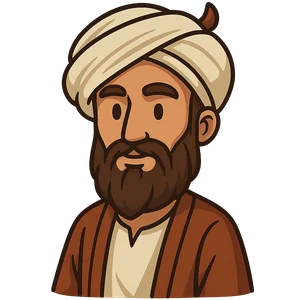
Muhammad ibn Musa al-Khwarizmi
A Persian mathematician, astronomer, and geographer during the Islamic Golden Age.
Reads at Grades 6–8 Listens at Grades 4–8
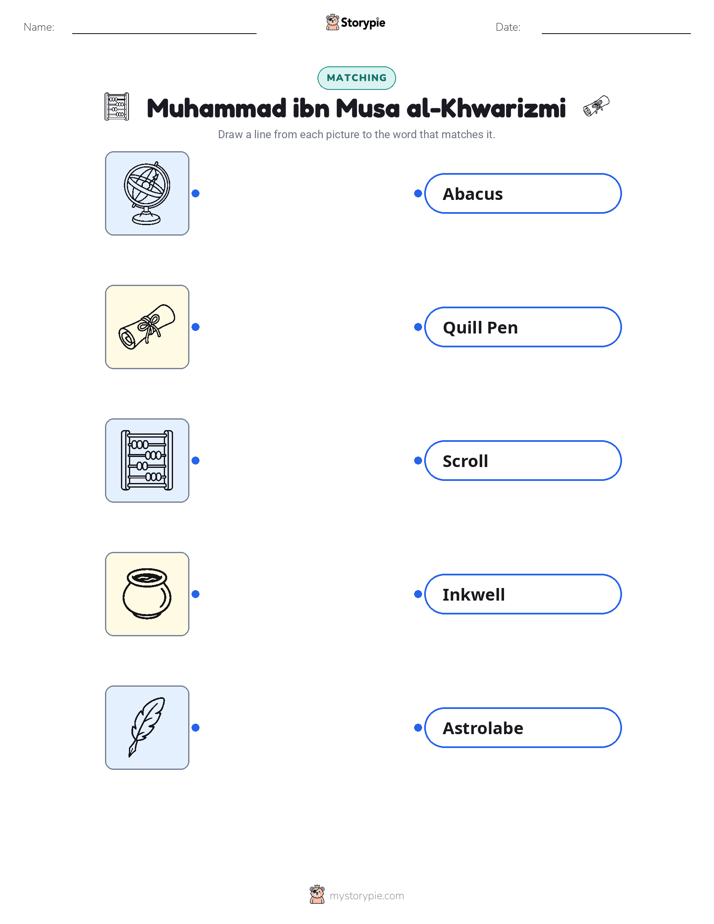
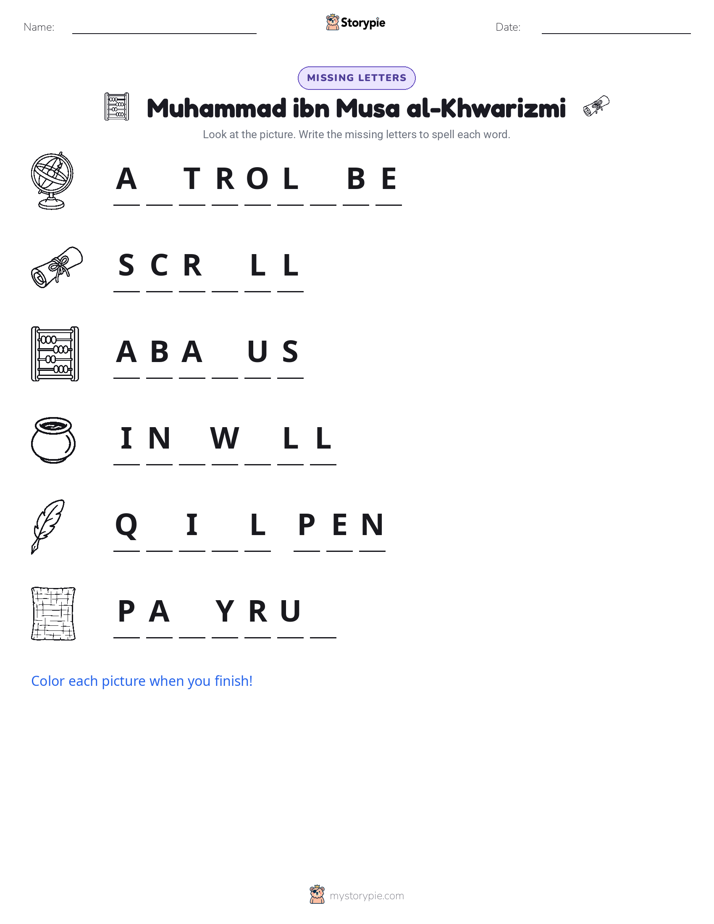
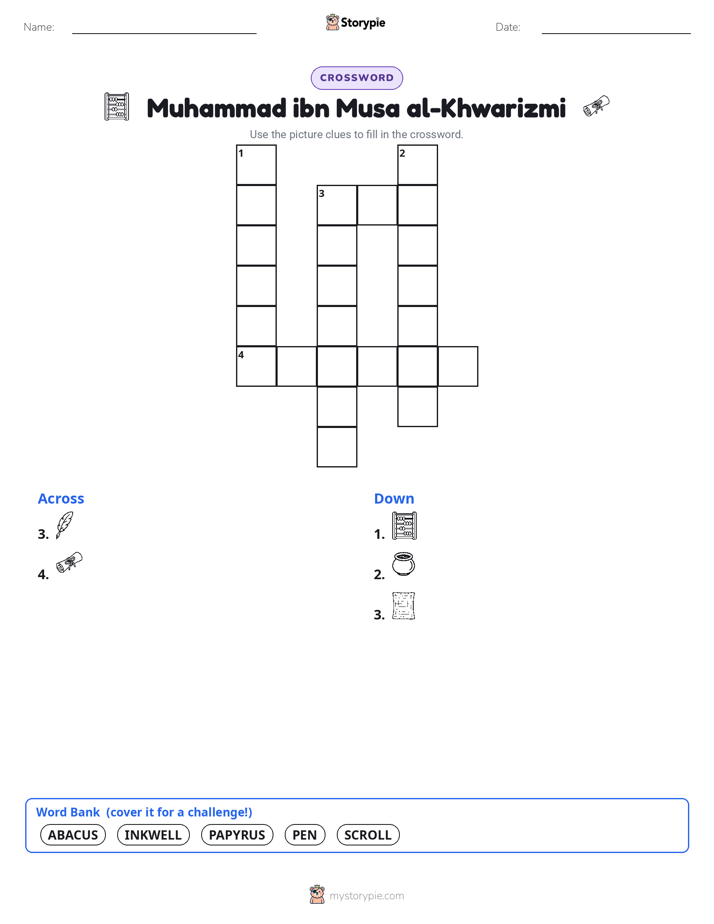
Print & create
Answer keys·No prep·Free with an account
28 worksheets · answer keys · full story · quiz · Ages 10-12 · CEFR B2
Plus adds 208,000+ more stories in 27 languages, audio for every one, and printables for all of them.
Just want Muhammad ibn Musa al-Khwarizmi?
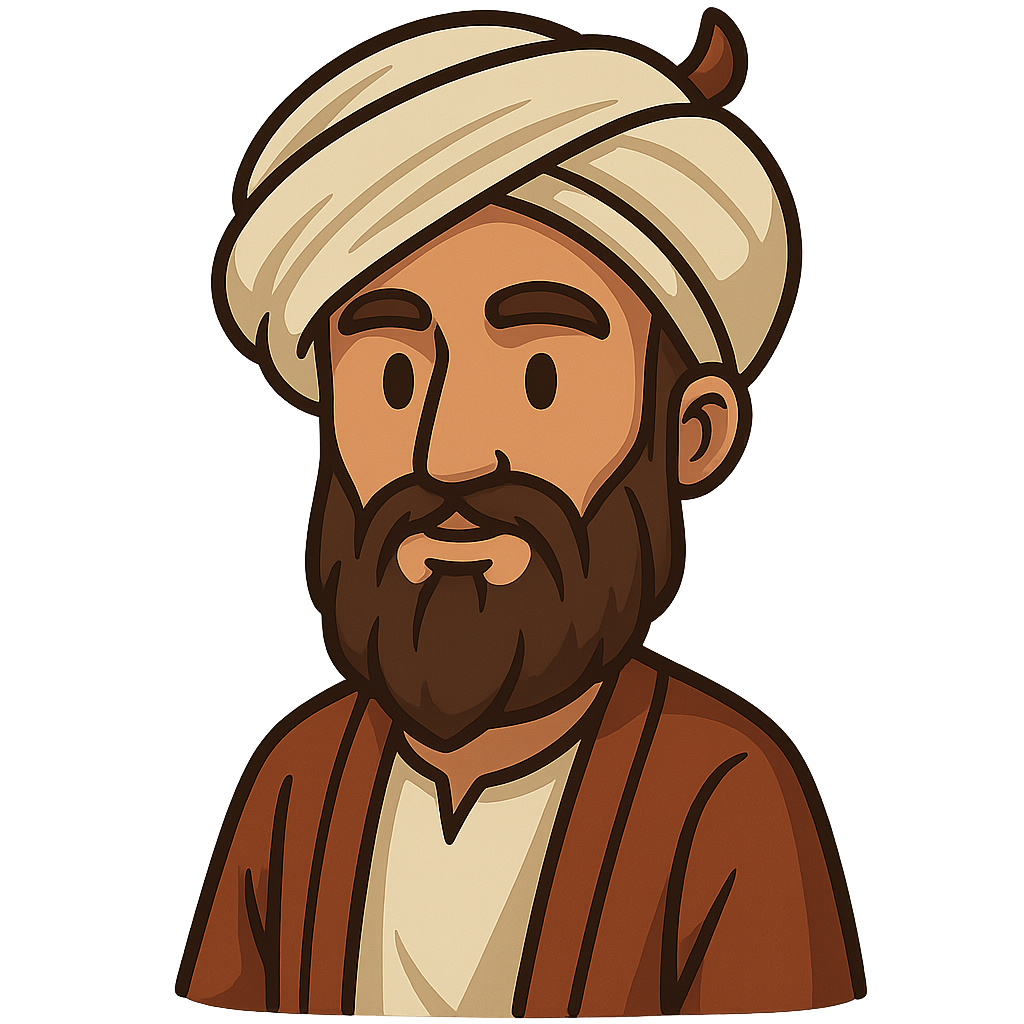
Hello. My name is Muhammad ibn Musa al-Khwarizmi, and I want to share the story of my life's work with numbers. I was born around the year 780 CE in a land called Khwarazm, a bustling and scholarly part of the great Persian Empire. From my earliest days, I was captivated by the world around me. I would stare up at the night sky and wonder about the patterns of the stars, and I saw mathematics hidden in the shapes of buildings and the transactions in the marketplace. My childhood took place during a remarkable period known as the Islamic Golden Age. It was a time of immense intellectual curiosity, where scholars were encouraged to explore, question, and build upon the knowledge of the past. This vibrant atmosphere fueled my passion for learning and set me on a path to uncover the secrets hidden within numbers, a journey that would change the world forever.
As a young man seeking knowledge, I knew I had to travel to the heart of the scholarly world: the magnificent city of Baghdad. In the early 9th century, Baghdad was the capital of the Abbasid Caliphate and the most important center for science and learning on Earth. The city was alive with energy, filled with libraries, observatories, and thinkers from every corner of the known world. My destination was the legendary House of Wisdom, or Bayt al-Hikma. Around the year 820 CE, I was honored to become a scholar there under the patronage of the ruler, Caliph al-Ma'mun, who was a great supporter of science. The House of Wisdom was a scholar’s paradise. I was surrounded by countless books containing the wisdom of civilizations that came before us. My colleagues and I spent our days translating and studying ancient texts from Greece, India, and Persia, gathering all the mathematical and astronomical knowledge we could find. This work allowed me to stand on the shoulders of giants and see how I could contribute something new.
Muhammad al-Khwarizmi: The Father of Algebra
Hello. My name is Muhammad ibn Musa al-Khwarizmi, and I want to share the story of my life's work with numbers. I was born around the year 780 CE in a land called Khwarazm, a bustling and scholarly part of the great Persian Empire. From my earliest days, I was captivated by the world around me. I would stare up at the night sky and wonder about the patterns of the stars, and I saw mathematics hidden in the shapes of buildings and the transactions in the marketplace. My childhood took place during a remarkable period known as the Islamic Golden Age. It was a time of immense intellectual curiosity, where scholars were encouraged to explore, question, and build upon the knowledge of the past. This vibrant atmosphere fueled my passion for learning and set me on a path to uncover the secrets hidden within numbers, a journey that would change the world forever.
As a young man seeking knowledge, I knew I had to travel to the heart of the scholarly world: the magnificent city of Baghdad. In the early 9th century, Baghdad was the capital of the Abbasid Caliphate and the most important center for science and learning on Earth. The city was alive with energy, filled with libraries, observatories, and thinkers from every corner of the known world. My destination was the legendary House of Wisdom, or Bayt al-Hikma. Around the year 820 CE, I was honored to become a scholar there under the patronage of the ruler, Caliph al-Ma'mun, who was a great supporter of science. The House of Wisdom was a scholar’s paradise. I was surrounded by countless books containing the wisdom of civilizations that came before us. My colleagues and I spent our days translating and studying ancient texts from Greece, India, and Persia, gathering all the mathematical and astronomical knowledge we could find. This work allowed me to stand on the shoulders of giants and see how I could contribute something new.
While studying the mathematics of the past, I realized that people needed a better, more reliable way to solve common problems. Think of a farmer dividing land among his children, or merchants calculating profits, or officials figuring out inheritance according to complex rules. They needed a universal method. So, around 820 CE, I wrote a book that I hoped would help. Its title was 'Al-Kitab al-mukhtasar fi hisab al-jabr wa'l-muqabala,' which means 'The Compendious Book on Calculation by Completion and Balancing.' In this book, I laid out a clear, step-by-step system for solving equations. The process involved two main steps. The first was 'al-jabr,' which means 'restoring' or 'completion.' This is the process of removing any negative quantities in an equation by adding the same value to both sides. The second step was 'al-muqabala,' or 'balancing,' which meant reducing the positive terms by subtracting equal amounts from both sides of the equation. By using these two simple operations, anyone could take a complicated problem and simplify it to find the unknown value. This book laid the foundations for a new branch of mathematics, which you now know by a name derived from my book's title: algebra.
My work on algebra was important, but I also wanted to make everyday counting and calculation easier for everyone. In my time, many people were still using clumsy systems like Roman numerals. Imagine trying to multiply CXXIII by XLVII. It was incredibly difficult and slow. I had studied texts from India and learned of a far superior system. Around the year 825 CE, I wrote another book explaining this system, which became known as the Hindu-Arabic numerals. This is the very same system you use today: 0, 1, 2, 3, 4, 5, 6, 7, 8, and 9. The most revolutionary part of this system was the concept of zero. Zero was not just a placeholder; it was a number in its own right, and its inclusion made calculation with place value possible. My book helped introduce these numerals to the Arabic-speaking world, and from there, they eventually spread to Europe and beyond. This contribution made arithmetic accessible and efficient for people in all walks of life, from scientists to shopkeepers.
My fascination with the world also led me to study the Earth and the stars. Under Caliph al-Ma'mun, I worked with a team of scholars on a massive geography project: to create a map of the known world. We studied the work of the great ancient geographer Ptolemy, who had lived centuries before me. While his work was foundational, we found many areas where we could make improvements and corrections, resulting in a more accurate picture of the continents and oceans. I also devoted much of my time to astronomy. I compiled detailed astronomical tables, known as a 'zij.' These tables were complex charts that helped predict the movements of the sun, the moon, and the planets. This work was not just for scientific curiosity; it had immense practical value. It helped people keep accurate time, determine the direction for prayer, and navigate safely across vast deserts and open seas.
I lived a full life dedicated to discovery, and my time on Earth ended around the year 850 CE. Though my life was over, my ideas were just beginning their journey. My books were translated into Latin and other languages, spreading my methods for calculation and problem-solving across Europe and Asia, influencing scholars for centuries to come. I am filled with pride to know that my name, al-Khwarizmi, was gradually changed over time to become the word you use today: 'algorithm,' which means a process or set of rules to be followed in calculations. And of course, the title of my book on equations, 'al-jabr,' gave the world 'algebra.' It is a wonderful feeling to know that the systems I developed so long ago are still helping people solve problems and are even at the heart of the amazing technologies, like computers, that power your world today.
Wow facts
About
A Persian mathematician, astronomer, and geographer during the Islamic Golden Age. He is known as the 'father of algebra' and for his works that helped bring the Hindu-Arabic numeral system to Europe.
Take a Quiz
Question 1 of 5
In my story, I mention the word 'al-jabr.' What does this term, which gave algebra its name, mean?
Explore next





Want to do even more?
Go beyond exploring. Unlock tools that turn every story into real learning.

Storypie Plus for families
Full stories, quizzes, and printables. Nights and car rides, sorted.
- Unlimited audio stories
- Create Mode: your child stars in the story
- Offline downloads
- Printable worksheets & coloring pages

Why Storypie for Schools
Students engaged. Prep in seconds. Evenings back to you.
- Worksheets & Quizzes
- Classroom Management
- Formative Assessment
- Custom Curriculum & Lesson Plans
- 27 Languages

Why Storypie for Homeschool
Curriculum done. They'll ask for more. Hours back in your day.
- Worksheet Generator
- First-Person Audio Stories
- Built-in Comprehension Quizzes
- Custom Curriculum & Lesson Plans
- Print & Go Activities