English


Sor Juana Inés de la Cruz
A 17th-century nun, poet, and scholar in New Spain (modern Mexico)…
Reads at Grades 6–8 Listens at Grades 4–8
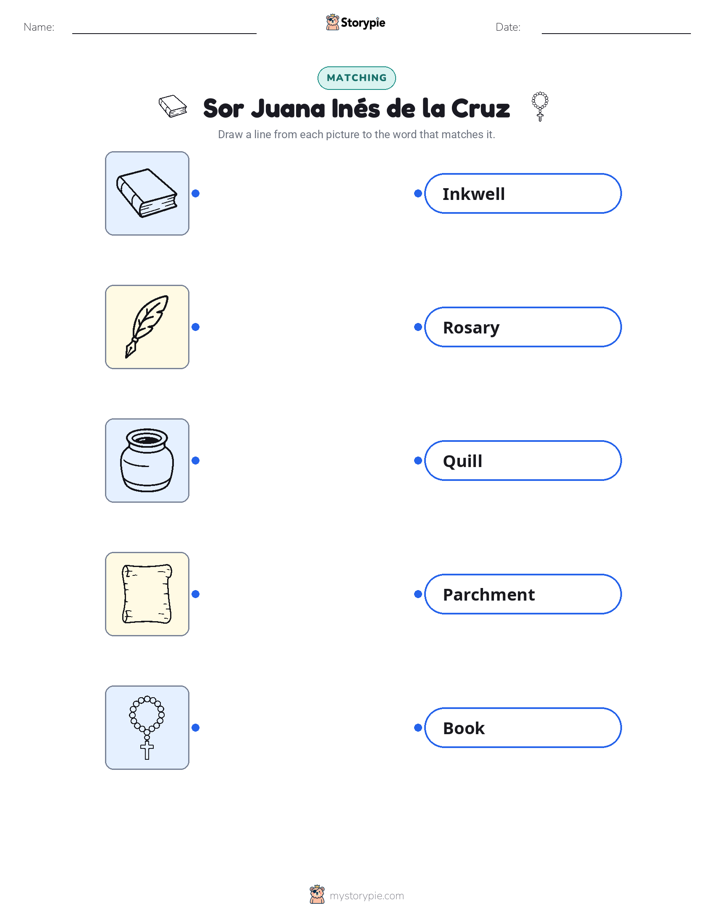
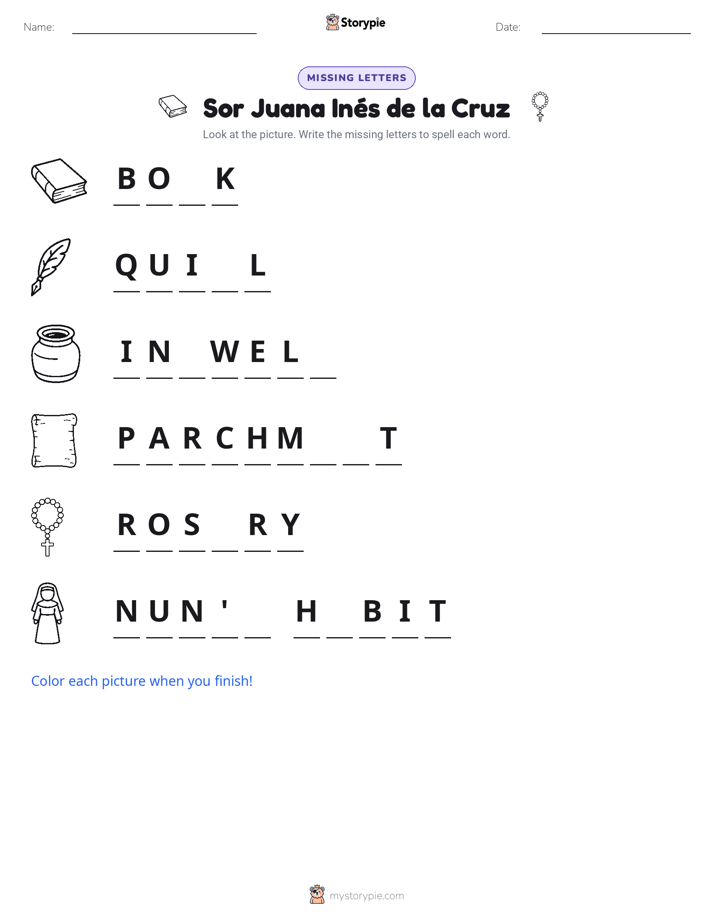
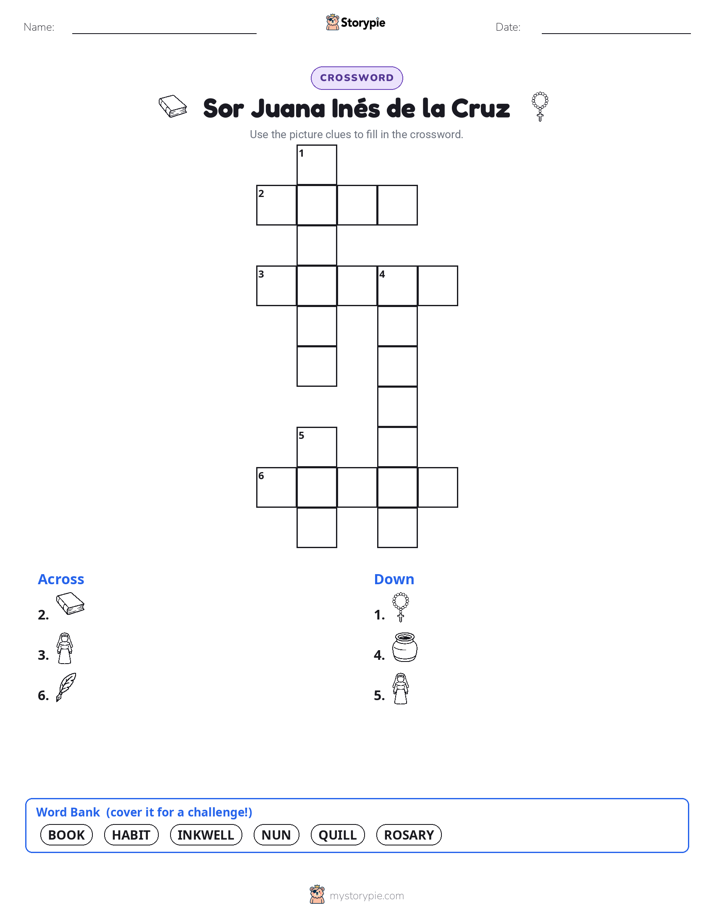
Print & create
Answer keys·No prep·Free with an account
28 worksheets · answer keys · full story · quiz · Ages 10-12 · CEFR B2
Plus adds 164,000+ more stories in 27 languages, audio for every one, and printables for all of them.
Just want Sor Juana Inés de la Cruz?
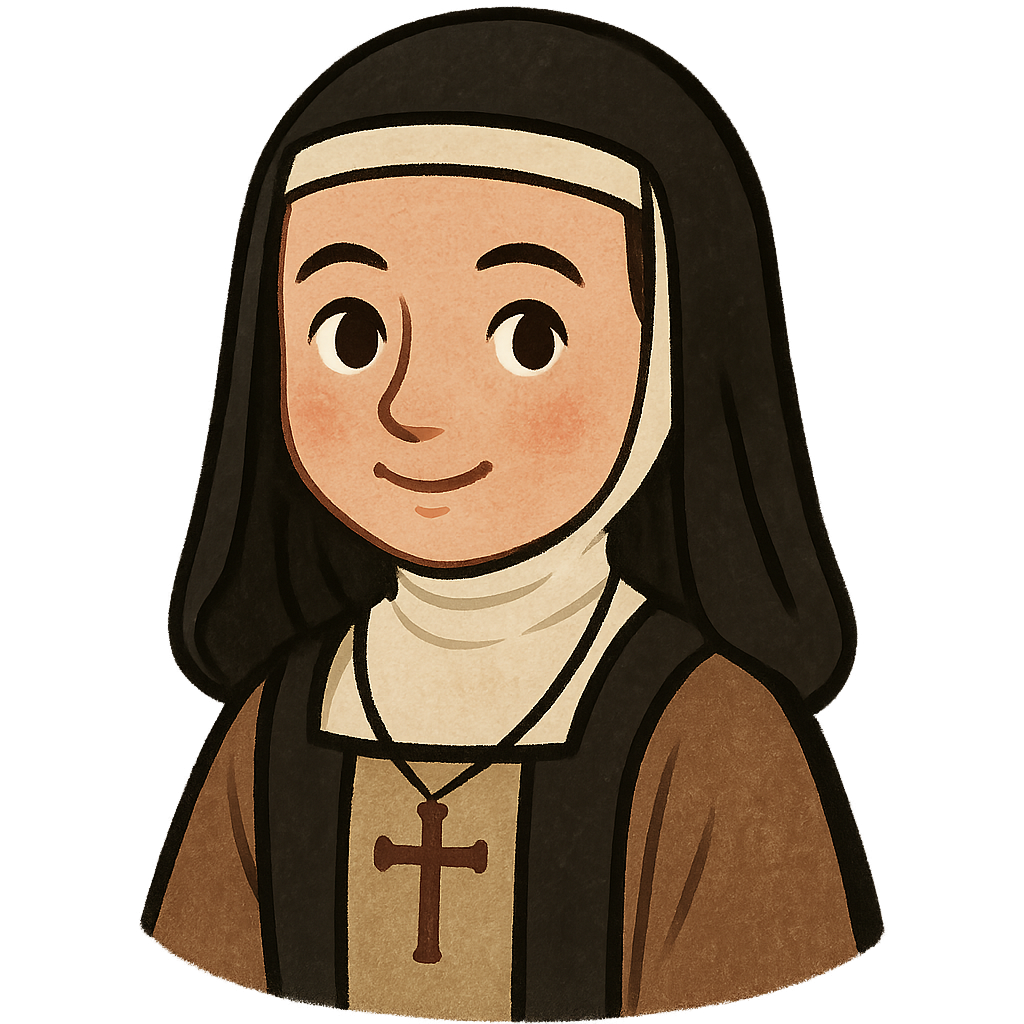
Hello, my name is Juana Inés, and I want to tell you my story. I was born Juana Inés de Asbaje y Ramírez de Santillana on November 12th, 1648, in a small village called San Miguel Nepantla in New Spain, which is now the country of Mexico. From my earliest days, I was not interested in playing with dolls; I was fascinated by books. My grandfather owned a wonderful library, a world of knowledge I longed to enter. I would secretly follow my older sister to her lessons, listening and learning. By the time I was only three years old, I had taught myself to read. My hunger for knowledge was immense. When I heard about the great universities in Mexico City, I begged my mother to let me attend. Since only men were allowed, I even offered to dress as a boy. She refused, but she understood that my mind was a special gift and saw the determination in my eyes.
When I was a teenager, around 1664, I was sent to live with wealthy relatives in Mexico City. It wasn't long before my reputation for being exceptionally intelligent reached the viceroy and his wife, who governed New Spain. They invited me to the palace to serve as a lady-in-waiting to the Vicereine, Leonor Carreto. To see if the rumors about my intellect were true, the viceroy arranged an incredible test for me in 1664. He assembled forty of the most learned men in all of Mexico—professors, philosophers, and poets. For hours, they questioned me on every subject you can imagine, from science and math to history and music. I answered every single question correctly. The scholars were astonished that a young woman could possess so much knowledge. While life at court was glamorous, I knew it wasn't where I could pursue my true passion: a life dedicated to learning.
Sor Juana Inés de la Cruz
Hello, my name is Juana Inés, and I want to tell you my story. I was born Juana Inés de Asbaje y Ramírez de Santillana on November 12th, 1648, in a small village called San Miguel Nepantla in New Spain, which is now the country of Mexico. From my earliest days, I was not interested in playing with dolls; I was fascinated by books. My grandfather owned a wonderful library, a world of knowledge I longed to enter. I would secretly follow my older sister to her lessons, listening and learning. By the time I was only three years old, I had taught myself to read. My hunger for knowledge was immense. When I heard about the great universities in Mexico City, I begged my mother to let me attend. Since only men were allowed, I even offered to dress as a boy. She refused, but she understood that my mind was a special gift and saw the determination in my eyes.
When I was a teenager, around 1664, I was sent to live with wealthy relatives in Mexico City. It wasn't long before my reputation for being exceptionally intelligent reached the viceroy and his wife, who governed New Spain. They invited me to the palace to serve as a lady-in-waiting to the Vicereine, Leonor Carreto. To see if the rumors about my intellect were true, the viceroy arranged an incredible test for me in 1664. He assembled forty of the most learned men in all of Mexico—professors, philosophers, and poets. For hours, they questioned me on every subject you can imagine, from science and math to history and music. I answered every single question correctly. The scholars were astonished that a young woman could possess so much knowledge. While life at court was glamorous, I knew it wasn't where I could pursue my true passion: a life dedicated to learning.
In my time, a woman had only two paths in life: she could marry or she could join a convent. I knew that marriage would mean giving up my studies to manage a household, a sacrifice I was not willing to make. Therefore, I chose the convent, as it was the only place where I could continue my life as a scholar. After a brief time with one order in 1667, I found my permanent home in 1669 when I entered the Hieronymite order at the Convent of Santa Paula. There, I took the name Sor Juana Inés de la Cruz. My room, which was called a cell, was far from small and empty. It was my sanctuary, filled with my greatest treasures: my books. I collected over 4,000 volumes, creating one of the largest private libraries in the Americas. I also had maps, globes, and both scientific and musical instruments. My cell became a well-known gathering place where the brightest minds of Mexico City would meet to discuss poetry, science, and philosophy.
From the quiet of my convent, I dedicated myself to writing. I wrote countless poems about love, faith, and friendship. I wrote plays that were performed for audiences throughout the city, and I even composed musical pieces. My work became celebrated not only in New Spain but also across the ocean in Spain. People began to call me 'The Tenth Muse,' a name that compared me to the nine goddesses of the arts from ancient Greek mythology. It was an extraordinary honor that placed my work among the greatest creative minds. In much of my writing, I explored a theme that was deeply important to me: the right of women to be educated. I firmly believed that a mind was a gift from God, and that it was meant to be cultivated and used, whether it belonged to a man or a woman. I argued that denying women access to knowledge was a profound mistake.
Not everyone agreed with my beliefs or my scholarly pursuits. Many powerful men in the Church felt that a woman, especially a nun, should not occupy her time with 'worldly' subjects like science or poetry. Around 1690, a bishop published one of my private theological critiques without my permission. He also wrote a public letter to me, using the fake name of a fellow nun, 'Sor Filotea,' instructing me to abandon my studies and focus only on prayer. This was a direct challenge to my life's work, and I knew I could not remain silent. In 1691, I wrote my most famous work, the 'Respuesta a Sor Filotea de la Cruz,' which means 'Reply to Sister Filotea.' In this brilliant and passionate letter, I defended my right, and the right of all women, to learn, to study, and to think for themselves. I used examples from history, mythology, and the Bible to prove that intelligent women were, and always had been, part of God's plan.
My 'Respuesta' was a brave defense of my beliefs, but it came at a high price. The pressure from Church leaders became overwhelming. Around 1694, I was forced to give up the things I loved most in the world. I sold my magnificent library of 4,000 books and my precious scientific instruments, and the money was given to help the poor. In a final act of submission, I signed documents renewing my religious vows in my own blood. I spent my last years dedicating myself entirely to caring for my sisters in the convent. In 1695, a terrible plague swept through Mexico City. I fell ill while nursing others who were sick. I lived to be 46 years old. Though my life came to an end, my words did not. My writings, including the 'Respuesta,' were saved by my supporters and are still read around the world today. I am remembered as one of Mexico's greatest literary figures and an early, powerful voice for the idea that everyone deserves the right to knowledge.
Wow facts
About
A 17th-century nun, poet, and scholar in New Spain (modern Mexico), celebrated as a major literary figure of the Spanish Golden Age and an early advocate for women's education.
Take a Quiz
Question 1 of 5
What is the central theme of Sor Juana's life story?
Explore next




Want to do even more?
Go beyond exploring. Unlock tools that turn every story into real learning.

Storypie Plus for families
Full stories, quizzes, and printables. Nights and car rides, sorted.
- Unlimited audio stories
- Create Mode: your child stars in the story
- Offline downloads
- Printable worksheets & coloring pages

Why Storypie for Schools
Students engaged. Prep in seconds. Evenings back to you.
- Worksheets & Quizzes
- Classroom Management
- Formative Assessment
- Custom Curriculum & Lesson Plans
- 27 Languages

Why Storypie for Homeschool
Curriculum done. They'll ask for more. Hours back in your day.
- Worksheet Generator
- First-Person Audio Stories
- Built-in Comprehension Quizzes
- Custom Curriculum & Lesson Plans
- Print & Go Activities