English

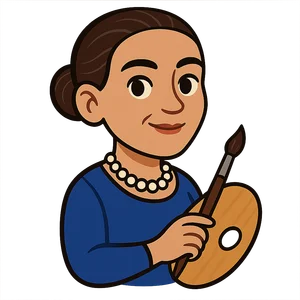
Tarsila do Amaral
Tarsila do Amaral was a leading Brazilian modernist artist whose vibrant paintings and involvement in the…
Reads at Grades 6–8 Listens at Grades 4–8
Print & create
Answer keys·No prep·Free with an account
28 worksheets · answer keys · full story · quiz · Ages 10-12 · CEFR B2
Plus adds 164,000+ more stories in 27 languages, audio for every one, and printables for all of them.
Just want Tarsila do Amaral?

Hello. My name is Tarsila do Amaral, and I want to tell you the story of how I painted my country, Brazil. I was born on September 1st, 1886, on a big coffee farm in São Paulo. My childhood was filled with the brightest colors you can imagine—the deep green of the jungle, the rich red of the earth, and the brilliant blue sky. I loved listening to the stories the farm workers told and singing folk songs. My family was wealthy, so they sent me to study in the city of São Paulo and later, in 1904, all the way to Barcelona, Spain. Even though I was far from home, the memories of Brazil's colors and landscapes stayed with me, like a painting in my mind.
Even after I returned to Brazil, I knew my journey as an artist was just beginning. In 1920, I sailed across the ocean to Paris, France, which was the center of the art world. I wanted to learn from the best, so I studied at a famous school called the Académie Julian. In Paris, I saw art that was completely new to me, with bold shapes and surprising colors. This was called Modernism. I learned from amazing artists, including one named Fernand Léger, who taught me about a style called Cubism. But the more I learned about European art, the more I thought about my own home. I asked myself, 'What does Brazilian art look like?'. I decided I wanted to use these modern ideas to paint the story of my own country.
When I returned to São Paulo in 1922, the city was buzzing with excitement. A big event was happening called the 'Semana de Arte Moderna,' or the Week of Modern Art. It was a festival for artists who wanted to break old rules and create something new and truly Brazilian. There, I met a group of brilliant friends who shared my dream: the writers Oswald de Andrade and Mário de Andrade, the poet Menotti Del Picchia, and the painter Anita Malfatti. We became known as the 'Grupo dos Cinco,' or the Group of Five. Together, we wanted to show the world the real Brazil—not a copy of Europe, but a country with its own unique voice, stories, and colors.
Tarsila do Amaral: Painting Brazil
Hello. My name is Tarsila do Amaral, and I want to tell you the story of how I painted my country, Brazil. I was born on September 1st, 1886, on a big coffee farm in São Paulo. My childhood was filled with the brightest colors you can imagine—the deep green of the jungle, the rich red of the earth, and the brilliant blue sky. I loved listening to the stories the farm workers told and singing folk songs. My family was wealthy, so they sent me to study in the city of São Paulo and later, in 1904, all the way to Barcelona, Spain. Even though I was far from home, the memories of Brazil's colors and landscapes stayed with me, like a painting in my mind.
Even after I returned to Brazil, I knew my journey as an artist was just beginning. In 1920, I sailed across the ocean to Paris, France, which was the center of the art world. I wanted to learn from the best, so I studied at a famous school called the Académie Julian. In Paris, I saw art that was completely new to me, with bold shapes and surprising colors. This was called Modernism. I learned from amazing artists, including one named Fernand Léger, who taught me about a style called Cubism. But the more I learned about European art, the more I thought about my own home. I asked myself, 'What does Brazilian art look like?'. I decided I wanted to use these modern ideas to paint the story of my own country.
When I returned to São Paulo in 1922, the city was buzzing with excitement. A big event was happening called the 'Semana de Arte Moderna,' or the Week of Modern Art. It was a festival for artists who wanted to break old rules and create something new and truly Brazilian. There, I met a group of brilliant friends who shared my dream: the writers Oswald de Andrade and Mário de Andrade, the poet Menotti Del Picchia, and the painter Anita Malfatti. We became known as the 'Grupo dos Cinco,' or the Group of Five. Together, we wanted to show the world the real Brazil—not a copy of Europe, but a country with its own unique voice, stories, and colors.
To find my inspiration, I traveled through the countryside of Brazil in 1924 with my friends. I saw the cactuses in the desert, the palm trees, the small towns with their colorful houses, and the friendly people. I called this my 'Pau-Brasil' or 'Brazilwood' phase, named after the tree that gave my country its name. I started using what I called 'caipira' colors—the bright pinks, yellows, and blues that reminded me of the countryside decorations and clothing. My shapes became simple and bold. One of my important paintings from this time, in 1923, was 'A Negra' (The Black Woman). It showed a powerful figure who represented the Afro-Brazilian people who were such an important part of my country's history and culture. I was painting the soul of Brazil.
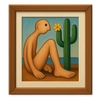
In 1928, I painted a special birthday present for my husband, Oswald. It was a very strange and wonderful painting of a person with a giant foot, a long body, and a tiny head, sitting next to a cactus under the sun. I called it 'Abaporu,' which means 'Man Who Eats' in the Tupi-Guarani language. Oswald was so amazed by it that it gave him a brilliant idea. He wrote the 'Manifesto Antropófago,' or the Cannibalist Manifesto. It sounds scary, but it was not about eating people. It was about 'eating' culture. The idea was that Brazilian artists should take in all the ideas from Europe, digest them, and then combine them with our own native culture to create something completely new and powerful. 'Abaporu' became the symbol of this movement, our most famous painting.
My art continued to change as I did. In the early 1930s, I traveled to the Soviet Union and became more interested in the lives of everyday working people. This led to a new phase in my art. In 1933, I painted 'Operários' (Workers), which shows the faces of many different workers crowded together. It was my way of showing the diverse people who were building the cities and industries of Brazil. My art was not just about landscapes anymore; it was also about the people and their struggles and strengths.
I continued to paint for my entire life, and my art was shown all over the world, including at a very important exhibition in Venice, Italy, in 1964. I lived to be 86 years old, passing away on January 17th, 1973. Today, people remember me as one of the most important artists in Brazil's history. My paintings helped my country see its own beauty and find its own artistic voice. I hope that when you see my art, with its fantastic creatures and vibrant colors, you feel the incredible spirit and magic of Brazil.
Wow facts
About
Tarsila do Amaral was a leading Brazilian modernist artist whose vibrant paintings and involvement in the Anthropophagy movement helped define a new artistic identity for Brazil in the 20th century.
Take a Quiz
Question 1 of 5
What problem was Tarsila trying to solve after studying art in Paris?
Explore next





Want to do even more?
Go beyond exploring. Unlock tools that turn every story into real learning.

Storypie Plus for families
Full stories, quizzes, and printables. Nights and car rides, sorted.
- Unlimited audio stories
- Create Mode: your child stars in the story
- Offline downloads
- Printable worksheets & coloring pages

Why Storypie for Schools
Students engaged. Prep in seconds. Evenings back to you.
- Worksheets & Quizzes
- Classroom Management
- Formative Assessment
- Custom Curriculum & Lesson Plans
- 27 Languages

Why Storypie for Homeschool
Curriculum done. They'll ask for more. Hours back in your day.
- Worksheet Generator
- First-Person Audio Stories
- Built-in Comprehension Quizzes
- Custom Curriculum & Lesson Plans
- Print & Go Activities