English

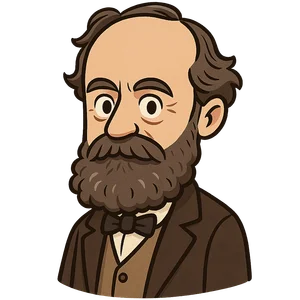
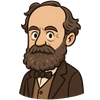
William James
William James was a pioneering American philosopher and psychologist…
Reads at Grades 6–8 Listens at Grades 4–8
Print & create
Answer keys·No prep·Free with an account
28 worksheets · answer keys · full story · quiz · Ages 10-12 · CEFR B2
Plus adds 244,000+ more stories in 27 languages, audio for every one, and printables for all of them.
Just want William James?
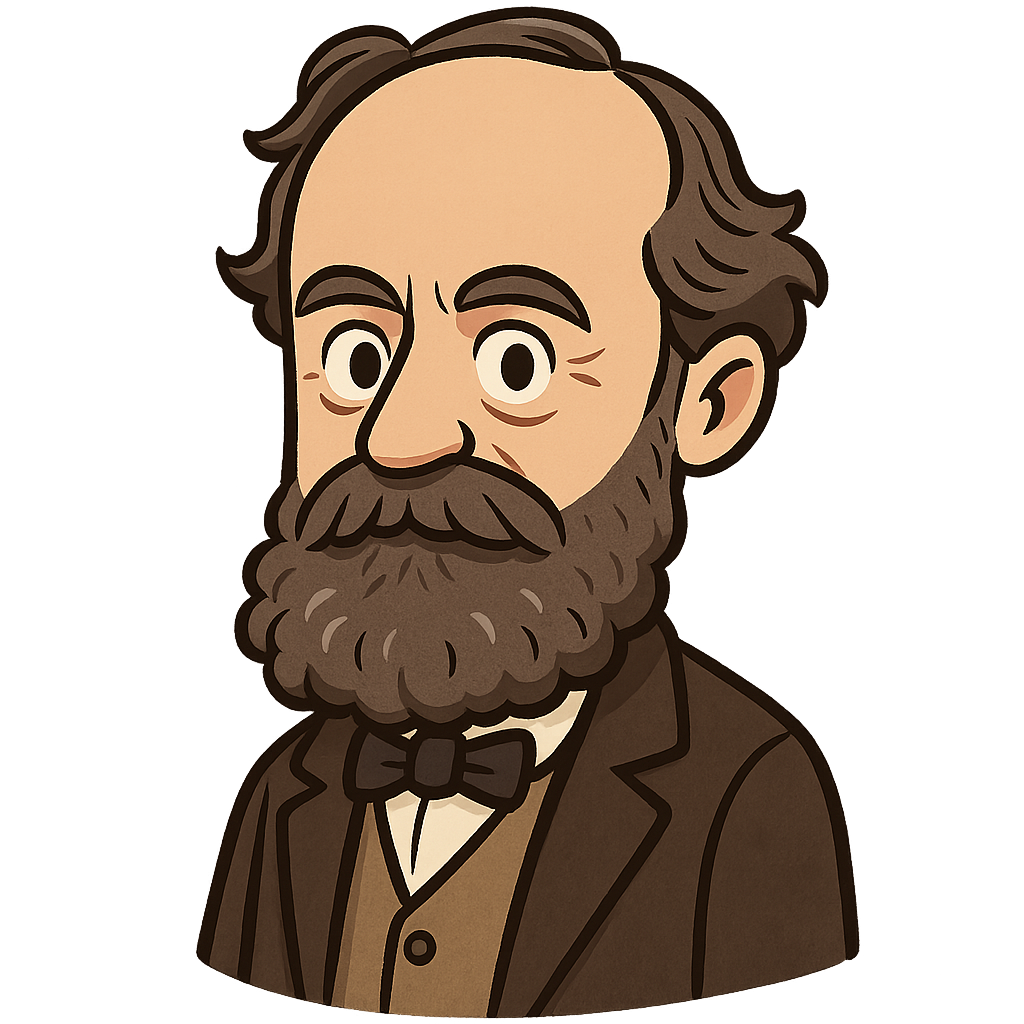
Hello, my name is William James, and I'd like to share my story with you. I was born on January 11th, 1842, in a bustling New York City. My family was quite unique; my father, Henry James Sr., was a deep thinker who encouraged my siblings and me to ask big questions and explore the world. My younger brother, Henry, would grow up to be a famous novelist. Our childhood was an adventure, as we often traveled between America and Europe. This allowed me to learn new languages and see that there were many different ways to live and think. This constant exposure to new cultures and ideas sparked a lifelong curiosity in me about what makes people tick. For a while, I was certain I would become an artist, as I loved to draw and paint, but my mind was also pulled toward science and the mysteries of the human body. I felt a constant tension between these different passions, wondering which one would ultimately define my life's work.
Choosing a career was not easy for me. I felt pulled in so many different directions. In 1861, I decided to pursue my artistic side and enrolled in art school, but I soon realized it wasn't the right fit. I switched to science at Harvard University, hoping to find more concrete answers to my questions. Still not quite satisfied, I entered Harvard Medical School in 1864, thinking that being a doctor might be the right path. As part of my studies, I joined a scientific expedition to the Amazon rainforest in 1865, but I quickly discovered that collecting specimens in the hot, humid jungle was not for me. During my twenties, I went through a difficult period of doubt and illness, which made me question everything about life and my purpose. I read many books on philosophy, searching for answers that could help me understand my own mind. I finally earned my medical degree in 1869, but I had already decided I wouldn't practice medicine. I was far more interested in the engine behind it all: the human mind.
William James: Exploring the Mind
Hello, my name is William James, and I'd like to share my story with you. I was born on January 11th, 1842, in a bustling New York City. My family was quite unique; my father, Henry James Sr., was a deep thinker who encouraged my siblings and me to ask big questions and explore the world. My younger brother, Henry, would grow up to be a famous novelist. Our childhood was an adventure, as we often traveled between America and Europe. This allowed me to learn new languages and see that there were many different ways to live and think. This constant exposure to new cultures and ideas sparked a lifelong curiosity in me about what makes people tick. For a while, I was certain I would become an artist, as I loved to draw and paint, but my mind was also pulled toward science and the mysteries of the human body. I felt a constant tension between these different passions, wondering which one would ultimately define my life's work.
Choosing a career was not easy for me. I felt pulled in so many different directions. In 1861, I decided to pursue my artistic side and enrolled in art school, but I soon realized it wasn't the right fit. I switched to science at Harvard University, hoping to find more concrete answers to my questions. Still not quite satisfied, I entered Harvard Medical School in 1864, thinking that being a doctor might be the right path. As part of my studies, I joined a scientific expedition to the Amazon rainforest in 1865, but I quickly discovered that collecting specimens in the hot, humid jungle was not for me. During my twenties, I went through a difficult period of doubt and illness, which made me question everything about life and my purpose. I read many books on philosophy, searching for answers that could help me understand my own mind. I finally earned my medical degree in 1869, but I had already decided I wouldn't practice medicine. I was far more interested in the engine behind it all: the human mind.
My true calling began when I started teaching at Harvard in 1872. I began by teaching subjects related to the body, like anatomy, but my heart was in understanding the mind. Psychology was a brand-new field, and I was thrilled to be one of its pioneers. In 1875, I established one of the first psychology laboratories in America, not for complex experiments, but to demonstrate to students how the mind works. For twelve long years, I poured all my ideas into a book called 'The Principles of Psychology', which was finally published in 1890. It was a massive work that changed how people thought about the mind. In it, I introduced an idea that your thoughts are not separate little blocks but flow together like a river—I called this the 'stream of consciousness.' I also explored how our feelings are connected to our bodies, suggesting that we feel afraid because our body is already reacting to danger, like running from a bear, not the other way around. This way of looking at psychology, focusing on how our minds help us adapt and function in the world, became known as functionalism.
As I grew older, my interest shifted more toward philosophy, the study of life's biggest questions. I wanted to find ideas that weren't just interesting to talk about but were actually useful in everyday life. Working with my friend, Charles Sanders Peirce, I helped develop a philosophy we called pragmatism. The core idea is simple: the value of an idea comes from its practical effect on your life. Is it useful? Does it work? Does it lead to a good outcome? If so, then it's a worthwhile belief. I wrote about this in my 1907 book, 'Pragmatism: A New Name for Some Old Ways of Thinking'. I believed that our beliefs have the power to shape our reality and that we should choose the ones that help us live more meaningful and energetic lives. It was a philosophy for action, not just for quiet contemplation.
I spent the rest of my life teaching, writing, and exploring the vast world of the human mind and spirit. I lived to be 68 years old. Today, many people call me the 'Father of American psychology' because I helped establish it as a respected science in the United States. My ideas, like the 'stream of consciousness' and pragmatism, are still studied by students, scientists, and thinkers all over the world. I hope my story inspires you to stay curious, to ask your own questions, and to understand that your thoughts and beliefs have the power to shape your world.
Wow facts
About
William James was a pioneering American philosopher and psychologist, often called the 'Father of American psychology.' He was a leading thinker in the philosophical school of pragmatism and the psychological school of functionalism.
Take a Quiz
Question 1 of 5
What is the main idea of the philosophy William James called 'pragmatism'?
Explore next





Want to do even more?
Go beyond exploring. Unlock tools that turn every story into real learning.

Storypie Plus for families
Full stories, quizzes, and printables. Nights and car rides, sorted.
- Unlimited audio stories
- Create Mode: your child stars in the story
- Offline downloads
- Printable worksheets & coloring pages

Why Storypie for Schools
Students engaged. Prep in seconds. Evenings back to you.
- Worksheets & Quizzes
- Classroom Management
- Formative Assessment
- Custom Curriculum & Lesson Plans
- 27 Languages

Why Storypie for Homeschool
Curriculum done. They'll ask for more. Hours back in your day.
- Worksheet Generator
- First-Person Audio Stories
- Built-in Comprehension Quizzes
- Custom Curriculum & Lesson Plans
- Print & Go Activities