English

Animal Instincts and Learned Behaviors
This concept distinguishes between innate…
Reads at Grades 6–8 Listens at Grades 4–8
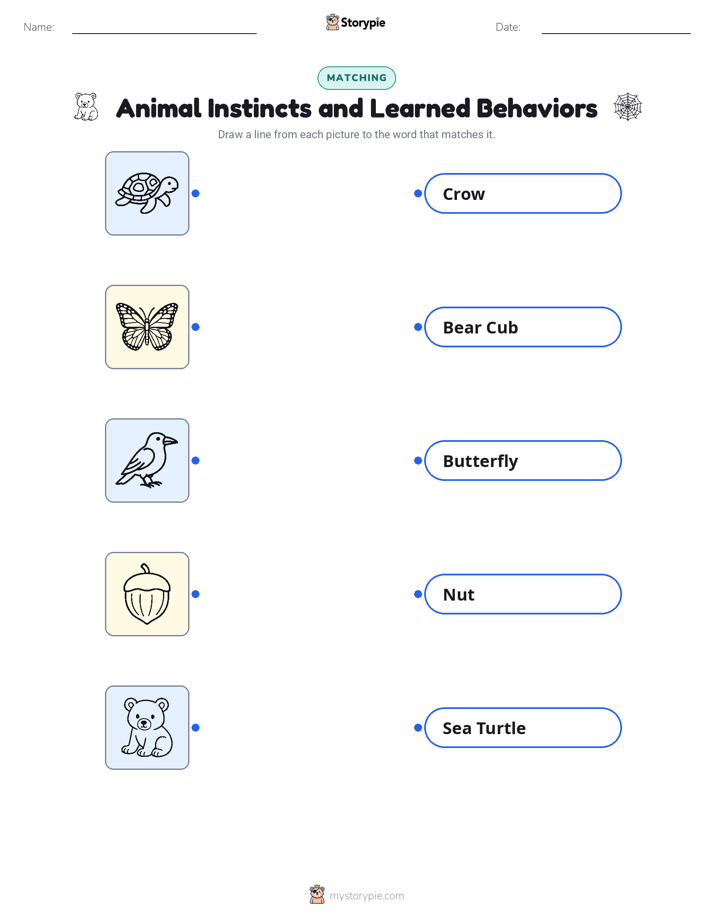
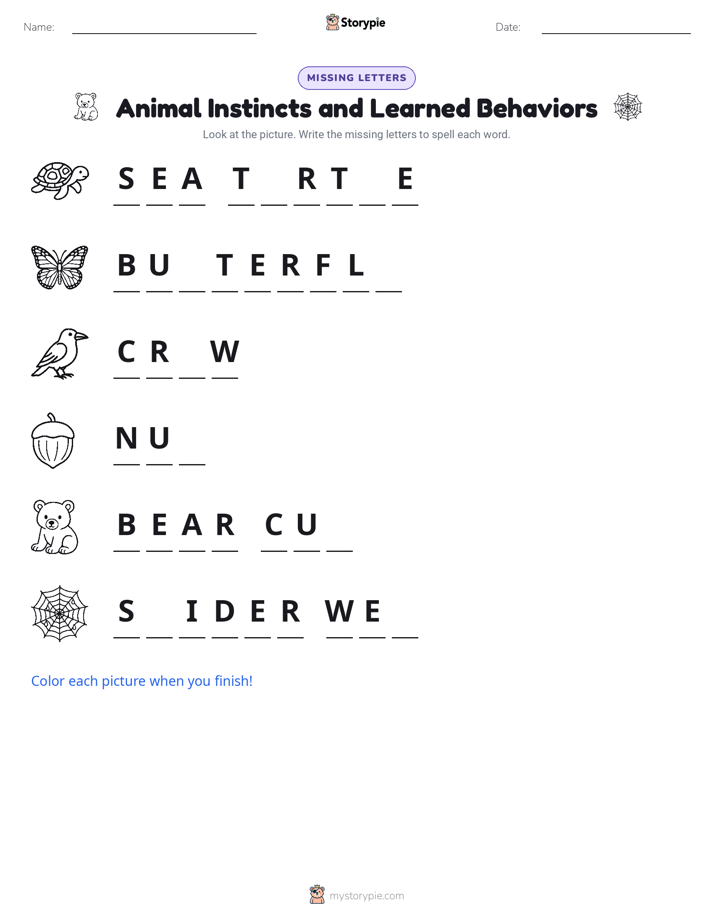
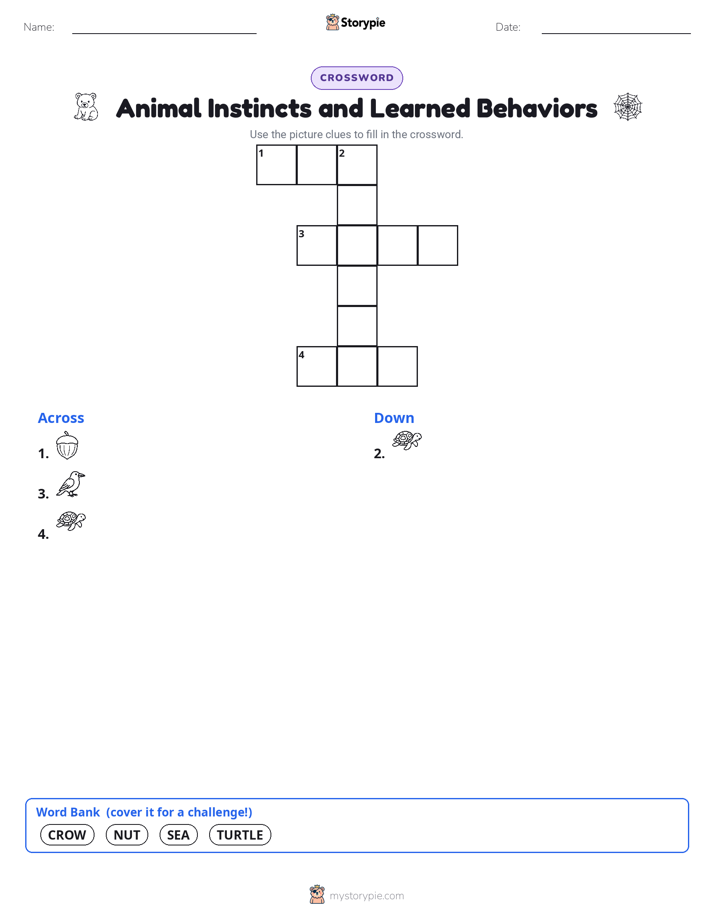
Print & create
Answer keys·No prep·Free with an account
28 worksheets · answer keys · full story · quiz · Ages 10-12 · CEFR B2
Plus adds 244,000+ more stories in 27 languages, audio for every one, and printables for all of them.
Just want Animal Instincts and Learned Behaviors?
I am two things at once. I am the reason a sea turtle, just hatched, scrambles desperately toward the ocean without a single lesson. I am the silent, ancient map inside a monarch butterfly that guides it thousands of miles to a forest it has never seen. But I am also the reason a clever crow learns to drop a nut on the road for a car to crack open, a trick it figured out by watching and thinking. I am the knowledge passed down from a mother bear to her cubs on how to find the best berries. Before you knew my name, you saw me everywhere—in the perfect web of a spider, in the loyal bark of your dog when the doorbell rings, and in the way a dolphin learns to leap through a hoop for a fishy reward. I am the unwritten rulebook every animal is born with, and I am also the diary they fill with their own experiences. I am the blueprint they start with, and the masterpiece they become. I am the invisible force that shapes the lives of every creature, from the smallest insect to the largest whale, guiding their actions from the moment they are born until their very last day.
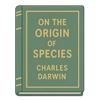
For thousands of years, humans watched me work without truly understanding how. They saw the instinct that drove wolves to hunt in packs and the learning that allowed them to tame a wild puppy into a loyal friend. But it was a man with a big beard and an even bigger idea who began to explain one half of my story. His name was Charles Darwin. In his famous book from 1859, *On the Origin of Species*, he explained that my instinctual side was not magic. It was the result of millions of years of tiny changes, a process he called natural selection. Animals with the most helpful built-in behaviors—like being instinctively scared of predators—were more likely to survive and have babies who inherited those same helpful instincts. Later, on April 17th, 1872, he published another book, *The Expression of the Emotions in Man and Animals*. In it, he showed how many of our automatic reactions, like smiling when we're happy or baring our teeth when we're angry, were instincts shared across different species, a legacy from our shared ancestors. He helped people see me not as a mysterious force, but as a powerful tool for survival, carefully shaped by time.
The Unseen Guide
I am two things at once. I am the reason a sea turtle, just hatched, scrambles desperately toward the ocean without a single lesson. I am the silent, ancient map inside a monarch butterfly that guides it thousands of miles to a forest it has never seen. But I am also the reason a clever crow learns to drop a nut on the road for a car to crack open, a trick it figured out by watching and thinking. I am the knowledge passed down from a mother bear to her cubs on how to find the best berries. Before you knew my name, you saw me everywhere—in the perfect web of a spider, in the loyal bark of your dog when the doorbell rings, and in the way a dolphin learns to leap through a hoop for a fishy reward. I am the unwritten rulebook every animal is born with, and I am also the diary they fill with their own experiences. I am the blueprint they start with, and the masterpiece they become. I am the invisible force that shapes the lives of every creature, from the smallest insect to the largest whale, guiding their actions from the moment they are born until their very last day.
For thousands of years, humans watched me work without truly understanding how. They saw the instinct that drove wolves to hunt in packs and the learning that allowed them to tame a wild puppy into a loyal friend. But it was a man with a big beard and an even bigger idea who began to explain one half of my story. His name was Charles Darwin. In his famous book from 1859, On the Origin of Species, he explained that my instinctual side was not magic. It was the result of millions of years of tiny changes, a process he called natural selection. Animals with the most helpful built-in behaviors—like being instinctively scared of predators—were more likely to survive and have babies who inherited those same helpful instincts. Later, on April 17th, 1872, he published another book, The Expression of the Emotions in Man and Animals. In it, he showed how many of our automatic reactions, like smiling when we're happy or baring our teeth when we're angry, were instincts shared across different species, a legacy from our shared ancestors. He helped people see me not as a mysterious force, but as a powerful tool for survival, carefully shaped by time.
In the 20th century, scientists really started to study both of my sides. A group of scientists called ethologists wanted to see me in action in the wild, not just in a lab. One of them, an Austrian named Konrad Lorenz, did something amazing in the 1930s. He became the first moving thing that a group of newly hatched greylag geese saw. Because of a powerful instinct called imprinting, the goslings immediately decided he was their mother and followed him everywhere. He showed that their instinct was to 'imprint' on their mother, but they had to learn who she was in the first few hours of life. Meanwhile, other scientists were studying my 'learned' side. In the 1890s, a Russian scientist named Ivan Pavlov discovered that he could teach dogs to associate a sound with food. He would ring a bell just before feeding them, and soon, the dogs would drool at the sound of the bell alone. He called this 'classical conditioning.' Later, an American psychologist named B.F. Skinner showed how animals could learn complex tasks through rewards, a method he called 'operant conditioning.' For a while, scientists argued about which part of me was more important. But eventually, they realized my two sides are always working together. In 1973, Konrad Lorenz, along with Niko Tinbergen and Karl von Frisch, won the Nobel Prize for their incredible work in finally organizing the study of animal behavior, proving that both my instinctual and learned sides are essential to understanding the animal world.
So, who am I? I am Animal Instincts and Learned Behaviors, the partnership that allows every creature to navigate its world. Understanding me is more important than ever. It helps conservationists create safe environments for endangered animals by respecting their natural instincts, like building wildlife corridors so they can migrate safely. It helps you train your dog using positive reinforcement, a method based on the work of Skinner. It helps you understand why your cat brings you 'gifts,' a remnant of its hunting instincts. I am in the perfect V-shape of migrating geese, the playful pounce of a kitten practicing its hunting skills, and the clever way an octopus learns to open a jar to get a treat. I show that every living thing is a mix of its deep evolutionary history and its own unique life story. I am a constant reminder that the world is full of amazing puzzles and that there is always something new and wonderful to discover about the creatures around us, and even about ourselves.
Wow facts
About
This concept distinguishes between innate, genetically hardwired behaviors (instincts) and behaviors acquired through experience, observation, or teaching (learned behaviors). It is a fundamental principle in biology and psychology for understanding how organisms adapt and survive.
Take a Quiz
Question 1 of 5
What is the main idea of this story?
Explore next





Want to do even more?
Go beyond exploring. Unlock tools that turn every story into real learning.

Storypie Plus for families
Full stories, quizzes, and printables. Nights and car rides, sorted.
- Unlimited audio stories
- Create Mode: your child stars in the story
- Offline downloads
- Printable worksheets & coloring pages

Why Storypie for Schools
Students engaged. Prep in seconds. Evenings back to you.
- Worksheets & Quizzes
- Classroom Management
- Formative Assessment
- Custom Curriculum & Lesson Plans
- 27 Languages

Why Storypie for Homeschool
Curriculum done. They'll ask for more. Hours back in your day.
- Worksheet Generator
- First-Person Audio Stories
- Built-in Comprehension Quizzes
- Custom Curriculum & Lesson Plans
- Print & Go Activities