English

Animal Migration
Animal migration is the seasonal…
Reads at Grades 6–8 Listens at Grades 4–8
Print & create
Answer keys·No prep·Free with an account
28 worksheets · answer keys · full story · quiz · Ages 10-12 · CEFR B2
Plus adds 244,000+ more stories in 27 languages, audio for every one, and printables for all of them.
Just want Animal Migration?
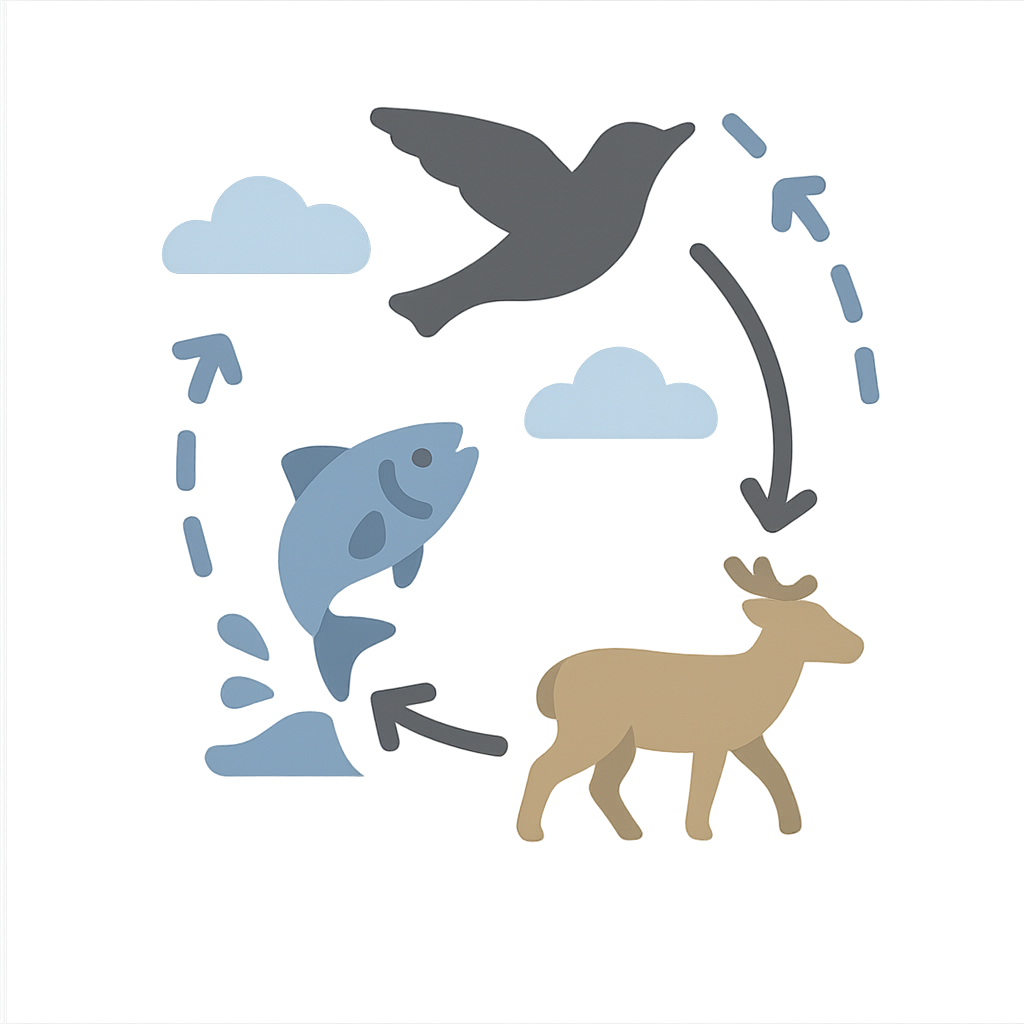
Have you ever felt a pull so deep you couldn’t ignore it? A hum beneath your feet, a whisper in the wind that says, 'It is time to go.' I am that feeling. Before your kind had names for me, I was an ancient, invisible rhythm felt in the bones of birds, the hearts of whales, and the delicate wings of butterflies. I am the reason a goose looks to the sky as the days grow shorter, the reason a sea turtle paddles relentlessly toward a shore it has never seen. I am the change in the light, the crispness in the air, the scent of a distant spring that promises safety and abundance. For millennia, I was a secret compass, a hidden map passed down through generations of creatures. Humans saw only the results of my work: the skies that emptied each autumn, leaving a profound silence, and the rivers that suddenly teemed with fish each spring. You watched the world empty and fill, and you wondered. I was the great mystery, the engine of a planet that is always, always in motion.
For thousands of years, humans watched my travelers come and go, and you searched for answers. Ancient cultures wove my patterns into their calendars and their myths, celebrating the return of the swallows as a sign of spring or marking their year by the arrival of the great herds. You were observers, full of wonder and guesswork. One of the first to try and solve my puzzle with logic was a Greek philosopher named Aristotle, around the 4th century BCE. He watched the birds of Greece with a keen eye. He correctly reasoned that some birds, like cranes, traveled enormous distances to escape the cold. But he couldn't see the whole picture. Without a way to follow them, he had to make educated guesses for the others. He proposed that swallows spent the winter hibernating in the mud at the bottom of rivers. He even suggested that some birds didn't leave at all, but transformed into entirely different species to survive the winter. His ideas were a fascinating combination of careful observation and imaginative leaps, the very beginning of the quest to understand my ways. They were trying to solve the puzzle that is me. I am Animal Migration.
The Secret Compass
Have you ever felt a pull so deep you couldn’t ignore it? A hum beneath your feet, a whisper in the wind that says, 'It is time to go.' I am that feeling. Before your kind had names for me, I was an ancient, invisible rhythm felt in the bones of birds, the hearts of whales, and the delicate wings of butterflies. I am the reason a goose looks to the sky as the days grow shorter, the reason a sea turtle paddles relentlessly toward a shore it has never seen. I am the change in the light, the crispness in the air, the scent of a distant spring that promises safety and abundance. For millennia, I was a secret compass, a hidden map passed down through generations of creatures. Humans saw only the results of my work: the skies that emptied each autumn, leaving a profound silence, and the rivers that suddenly teemed with fish each spring. You watched the world empty and fill, and you wondered. I was the great mystery, the engine of a planet that is always, always in motion.
For thousands of years, humans watched my travelers come and go, and you searched for answers. Ancient cultures wove my patterns into their calendars and their myths, celebrating the return of the swallows as a sign of spring or marking their year by the arrival of the great herds. You were observers, full of wonder and guesswork. One of the first to try and solve my puzzle with logic was a Greek philosopher named Aristotle, around the 4th century BCE. He watched the birds of Greece with a keen eye. He correctly reasoned that some birds, like cranes, traveled enormous distances to escape the cold. But he couldn't see the whole picture. Without a way to follow them, he had to make educated guesses for the others. He proposed that swallows spent the winter hibernating in the mud at the bottom of rivers. He even suggested that some birds didn't leave at all, but transformed into entirely different species to survive the winter. His ideas were a fascinating combination of careful observation and imaginative leaps, the very beginning of the quest to understand my ways. They were trying to solve the puzzle that is me. I am Animal Migration.
As centuries passed, the theories about my methods grew even more creative. The mystery deepened because no one could prove where my travelers went. In 1694, an English writer named Charles Morton, struggling to explain the disappearance of birds, published a pamphlet suggesting they flew to the moon for the winter. It sounds silly now, but it shows how desperate people were for an explanation. The real breakthrough, the moment when guesswork began to transform into fact, came much later. It happened on June 5th, 1899. A Danish teacher named Hans Christian Cornelius Mortensen had a brilliantly simple idea. He began capturing storks and placing lightweight aluminum rings, each with a unique number and his address, on their legs. This process, which you now call bird banding, was revolutionary. It was like giving each bird a passport. For the first time, when one of his ringed storks was found hundreds of miles away in another country, there was undeniable proof. My secret journeys were no longer just a theory. The rings told a story of incredible flights across continents and oceans, turning centuries of speculation into real, trackable science.
Today, you understand my work in ways Aristotle could only dream of. You know that I guide Monarch butterflies on a multi-generational journey from Canada all the way to Mexico. You know I lead humpback whales from the frigid feeding grounds of the polar seas to the warm, tropical waters where they give birth. You see my power in the thundering herds of wildebeest crossing the Serengeti, following the rains in a constant search for fresh grass. Bird banding is still used, but now you have even more amazing tools. Tiny satellite trackers, light enough for an eagle to carry, beam information to computers, drawing my secret highways on your maps in real-time. You can follow a single Arctic Tern on its staggering journey from the North Pole to the South Pole and back again. I am a vital heartbeat for the planet, connecting ecosystems and shuffling life around the globe to keep it healthy. My journeys are a powerful reminder that every creature, no matter how small, is part of a much larger story, and that we all share one interconnected world. My paths show that amazing feats are possible, and that there are still so many wonderful mysteries about our world left for you to discover.
Wow facts
About
Animal migration is the seasonal, large-scale movement of animals from one habitat to another in search of food, better conditions, or breeding grounds.
Take a Quiz
Question 1 of 5
What was the main problem humans faced for centuries when trying to understand animal migration?
Explore next




Want to do even more?
Go beyond exploring. Unlock tools that turn every story into real learning.

Storypie Plus for families
Full stories, quizzes, and printables. Nights and car rides, sorted.
- Unlimited audio stories
- Create Mode: your child stars in the story
- Offline downloads
- Printable worksheets & coloring pages

Why Storypie for Schools
Students engaged. Prep in seconds. Evenings back to you.
- Worksheets & Quizzes
- Classroom Management
- Formative Assessment
- Custom Curriculum & Lesson Plans
- 27 Languages

Why Storypie for Homeschool
Curriculum done. They'll ask for more. Hours back in your day.
- Worksheet Generator
- First-Person Audio Stories
- Built-in Comprehension Quizzes
- Custom Curriculum & Lesson Plans
- Print & Go Activities