English

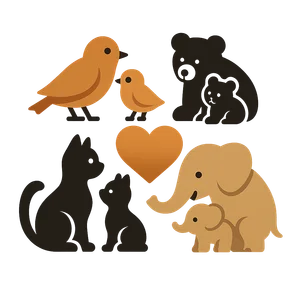
Baby Animals and Their Parents
The biological and behavioral relationship between animal parents and their offspring…
Reads at Grades 6–8 Listens at Grades 4–8
Print & create
Answer keys·No prep·Free with an account
28 worksheets · answer keys · full story · quiz · Ages 10-12 · CEFR B2
Plus adds 244,000+ more stories in 27 languages, audio for every one, and printables for all of them.
Just want Baby Animals and Their Parents?
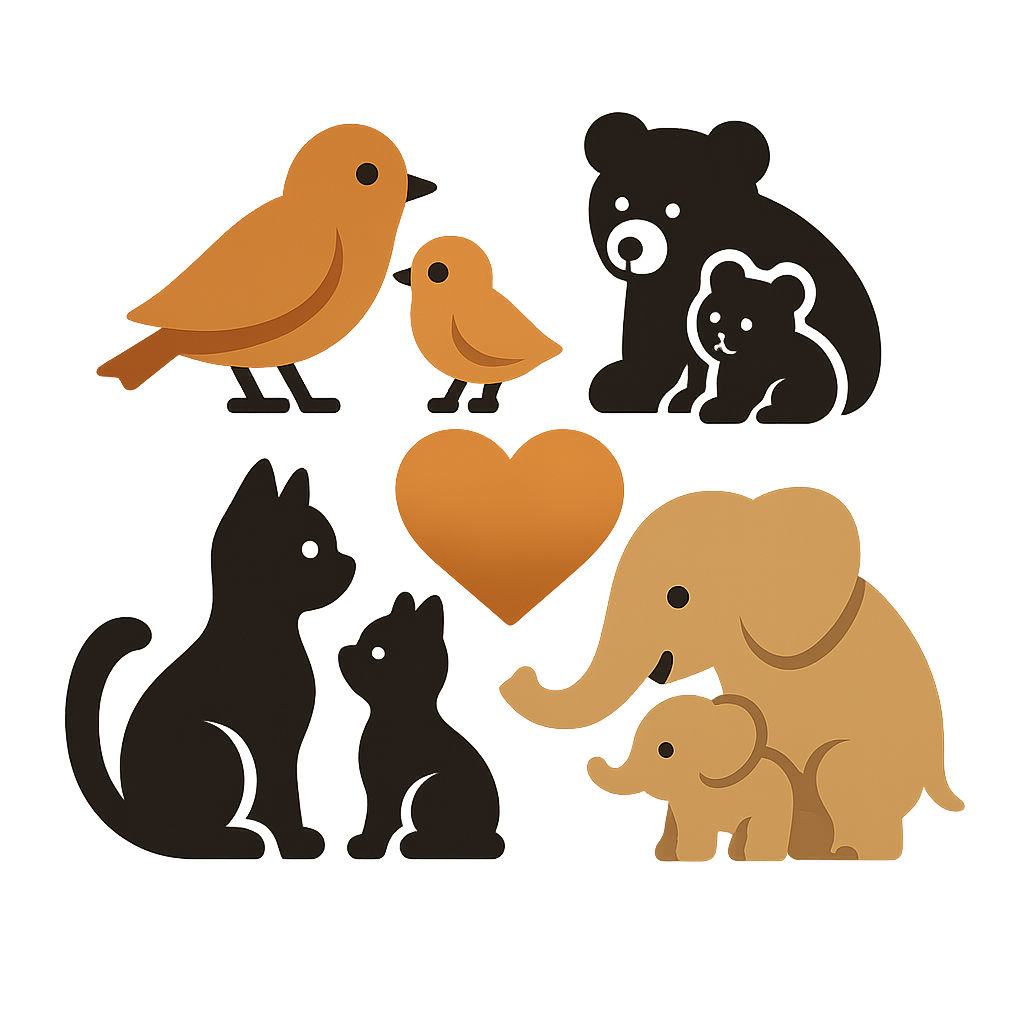
Imagine the vast, cold ocean. A mother blue whale nudges her enormous calf toward the surface for its first breath. Picture the Antarctic winds howling as an emperor penguin father balances a precious egg on his feet, keeping it warm for two months without eating. Think of a mother bear in a dense forest, patiently teaching her cubs which berries are safe to eat and how to fish for salmon in a rushing river. I was there for all of it, an ancient and powerful force, an invisible promise that a life just beginning will be protected. I am the shield against the storm, the first teacher, the tireless provider. For millennia, I have been the silent, beating heart of survival, connecting one generation to the next. I am the bond between baby animals and their parents. You can call me Parental Care.
For most of human history, people saw me but did not truly understand me. Early humans watched animals closely, their survival depending on it. They saw a lioness ferociously defend her cubs and a mother bird tirelessly bring worms to her chirping chicks. These observations were practical lessons in survival and the ways of the world. Much later, curious minds began to document what they saw. In the 4th century BCE, a Greek philosopher named Aristotle, one of the first great naturalists, sat by rivers and seas, taking notes. He wrote about the sheatfish, a type of catfish, describing how the male guards the eggs fiercely after the female lays them, chasing away any intruders. For centuries, this was the way people understood me. I was seen as a collection of fascinating but simple, automatic actions. People knew what animals did for their young, but the deeper question of 'why' remained a mystery, a puzzle waiting for the right key.
The Invisible Promise
Imagine the vast, cold ocean. A mother blue whale nudges her enormous calf toward the surface for its first breath. Picture the Antarctic winds howling as an emperor penguin father balances a precious egg on his feet, keeping it warm for two months without eating. Think of a mother bear in a dense forest, patiently teaching her cubs which berries are safe to eat and how to fish for salmon in a rushing river. I was there for all of it, an ancient and powerful force, an invisible promise that a life just beginning will be protected. I am the shield against the storm, the first teacher, the tireless provider. For millennia, I have been the silent, beating heart of survival, connecting one generation to the next. I am the bond between baby animals and their parents. You can call me Parental Care.
For most of human history, people saw me but did not truly understand me. Early humans watched animals closely, their survival depending on it. They saw a lioness ferociously defend her cubs and a mother bird tirelessly bring worms to her chirping chicks. These observations were practical lessons in survival and the ways of the world. Much later, curious minds began to document what they saw. In the 4th century BCE, a Greek philosopher named Aristotle, one of the first great naturalists, sat by rivers and seas, taking notes. He wrote about the sheatfish, a type of catfish, describing how the male guards the eggs fiercely after the female lays them, chasing away any intruders. For centuries, this was the way people understood me. I was seen as a collection of fascinating but simple, automatic actions. People knew what animals did for their young, but the deeper question of 'why' remained a mystery, a puzzle waiting for the right key.
That key began to turn in the 19th century. A brilliant English naturalist named Charles Darwin changed everything. In his groundbreaking book, 'On the Origin of Species,' published on November 24th, 1859, he presented a powerful new idea. He argued that I wasn't just a series of nice behaviors; I was a crucial advantage in the struggle for existence. Parents who took better care of their offspring were more likely to see them survive, grow up, and have families of their own. I was a tool of evolution. This idea sparked a new scientific field called ethology, the study of animal behavior. One of its pioneers was an Austrian scientist named Konrad Lorenz. In the 1930s, he conducted a famous experiment. He was present when a clutch of greylag geese hatched, and the goslings saw him before they saw their own mother. They immediately began to follow him everywhere, a behavior he called 'imprinting.' This showed that some of my behaviors are instinctual and happen during a critical window of time. His work helped untangle the difference between instinct, like a spider knowing how to spin a perfect web without being taught, and learned behavior, like a cheetah mother teaching her cubs the complex art of stalking prey. For their incredible discoveries about how I work, Konrad Lorenz, along with Niko Tinbergen and Karl von Frisch, was awarded the Nobel Prize in Physiology or Medicine on October 11th, 1973.
Today, the secrets that scientists like Darwin and Lorenz unlocked are more important than ever. Understanding me is a vital tool for conservationists fighting to save endangered species. Take the California condor, a magnificent bird that was once on the brink of extinction. When conservationists had to raise chicks in captivity, they faced a serious problem. If the chicks saw humans feeding them, they would imprint on people and would not know how to survive in the wild. The solution was brilliant and born from Lorenz's work. The scientists used large puppets that looked exactly like adult condors to feed the chicks. The young birds imprinted on the puppets, grew up seeing a model of their own species, and were later successfully released into their natural habitat. This is just one of many ways that understanding my nature helps protect the future of life on Earth. I am a universal language of connection, a thread that ties the smallest insect to the largest whale, and a reminder to you, too, of the profound importance of caring for the next generation and protecting the beautiful, fragile planet we all share.
Wow facts
About
The biological and behavioral relationship between animal parents and their offspring, encompassing instinctual care, protection, and learned behaviors essential for survival.
Take a Quiz
Question 1 of 5
Which statement best summarizes the main idea of the story?
Explore next



Want to do even more?
Go beyond exploring. Unlock tools that turn every story into real learning.

Storypie Plus for families
Full stories, quizzes, and printables. Nights and car rides, sorted.
- Unlimited audio stories
- Create Mode: your child stars in the story
- Offline downloads
- Printable worksheets & coloring pages

Why Storypie for Schools
Students engaged. Prep in seconds. Evenings back to you.
- Worksheets & Quizzes
- Classroom Management
- Formative Assessment
- Custom Curriculum & Lesson Plans
- 27 Languages

Why Storypie for Homeschool
Curriculum done. They'll ask for more. Hours back in your day.
- Worksheet Generator
- First-Person Audio Stories
- Built-in Comprehension Quizzes
- Custom Curriculum & Lesson Plans
- Print & Go Activities