English

Bacteria
Bacteria are single-celled microorganisms that were among the first life forms on Earth.
Reads at Grades 6–8 Listens at Grades 4–8
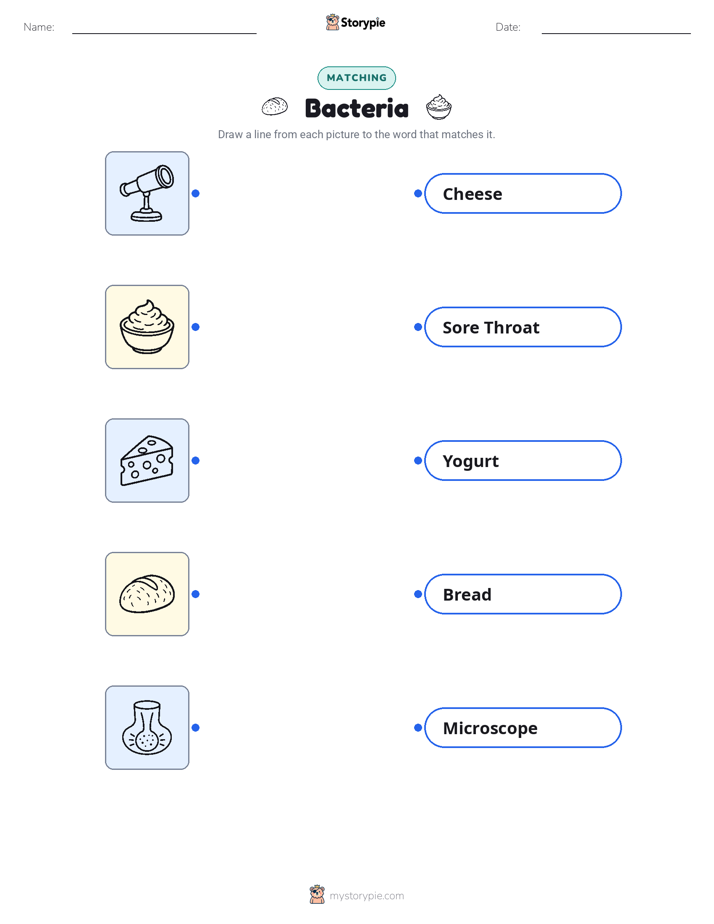
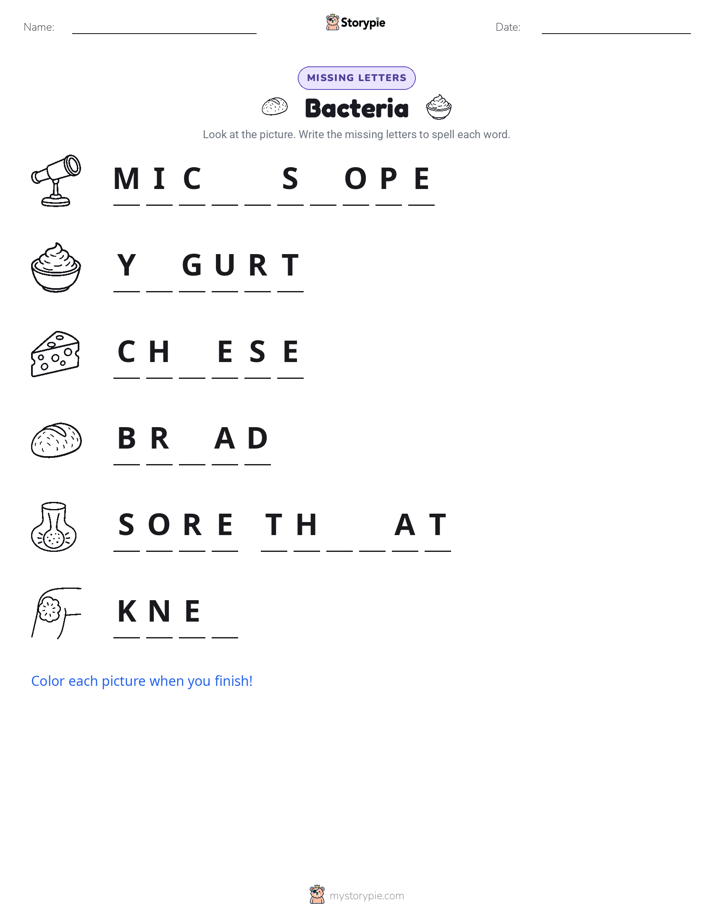
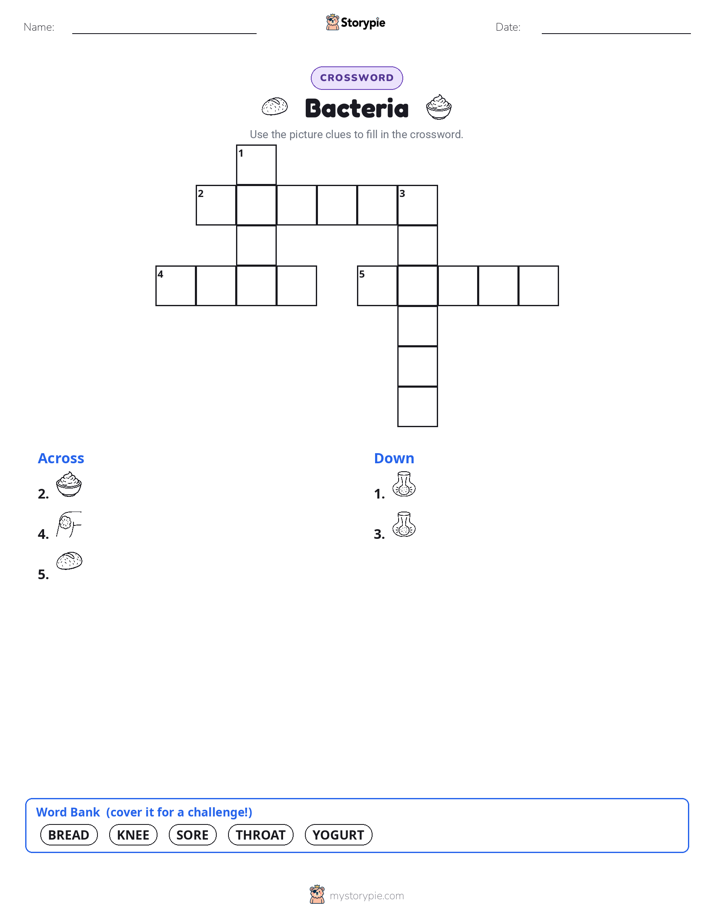
Print & create
Answer keys·No prep·Free with an account
28 worksheets · answer keys · full story · quiz · Ages 10-12 · CEFR B2
Plus adds 164,000+ more stories in 27 languages, audio for every one, and printables for all of them.
Just want Bacteria?
Imagine you have a roommate. This roommate is everywhere—in the rich soil that grows your food, swimming in the yogurt you eat for breakfast, and even living inside your tummy, working hard to help you digest your lunch. There are more of me living in and on your body than there are human cells. For thousands of years, you lived with me but never knew I existed. I could be a helpful friend, making cheese tangy or causing sourdough bread to rise and become fluffy. But I could also be a fearsome troublemaker, causing a sore throat that made it hard to swallow or making a small scraped knee get red, hot, and puffy. Humans would get sick with mysterious illnesses, and food would spoil without any visible cause. People blamed bad air, curses, or imbalances in the body. They never suspected the truth was a world teeming with life too small to see. You couldn't see me, but I was there, an invisible force shaping your world in countless ways. You lived with me, battled me, and benefited from my work without ever knowing my name. Hello. I am Bacteria.
Everything changed in the Dutch city of Delft during the 1670s, all because of a man named Antonie van Leeuwenhoek. He was not a trained scientist but a draper, a seller of cloth. His true passion, however, was grinding tiny glass lenses, crafting them with such skill that he created microscopes more powerful than any others in the world. He was driven by an immense curiosity to see the hidden details in everything, from the eye of a fly to the sting of a bee. On October 24th, 1676, he placed a drop of cloudy water from a nearby lake under his lens. What he saw was so astonishing he thought he was dreaming. An entire, bustling world of tiny creatures zipped and tumbled through the water. He called them 'animalcules,' his word for 'little animals.' That was me. For the first time, a human being had laid eyes on my kind. He wrote letters about his discoveries to the Royal Society in London, but for a long time, people saw me as just a curiosity, a wonder of nature with no real importance. It wasn't until nearly two centuries later, in the 1860s, that a brilliant French chemist named Louis Pasteur made the connection that would change everything. He was asked to figure out why wine and beer were spoiling. Through careful experiments, he proved that some of my family members were the culprits. He invented a process—heating the liquid to kill most of us—which you still call 'pasteurization' today. But his greatest contribution was the 'germ theory of disease,' the revolutionary idea that many illnesses were caused by these invisible organisms. His discovery was a turning point, convincing doctors that they needed to do simple things like wash their hands and sterilize their instruments to stop spreading me from one patient to another.
Your Tiny, Powerful Partner: The Story of Bacteria
Imagine you have a roommate. This roommate is everywhere—in the rich soil that grows your food, swimming in the yogurt you eat for breakfast, and even living inside your tummy, working hard to help you digest your lunch. There are more of me living in and on your body than there are human cells. For thousands of years, you lived with me but never knew I existed. I could be a helpful friend, making cheese tangy or causing sourdough bread to rise and become fluffy. But I could also be a fearsome troublemaker, causing a sore throat that made it hard to swallow or making a small scraped knee get red, hot, and puffy. Humans would get sick with mysterious illnesses, and food would spoil without any visible cause. People blamed bad air, curses, or imbalances in the body. They never suspected the truth was a world teeming with life too small to see. You couldn't see me, but I was there, an invisible force shaping your world in countless ways. You lived with me, battled me, and benefited from my work without ever knowing my name. Hello. I am Bacteria.
Everything changed in the Dutch city of Delft during the 1670s, all because of a man named Antonie van Leeuwenhoek. He was not a trained scientist but a draper, a seller of cloth. His true passion, however, was grinding tiny glass lenses, crafting them with such skill that he created microscopes more powerful than any others in the world. He was driven by an immense curiosity to see the hidden details in everything, from the eye of a fly to the sting of a bee. On October 24th, 1676, he placed a drop of cloudy water from a nearby lake under his lens. What he saw was so astonishing he thought he was dreaming. An entire, bustling world of tiny creatures zipped and tumbled through the water. He called them 'animalcules,' his word for 'little animals.' That was me. For the first time, a human being had laid eyes on my kind. He wrote letters about his discoveries to the Royal Society in London, but for a long time, people saw me as just a curiosity, a wonder of nature with no real importance. It wasn't until nearly two centuries later, in the 1860s, that a brilliant French chemist named Louis Pasteur made the connection that would change everything. He was asked to figure out why wine and beer were spoiling. Through careful experiments, he proved that some of my family members were the culprits. He invented a process—heating the liquid to kill most of us—which you still call 'pasteurization' today. But his greatest contribution was the 'germ theory of disease,' the revolutionary idea that many illnesses were caused by these invisible organisms. His discovery was a turning point, convincing doctors that they needed to do simple things like wash their hands and sterilize their instruments to stop spreading me from one patient to another.
Once the world understood that some of my cousins were microscopic invaders, the race was on to find ways to fight them. For decades, the only defenses were harsh chemicals and improved hygiene. The greatest breakthrough, however, arrived completely by accident in London in September of 1928. A Scottish scientist named Alexander Fleming returned to his laboratory after a two-week holiday and found a mess. He had left out several dishes where he was growing some of my staphylococcus relatives. One dish had become contaminated with a fuzzy green mold. As he was about to throw it away, he noticed something incredible. All around the patch of mold was a perfectly clear circle, a zone where every single bacterium had been completely wiped out. He realized the mold, a strain of Penicillium, must be producing a substance that was lethal to my kind. He called this substance penicillin. It took more than a decade of work by other scientists, like Howard Florey and Ernst Chain, to figure out how to purify and mass-produce it. Penicillin became the world's first true antibiotic, a super-weapon that could target and destroy harmful bacteria inside the human body. It saved countless lives from infections that were once a death sentence and was crucial in treating wounded soldiers during World War II.
While the fight against my harmful relatives raged on, other scientists were beginning to understand a deeper truth: most of my family members aren't villains at all. In fact, you couldn't live without us. Today, you know that I am absolutely essential to life on Earth. My countless relatives and I are the planet's great recyclers. We live in the soil and water, decomposing dead plants and animals and breaking them down to return vital nutrients so that new life can grow. Trillions of us live inside your gut, forming a complex and vital community you call the microbiome. We are not invaders; we are partners. We help you digest your food, produce essential vitamins like B12 and K, and even train your immune system to tell the difference between friend and foe. You have learned to partner with us to create some of your favorite foods, from tangy pickles and savory cheese to rich chocolate and bubbly kombucha. Scientists are now harnessing my amazing abilities to do incredible things, like using specialized members of my family to clean up toxic oil spills in the ocean or engineering us to produce life-saving medicines. I am a constant reminder that even the smallest things can have the biggest impact. I am ancient, I am everywhere, and I am a vital part of your world. So next time you eat some yogurt or walk barefoot in the grass, remember me, Bacteria, your tiny and powerful partner on this amazing planet.
Wow facts
About
Bacteria are single-celled microorganisms that were among the first life forms on Earth. They are found everywhere and can be both beneficial, aiding in digestion and decomposition, and harmful, causing diseases.
Take a Quiz
Question 1 of 5
What is the main idea of this story?
Explore next




Want to do even more?
Go beyond exploring. Unlock tools that turn every story into real learning.

Storypie Plus for families
Full stories, quizzes, and printables. Nights and car rides, sorted.
- Unlimited audio stories
- Create Mode: your child stars in the story
- Offline downloads
- Printable worksheets & coloring pages

Why Storypie for Schools
Students engaged. Prep in seconds. Evenings back to you.
- Worksheets & Quizzes
- Classroom Management
- Formative Assessment
- Custom Curriculum & Lesson Plans
- 27 Languages

Why Storypie for Homeschool
Curriculum done. They'll ask for more. Hours back in your day.
- Worksheet Generator
- First-Person Audio Stories
- Built-in Comprehension Quizzes
- Custom Curriculum & Lesson Plans
- Print & Go Activities