English

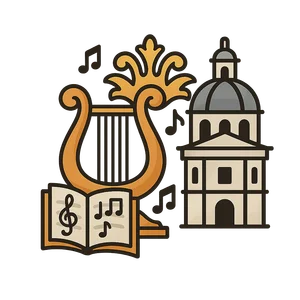
Baroque Period
The Baroque is a period of artistic style that emerged around 1600 in Rome, Italy…
Reads at Grades 6–8 Listens at Grades 4–8
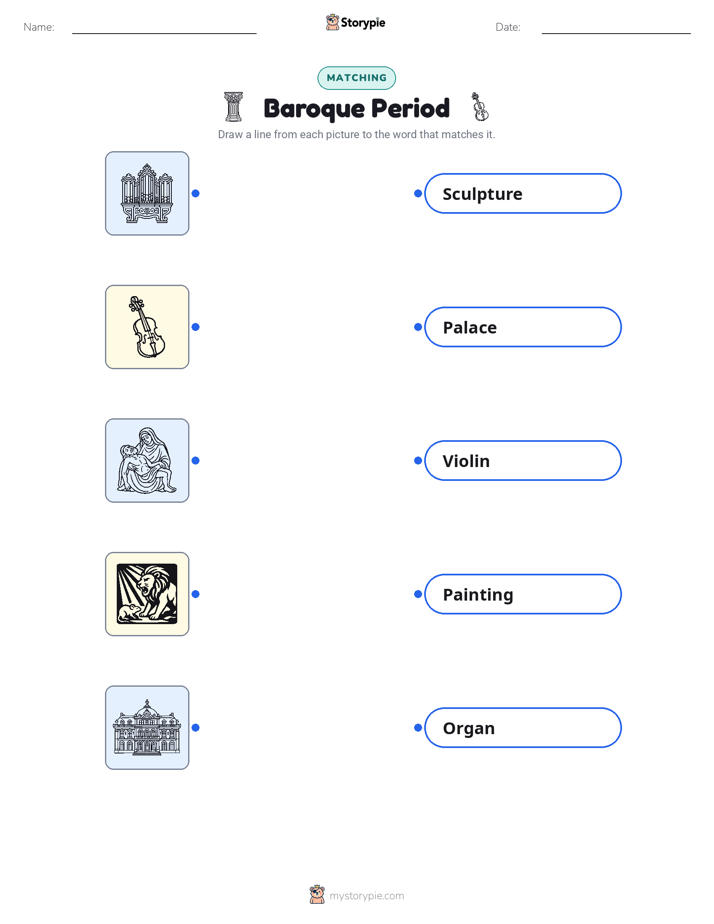
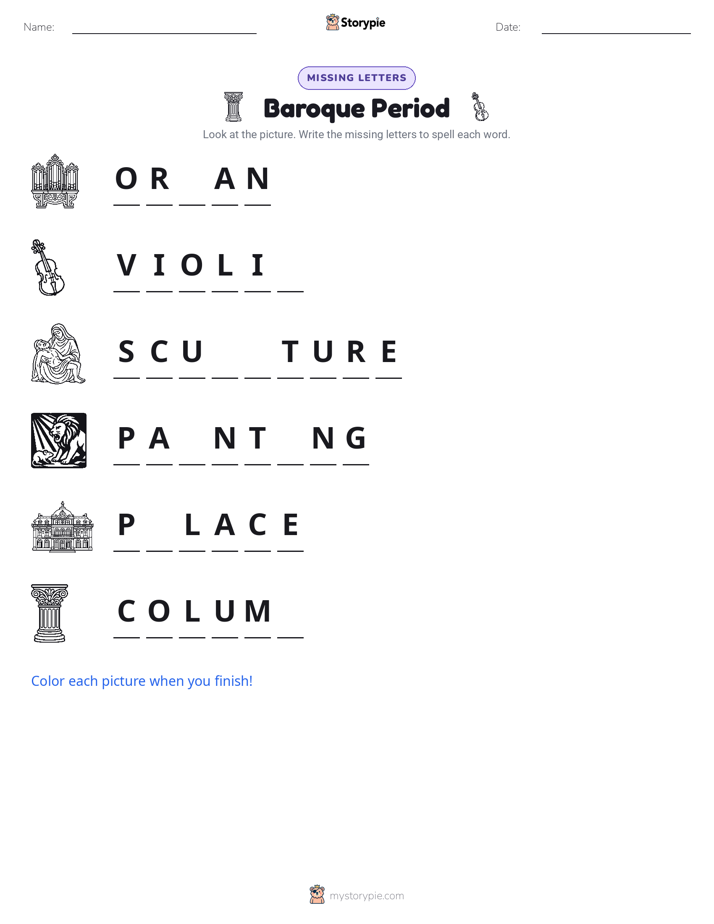
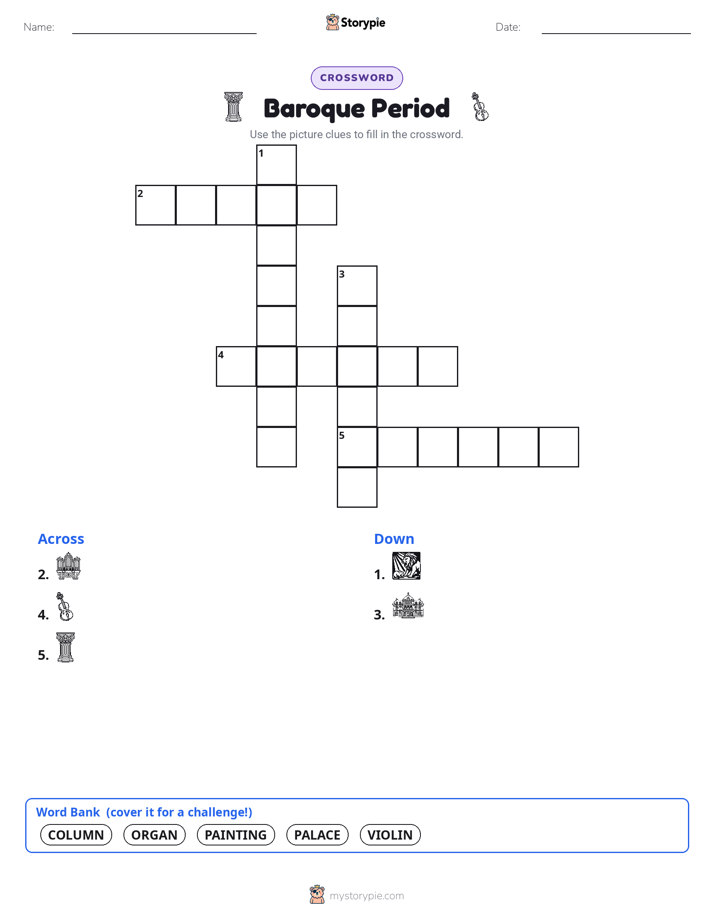
Print & create
Answer keys·No prep·Free with an account
28 worksheets · answer keys · full story · quiz · Ages 10-12 · CEFR B2
Plus adds 244,000+ more stories in 27 languages, audio for every one, and printables for all of them.
Just want Baroque Period?
Have you ever walked into a room so grand it took your breath away? Imagine looking up at a ceiling where golden swirls curl like vines and painted figures seem to fly through clouds. Picture a statue carved from marble that looks so real, you expect it to move at any second. Think of a painting where a single beam of light cuts through deep, velvety shadows, making a dramatic scene feel urgent and alive. Or have you ever heard music from a pipe organ so powerful it vibrates through the floor and fills every inch of a cathedral with sound, telling a story of struggle and triumph without a single word? It’s a feeling of awe, of drama, and of something much larger than yourself. It’s the kind of art that isn't just meant to be seen or heard; it’s meant to be felt deep in your soul, giving you goosebumps and making your heart beat a little faster. That feeling of drama, emotion, and magnificent power? That's me. I am the Baroque Period.
My story begins in Rome, Italy, around the year 1600. It was a time of great change, and the people in power wanted art that could do more than just look pretty. The Catholic Church was going through a period called the Counter-Reformation, a movement to bring people back to the faith with renewed passion. They needed art that was not just beautiful, but also intensely emotional and inspiring. I was their answer. I was born from a desire to touch people's hearts and minds directly. An artist named Michelangelo Merisi da Caravaggio became one of my first and most powerful voices. He used a technique called 'chiaroscuro,' which is a fancy word for using extreme contrasts between light and dark. In his paintings, light wasn't just light; it was a spotlight that revealed a moment of divine importance or deep human struggle, making biblical stories feel as real and immediate as if they were happening in a nearby alley. Then there was the sculptor and architect Gian Lorenzo Bernini. He could make cold, hard marble look as soft as fabric or as alive as human skin. His work on St. Peter's Basilica in Rome was designed to make people feel overwhelmed with spiritual wonder. In his sculpture 'The Ecstasy of Saint Teresa,' completed in 1652, he captured a moment of pure emotion so powerfully that the stone itself seems to tremble. I didn't stay in Italy for long. Kings and queens across Europe saw my power. King Louis XIV of France, the 'Sun King,' adopted me to show his absolute authority. He used my grand, ornate style to build his magnificent Palace of Versailles, with its famous Hall of Mirrors, beginning the massive expansion in 1661. My style became a symbol of power, wealth, and divine right.
I Am the Baroque Period
Have you ever walked into a room so grand it took your breath away? Imagine looking up at a ceiling where golden swirls curl like vines and painted figures seem to fly through clouds. Picture a statue carved from marble that looks so real, you expect it to move at any second. Think of a painting where a single beam of light cuts through deep, velvety shadows, making a dramatic scene feel urgent and alive. Or have you ever heard music from a pipe organ so powerful it vibrates through the floor and fills every inch of a cathedral with sound, telling a story of struggle and triumph without a single word? It’s a feeling of awe, of drama, and of something much larger than yourself. It’s the kind of art that isn't just meant to be seen or heard; it’s meant to be felt deep in your soul, giving you goosebumps and making your heart beat a little faster. That feeling of drama, emotion, and magnificent power? That's me. I am the Baroque Period.
My story begins in Rome, Italy, around the year 1600. It was a time of great change, and the people in power wanted art that could do more than just look pretty. The Catholic Church was going through a period called the Counter-Reformation, a movement to bring people back to the faith with renewed passion. They needed art that was not just beautiful, but also intensely emotional and inspiring. I was their answer. I was born from a desire to touch people's hearts and minds directly. An artist named Michelangelo Merisi da Caravaggio became one of my first and most powerful voices. He used a technique called 'chiaroscuro,' which is a fancy word for using extreme contrasts between light and dark. In his paintings, light wasn't just light; it was a spotlight that revealed a moment of divine importance or deep human struggle, making biblical stories feel as real and immediate as if they were happening in a nearby alley. Then there was the sculptor and architect Gian Lorenzo Bernini. He could make cold, hard marble look as soft as fabric or as alive as human skin. His work on St. Peter's Basilica in Rome was designed to make people feel overwhelmed with spiritual wonder. In his sculpture 'The Ecstasy of Saint Teresa,' completed in 1652, he captured a moment of pure emotion so powerfully that the stone itself seems to tremble. I didn't stay in Italy for long. Kings and queens across Europe saw my power. King Louis XIV of France, the 'Sun King,' adopted me to show his absolute authority. He used my grand, ornate style to build his magnificent Palace of Versailles, with its famous Hall of Mirrors, beginning the massive expansion in 1661. My style became a symbol of power, wealth, and divine right.
But my voice wasn't just visual; it echoed through the concert halls and churches of Europe in the form of music. My music was as complex, dramatic, and full of emotion as my art and architecture. In Italy, a composer named Antonio Vivaldi gave me a vibrant musical voice. His most famous work, 'The Four Seasons,' published in 1725, was revolutionary. He used violins to mimic the chatter of birds in spring, the fury of a summer thunderstorm, and the icy shiver of winter. He was painting pictures with sound. Farther north, in Germany, was a man who became one of my greatest masters: Johann Sebastian Bach. His music was a breathtaking mix of mathematical precision and deep spiritual feeling. He created incredibly complex pieces called fugues, where different musical lines would chase each other in an intricate, beautiful dance. His death in 1750 is often considered my grand finale, the end of my golden age. Another giant was George Frideric Handel. Though born in Germany, he moved to England and became a star. He wrote grand musical pieces called oratorios, like his famous 'Messiah,' which was first performed in Dublin on April 13th, 1742. It was designed to fill huge spaces with glorious sound, sung by choirs and played by orchestras, making listeners feel like they were hearing the heavens open up. These composers, and many others, developed new forms like the opera—a play told entirely through music—and the concerto, which showcased the dazzling skill of a single instrument against the backdrop of a full orchestra.
My main era may have ended around the middle of the 18th century, as people began to prefer simpler, lighter styles. But I never truly disappeared. My echo can still be seen, heard, and felt all over the world. You can see me in the grand, ornate architecture of historic cities, in palaces and cathedrals that still inspire awe. You can hear me whenever an orchestra plays the soaring melodies of Vivaldi or the complex harmonies of Bach. My spirit is even present in ways you might not expect. The dramatic lighting used in movies and theater to create suspense or highlight a key moment? That's a trick learned from Caravaggio and my love of chiaroscuro. My influence lives on in any art that aims to be big, bold, and overflowing with feeling. I am a reminder that it is a wonderful and powerful thing to express big emotions, to create things that are not just looked at but experienced. I taught the world that art could be a powerful, sweeping story, and that story continues to inspire artists, musicians, and dreamers to feel deeply and create boldly.
Wow facts
About
The Baroque is a period of artistic style that emerged around 1600 in Rome, Italy, and spread throughout Europe. It is characterized by drama, emotion, and grandeur in art, music, and architecture.
Take a Quiz
Question 1 of 5
What is the main idea of this story about the Baroque Period?
Explore next






Want to do even more?
Go beyond exploring. Unlock tools that turn every story into real learning.

Storypie Plus for families
Full stories, quizzes, and printables. Nights and car rides, sorted.
- Unlimited audio stories
- Create Mode: your child stars in the story
- Offline downloads
- Printable worksheets & coloring pages

Why Storypie for Schools
Students engaged. Prep in seconds. Evenings back to you.
- Worksheets & Quizzes
- Classroom Management
- Formative Assessment
- Custom Curriculum & Lesson Plans
- 27 Languages

Why Storypie for Homeschool
Curriculum done. They'll ask for more. Hours back in your day.
- Worksheet Generator
- First-Person Audio Stories
- Built-in Comprehension Quizzes
- Custom Curriculum & Lesson Plans
- Print & Go Activities