English

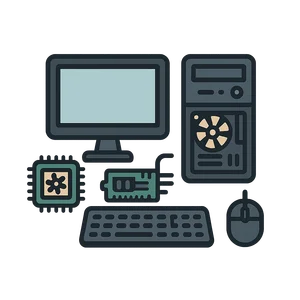
Computer Hardware (Parts of a Computer)
Computer hardware refers to the physical components that make up a computer system, such as the processor…
Reads at Grades 6–8 Listens at Grades 4–8
Print & create
Answer keys·No prep·Free with an account
28 worksheets · answer keys · full story · quiz · Ages 10-12 · CEFR B2
Plus adds 244,000+ more stories in 27 languages, audio for every one, and printables for all of them.
Just want Computer Hardware (Parts of a Computer)?
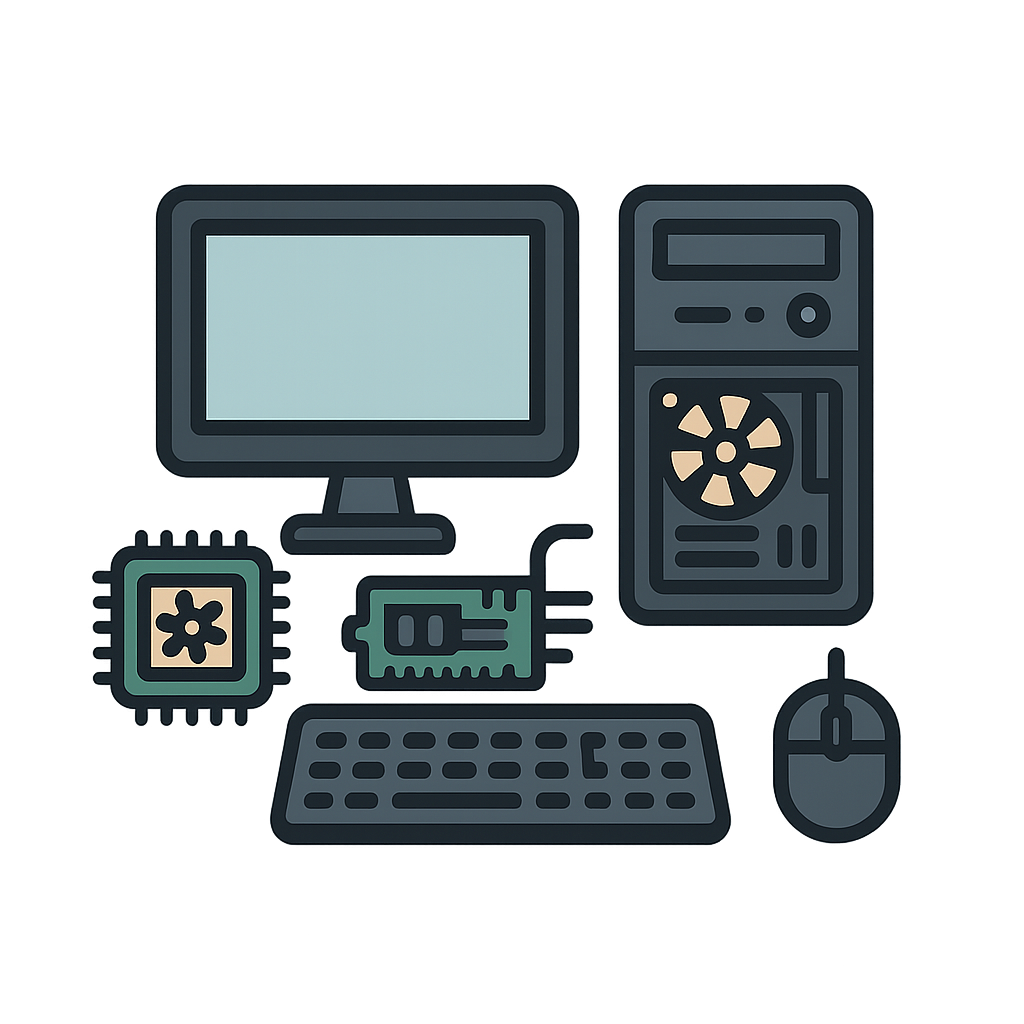
Have you ever felt that little thrill when a screen flickers to life, bathing your face in a soft glow? Or heard the satisfying click of a mouse, the quiet hum of a fan spinning inside a mysterious box? It feels like magic, doesn't it? As if some invisible intelligence is waiting for your command, ready to open up worlds of games, connect you with friends, or help you build incredible school projects. You might think it's all just programs and code, but there’s a secret, physical world inside that box that makes everything possible. I am that world. I am the bones and the brain, the heart and the nervous system of your device. I am the team of physical parts that software needs to come alive. I am Computer Hardware.
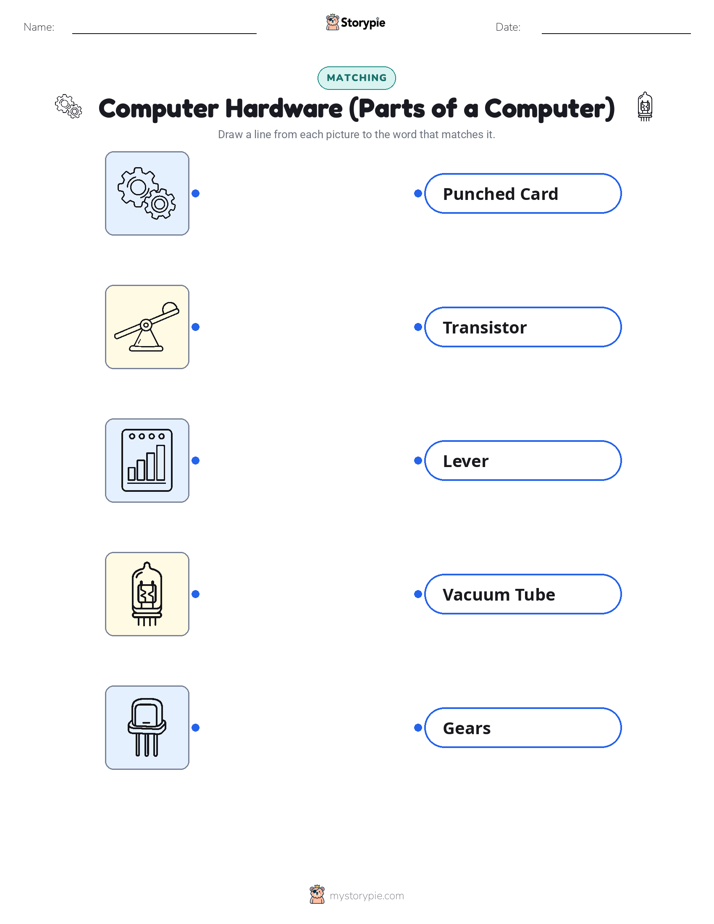
My story didn't begin with electricity or silicon. My earliest ancestors were mechanical dreamers, giants made of brass and steel. Long before the first spark of a modern computer, a brilliant man in London named Charles Babbage imagined me. In the 1830s, he was frustrated by the human errors he saw in mathematical tables. He dreamed of a machine that could calculate perfectly, every single time. He designed something called the Difference Engine, a complex contraption of gears and levers meant to automate these calculations. But his greatest idea was the Analytical Engine. It was the first true blueprint for a general-purpose computer. It had a 'mill' to do the calculations, just like a modern CPU, and a 'store' to hold the numbers, much like memory. It could even be programmed using punched cards. Though Babbage never managed to build it completely in his lifetime, the idea of me—a machine with distinct parts working together to process information—was born from his incredible mind.
The Ghost in the Machine: The Story of Computer Hardware
Have you ever felt that little thrill when a screen flickers to life, bathing your face in a soft glow? Or heard the satisfying click of a mouse, the quiet hum of a fan spinning inside a mysterious box? It feels like magic, doesn't it? As if some invisible intelligence is waiting for your command, ready to open up worlds of games, connect you with friends, or help you build incredible school projects. You might think it's all just programs and code, but there’s a secret, physical world inside that box that makes everything possible. I am that world. I am the bones and the brain, the heart and the nervous system of your device. I am the team of physical parts that software needs to come alive. I am Computer Hardware.
My story didn't begin with electricity or silicon. My earliest ancestors were mechanical dreamers, giants made of brass and steel. Long before the first spark of a modern computer, a brilliant man in London named Charles Babbage imagined me. In the 1830s, he was frustrated by the human errors he saw in mathematical tables. He dreamed of a machine that could calculate perfectly, every single time. He designed something called the Difference Engine, a complex contraption of gears and levers meant to automate these calculations. But his greatest idea was the Analytical Engine. It was the first true blueprint for a general-purpose computer. It had a 'mill' to do the calculations, just like a modern CPU, and a 'store' to hold the numbers, much like memory. It could even be programmed using punched cards. Though Babbage never managed to build it completely in his lifetime, the idea of me—a machine with distinct parts working together to process information—was born from his incredible mind.
For nearly a century, I remained mostly an idea. Then, the world needed faster calculations than ever before, and the age of sparks and switches began. On February 15th, 1946, one of my most famous early forms, the ENIAC, was unveiled. I was colossal, filling a room the size of a large classroom. Instead of gears, my brain was made of over 17,000 delicate glass vacuum tubes. They glowed and flickered, acting as tiny electronic switches, allowing me to perform calculations thousands of times faster than any human. But I was a fragile giant. Those vacuum tubes were hot, unreliable, and constantly burning out. Keeping me running was a full-time job for a team of engineers. My big breakthrough came just a year later, in 1947, when scientists at Bell Labs invented something tiny but revolutionary: the transistor. It could do everything a vacuum tube could, but it was solid, small, and used far less power. The transistor was the key that would unlock my potential, allowing me to shrink from the size of a room to something that could one day fit on a desk.
The invention of the transistor started a revolution, one that would take place on a material you might find at the beach: silicon. The next great leap was figuring out how to stop wiring individual transistors together by hand. Around 1958, two brilliant engineers, Jack Kilby and Robert Noyce, independently came up with the same world-changing idea: the integrated circuit. They discovered how to build not just one, but many transistors and other electronic components onto a single, tiny chip of silicon. This was the birth of the microchip. Suddenly, I could become exponentially smaller, faster, and cheaper to produce. The final piece of the puzzle fell into place in 1971 when a company named Intel released the 4004. It was the world's first commercially available microprocessor, which meant my entire 'brain'—the Central Processing Unit, or CPU—could fit onto a single chip no bigger than your fingernail. This invention paved the way for the personal computer revolution, finally letting me move out of massive laboratories and into your homes, schools, and offices.
Today, I am the silent, powerful team working inside every device you use. Think of us as a highly specialized crew. The CPU is the brilliant 'brain,' executing billions of instructions every second to run your programs. The RAM is the 'short-term memory,' a fast workspace that juggles all the tasks you have open right now. The hard drive or solid-state drive (SSD) is the 'long-term memory,' a vast library that stores all your files, photos, and games. And the GPU is the 'artist,' a specialized processor dedicated to creating the beautiful, smooth graphics you see on your screen. Together, we bring the digital world to your fingertips. My evolution never stops. I am always getting smaller, more powerful, and more efficient, helping humanity solve enormous challenges, from creating new medicines to exploring space. I am the physical foundation for every digital creation, and I can't wait to see what incredible ideas you will bring to life with my help.
Wow facts
About
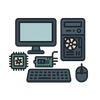
Computer hardware refers to the physical components that make up a computer system, such as the processor, memory, storage devices, and motherboard. These parts have evolved from massive, room-sized machines to the microscopic circuits in modern devices.
Take a Quiz
Question 1 of 5
What was the main problem with the ENIAC computer's vacuum tubes that the transistor solved?
Explore next



Want to do even more?
Go beyond exploring. Unlock tools that turn every story into real learning.

Storypie Plus for families
Full stories, quizzes, and printables. Nights and car rides, sorted.
- Unlimited audio stories
- Create Mode: your child stars in the story
- Offline downloads
- Printable worksheets & coloring pages

Why Storypie for Schools
Students engaged. Prep in seconds. Evenings back to you.
- Worksheets & Quizzes
- Classroom Management
- Formative Assessment
- Custom Curriculum & Lesson Plans
- 27 Languages

Why Storypie for Homeschool
Curriculum done. They'll ask for more. Hours back in your day.
- Worksheet Generator
- First-Person Audio Stories
- Built-in Comprehension Quizzes
- Custom Curriculum & Lesson Plans
- Print & Go Activities