English

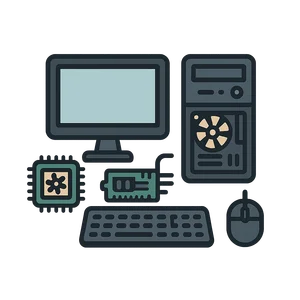
Computer Hardware (Parts of a Computer)
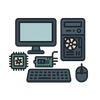
Computer hardware refers to the physical components that make up a computer system, such as the processor…
Reads at Grades 3–5 Listens at Grades 1–5
Print & create
Answer keys·No prep·Free with an account
28 worksheets · answer keys · full story · quiz · Ages 8-10 · CEFR B1
Plus adds 244,000+ more stories in 27 languages, audio for every one, and printables for all of them.
Just want Computer Hardware (Parts of a Computer)?
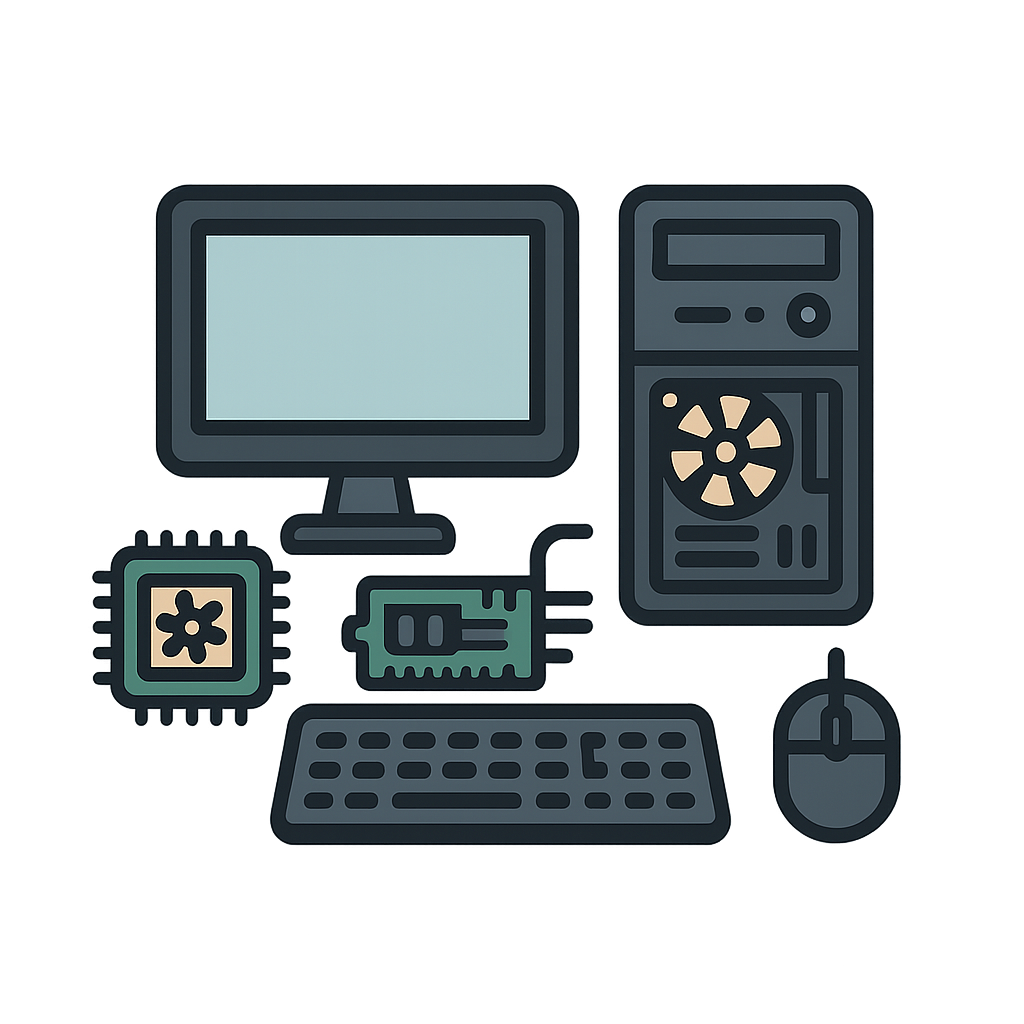
Have you ever sat in front of a glowing screen, the gentle hum of a fan whispering in the background. With a click of a mouse or a tap on a keyboard, a whole world of games, videos, and information opens up. It feels like magic, doesn't it. But it’s not magic, it’s a team. I am that team, living inside the box. I am all the physical pieces you can see and touch, the wires, the chips, and the boards that work together to bring that screen to life. Can you guess my name. I am Computer Hardware.
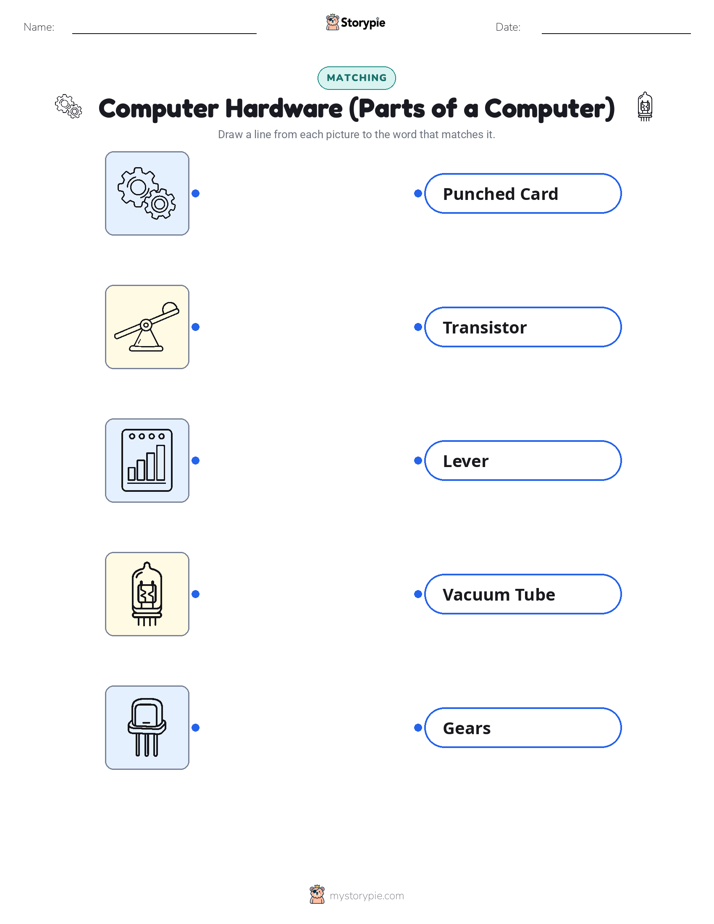
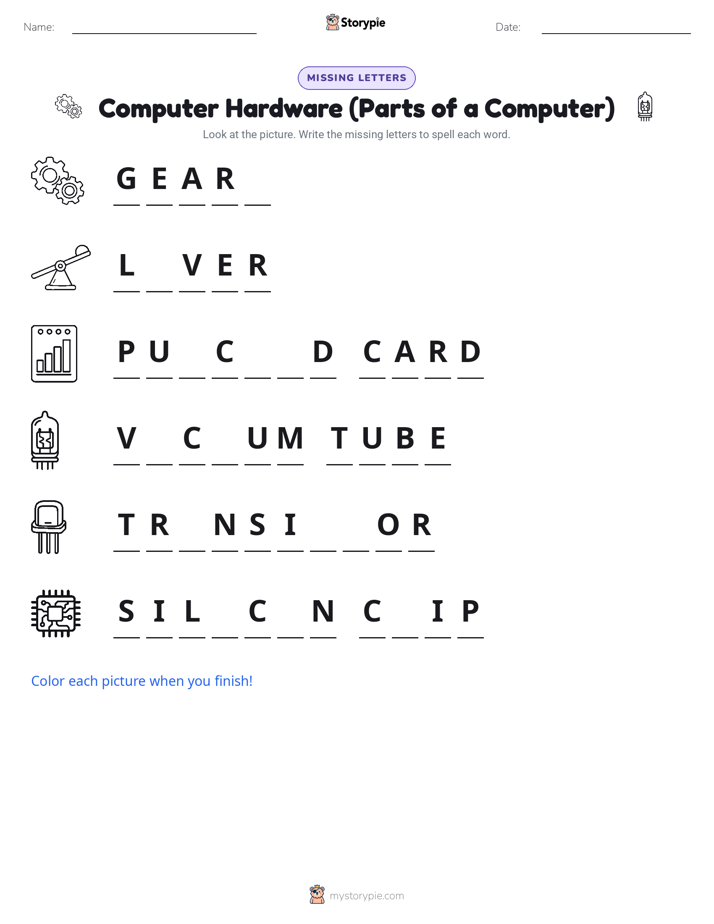
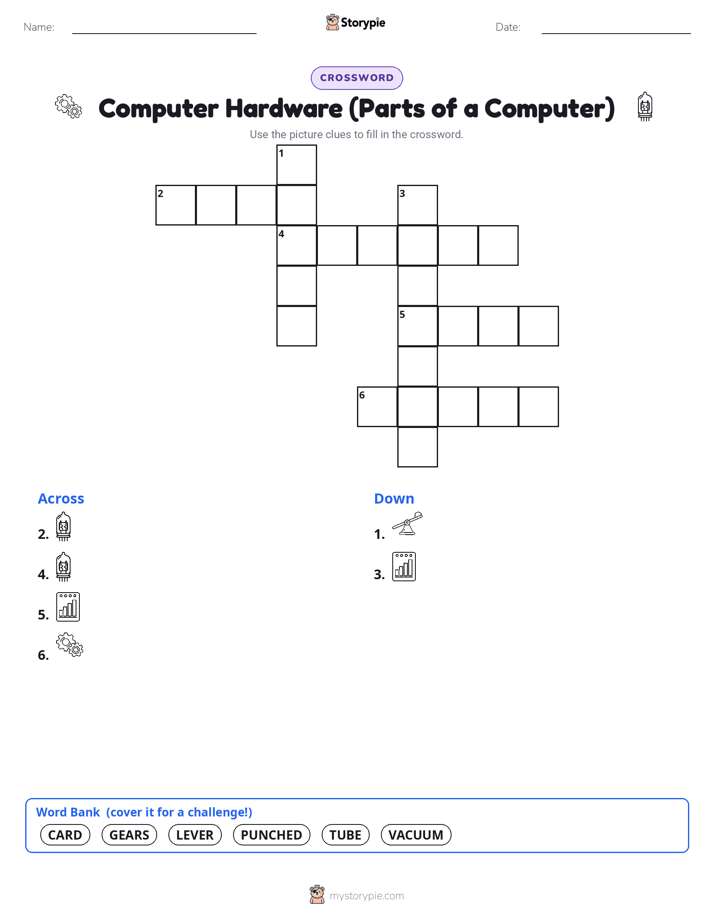
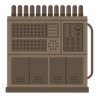
My family history is long and full of giant ancestors. Imagine traveling back to the 1830s, where a brilliant man named Charles Babbage dreamed up one of my earliest relatives, the Analytical Engine. It was a magnificent machine designed with thousands of spinning gears and levers, a mechanical brain meant to solve math problems automatically. It was such a big idea that he never got to finish building it, but the plan was there. Then, leap forward to the 1940s. My relatives from this time were truly enormous. One famous one was called ENIAC. It didn't just sit on a desk; it filled an entire room. Instead of tiny chips, it used thousands of glowing glass vacuum tubes that got incredibly hot and often burned out. ENIAC was powerful for its time, helping scientists with important calculations, but it was slow, clumsy, and only a few special people ever got to use it. Can you imagine a world where one computer took up more space than your bedroom.
I couldn't stay a giant forever. I had to get smaller, faster, and smarter so I could help everyone, not just a few scientists. The first big change happened at a place called Bell Labs on December 16th, 1947. That’s when three clever scientists invented something called the transistor. It was a tiny, tiny switch that could do the same job as those big, hot vacuum tubes but was much smaller and more reliable. It was a huge breakthrough. Then, in 1958, an engineer named Jack Kilby had an even bigger idea. He figured out how to put many transistors and other parts onto one tiny sliver of material. He created the first integrated circuit, which you might know as a microchip. It was like shrinking an entire neighborhood of electronic parts down to the size of your fingernail. The most important step came in 1971, when a company called Intel created the first microprocessor. This amazing invention put the entire 'thinking' part of a computer, its brain, onto a single chip. This was the final piece of the puzzle that made personal computers, the kind you have at home or school, possible for everyone.
I Am Computer Hardware
Have you ever sat in front of a glowing screen, the gentle hum of a fan whispering in the background. With a click of a mouse or a tap on a keyboard, a whole world of games, videos, and information opens up. It feels like magic, doesn't it. But it’s not magic, it’s a team. I am that team, living inside the box. I am all the physical pieces you can see and touch, the wires, the chips, and the boards that work together to bring that screen to life. Can you guess my name. I am Computer Hardware.
My family history is long and full of giant ancestors. Imagine traveling back to the 1830s, where a brilliant man named Charles Babbage dreamed up one of my earliest relatives, the Analytical Engine. It was a magnificent machine designed with thousands of spinning gears and levers, a mechanical brain meant to solve math problems automatically. It was such a big idea that he never got to finish building it, but the plan was there. Then, leap forward to the 1940s. My relatives from this time were truly enormous. One famous one was called ENIAC. It didn't just sit on a desk; it filled an entire room. Instead of tiny chips, it used thousands of glowing glass vacuum tubes that got incredibly hot and often burned out. ENIAC was powerful for its time, helping scientists with important calculations, but it was slow, clumsy, and only a few special people ever got to use it. Can you imagine a world where one computer took up more space than your bedroom.
I couldn't stay a giant forever. I had to get smaller, faster, and smarter so I could help everyone, not just a few scientists. The first big change happened at a place called Bell Labs on December 16th, 1947. That’s when three clever scientists invented something called the transistor. It was a tiny, tiny switch that could do the same job as those big, hot vacuum tubes but was much smaller and more reliable. It was a huge breakthrough. Then, in 1958, an engineer named Jack Kilby had an even bigger idea. He figured out how to put many transistors and other parts onto one tiny sliver of material. He created the first integrated circuit, which you might know as a microchip. It was like shrinking an entire neighborhood of electronic parts down to the size of your fingernail. The most important step came in 1971, when a company called Intel created the first microprocessor. This amazing invention put the entire 'thinking' part of a computer, its brain, onto a single chip. This was the final piece of the puzzle that made personal computers, the kind you have at home or school, possible for everyone.
Today, my family of parts works together like a perfectly trained team. Let me introduce you to the main players. The most important part is my brain, called the CPU, or Central Processing Unit. It’s the super-fast thinker that does all the calculations and follows every instruction you give me. Then there’s the RAM, which stands for Random Access Memory. Think of RAM as my short-term memory, like a juggler keeping all your open programs and files in the air at once. The more RAM I have, the more things I can juggle without dropping anything. For my long-term memory, I have a Hard Drive or a Solid-State Drive. This is like my library, where I store all your games, photos, and documents safely, even when the power is off. Connecting all of us is the Motherboard. It’s like my nervous system, a big circuit board with tiny electronic roads that let my brain, memory, and all other parts talk to each other instantly. Without the motherboard, we’d just be a jumble of disconnected pieces.
Now, I don't just live in desktop computers anymore. I am in the smartphone in your pocket, the tablet you use to draw, and even in your family’s car, helping it run safely. I help doctors discover new medicines, artists create amazing movies, and allow you to talk to family members who live thousands of miles away. Every day, smart engineers and creative dreamers are finding new ways to make my parts even smaller, faster, and more powerful. They are constantly redesigning my brain, my memory, and my connections. I am always changing and evolving, excited to see what amazing things you will build with me in the future.
Wow facts
About
Computer hardware refers to the physical components that make up a computer system, such as the processor, memory, storage devices, and motherboard. These parts have evolved from massive, room-sized machines to the microscopic circuits in modern devices.
Take a Quiz
Question 1 of 5
What was the name of the giant computer from the 1940s that filled an entire room?
Explore next



Want to do even more?
Go beyond exploring. Unlock tools that turn every story into real learning.

Storypie Plus for families
Full stories, quizzes, and printables. Nights and car rides, sorted.
- Unlimited audio stories
- Create Mode: your child stars in the story
- Offline downloads
- Printable worksheets & coloring pages

Why Storypie for Schools
Students engaged. Prep in seconds. Evenings back to you.
- Worksheets & Quizzes
- Classroom Management
- Formative Assessment
- Custom Curriculum & Lesson Plans
- 27 Languages

Why Storypie for Homeschool
Curriculum done. They'll ask for more. Hours back in your day.
- Worksheet Generator
- First-Person Audio Stories
- Built-in Comprehension Quizzes
- Custom Curriculum & Lesson Plans
- Print & Go Activities