English

Continental Drift
The theory that Earth's continents have moved over geologic time relative to each other…
Reads at Grades 3–5 Listens at Grades 1–5
Print & create
Answer keys·No prep·Free with an account
28 worksheets · answer keys · full story · quiz · Ages 8-10 · CEFR B1
Plus adds 102,000+ more stories in 27 languages, audio for every one, and printables for all of them.
Just want Continental Drift?
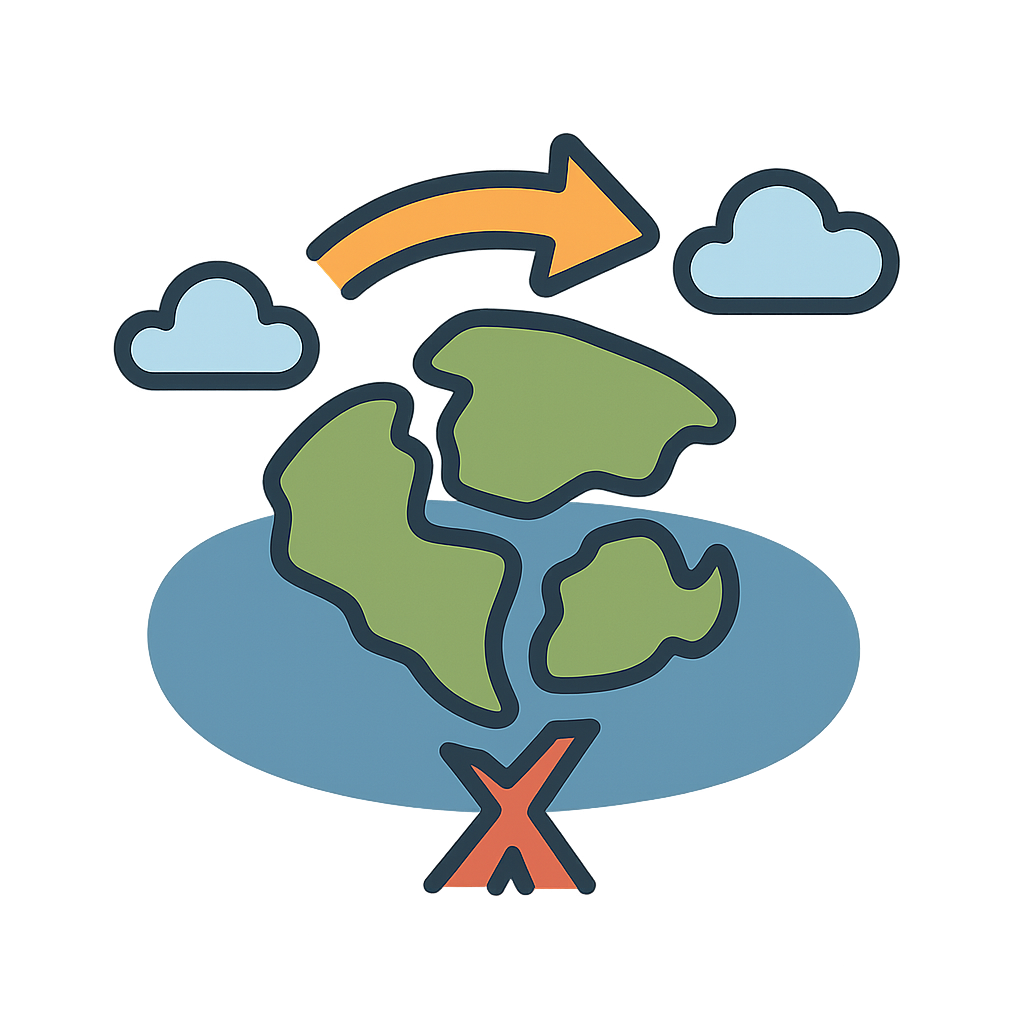
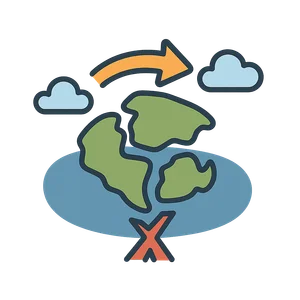
Can you feel me. I am a giant, slow-motion puzzle. Imagine the whole world, with its big chunks of land and wide, blue oceans, as a collection of enormous puzzle pieces. For a very long time, nobody knew the pieces could move. They looked at maps and saw how the bumpy eastern coastline of South America looked like it could snuggle right into the curved western side of Africa. It was a perfect fit, but they were separated by an entire ocean. How could that be. People also found another strange clue. They would dig up fossils of the exact same ancient plants and little animals on continents that were thousands of miles apart. It was a huge mystery. How could a small lizard that couldn't swim have crossed the massive Atlantic Ocean. It was as if someone had a giant map, tore it into pieces, and scattered them across the globe. I am the big idea that explains this mystery. I am the force that shows the continents are always moving, like giant rafts on a slow-moving river. You can call me Continental Drift.
For centuries, people noticed these little clues, but they couldn't put them all together. Way back in 1596, a very clever mapmaker from Belgium named Abraham Ortelius looked at his new maps of the world and thought the Americas looked like they had been torn away from Europe and Africa. He was one of the first to see the puzzle-piece fit. But my biggest champion came much later. His name was Alfred Wegener, and he was a curious German scientist who loved exploring and studying the weather. Around the year 1910, he was looking at a world map in an atlas and the idea hit him like a lightning bolt. He felt certain that all the continents had once been connected. He spent years gathering clues like a detective. His first clue was the one Abraham Ortelius saw, the jigsaw puzzle fit. His second clue was fossils. He found that the remains of a little reptile called *Mesosaurus* were found in both South America and southern Africa, and nowhere else in the world. Since *Mesosaurus* was a freshwater animal, it couldn't have swum across the salty ocean. Then he noticed his third clue, mountains. The Appalachian Mountains in North America seemed to perfectly line up with mountains in Scotland and Scandinavia if you pushed the continents back together. His fourth clue was ice. He found evidence of ancient glaciers, huge sheets of ice, in places that are now hot deserts or tropical jungles, like Africa and India. This only made sense if those continents were once located somewhere much colder, near the South Pole. In 1915, he published all his ideas in a book and named the ancient supercontinent 'Pangaea,' which means 'all lands.' But most other scientists didn't believe him. They laughed at his idea because he couldn't answer one very big question, what powerful engine was strong enough to push entire continents around. He knew they were moving, but he couldn't explain how.
The Earth's Drifting Puzzle
Can you feel me. I am a giant, slow-motion puzzle. Imagine the whole world, with its big chunks of land and wide, blue oceans, as a collection of enormous puzzle pieces. For a very long time, nobody knew the pieces could move. They looked at maps and saw how the bumpy eastern coastline of South America looked like it could snuggle right into the curved western side of Africa. It was a perfect fit, but they were separated by an entire ocean. How could that be. People also found another strange clue. They would dig up fossils of the exact same ancient plants and little animals on continents that were thousands of miles apart. It was a huge mystery. How could a small lizard that couldn't swim have crossed the massive Atlantic Ocean. It was as if someone had a giant map, tore it into pieces, and scattered them across the globe. I am the big idea that explains this mystery. I am the force that shows the continents are always moving, like giant rafts on a slow-moving river. You can call me Continental Drift.
For centuries, people noticed these little clues, but they couldn't put them all together. Way back in 1596, a very clever mapmaker from Belgium named Abraham Ortelius looked at his new maps of the world and thought the Americas looked like they had been torn away from Europe and Africa. He was one of the first to see the puzzle-piece fit. But my biggest champion came much later. His name was Alfred Wegener, and he was a curious German scientist who loved exploring and studying the weather. Around the year 1910, he was looking at a world map in an atlas and the idea hit him like a lightning bolt. He felt certain that all the continents had once been connected. He spent years gathering clues like a detective. His first clue was the one Abraham Ortelius saw, the jigsaw puzzle fit. His second clue was fossils. He found that the remains of a little reptile called Mesosaurus were found in both South America and southern Africa, and nowhere else in the world. Since Mesosaurus was a freshwater animal, it couldn't have swum across the salty ocean. Then he noticed his third clue, mountains. The Appalachian Mountains in North America seemed to perfectly line up with mountains in Scotland and Scandinavia if you pushed the continents back together. His fourth clue was ice. He found evidence of ancient glaciers, huge sheets of ice, in places that are now hot deserts or tropical jungles, like Africa and India. This only made sense if those continents were once located somewhere much colder, near the South Pole. In 1915, he published all his ideas in a book and named the ancient supercontinent 'Pangaea,' which means 'all lands.' But most other scientists didn't believe him. They laughed at his idea because he couldn't answer one very big question, what powerful engine was strong enough to push entire continents around. He knew they were moving, but he couldn't explain how.
Alfred Wegener's big idea had to wait for many decades after he was gone. But I was still there, slowly shifting the world's puzzle pieces. In the 1950s and 1960s, scientists developed amazing new technology that let them map the ocean floor for the very first time. What they found was astonishing. They discovered giant mountain ranges running down the middle of the oceans, like a giant seam on a baseball. They also found evidence that the seafloor was slowly spreading apart from these ridges, making new ocean crust and pushing the continents away from each other. This was it. This was the powerful engine that Alfred Wegener had been missing. His idea was finally proven right. Today, scientists call my modern, super-powered version the theory of Plate Tectonics. I am still at work every single day, pushing continents, building mountains, and causing earthquakes. My story teaches us to always stay curious and keep looking for clues. Sometimes, the biggest and most amazing ideas just need a little more time and a few more puzzle pieces to be proven right.
Wow facts
About
The theory that Earth's continents have moved over geologic time relative to each other, thus appearing to have 'drifted' across the ocean bed.
Take a Quiz
Question 1 of 5
Why didn't most scientists believe Alfred Wegener's idea at first?
Explore next





Want to do even more?
Go beyond exploring. Unlock tools that turn every story into real learning.

Storypie Plus for families
Full stories, quizzes, and printables. Nights and car rides, sorted.
- Unlimited audio stories
- Create Mode: your child stars in the story
- Offline downloads
- Printable worksheets & coloring pages

Why Storypie for Schools
Students engaged. Prep in seconds. Evenings back to you.
- Worksheets & Quizzes
- Classroom Management
- Formative Assessment
- Custom Curriculum & Lesson Plans
- 27 Languages

Why Storypie for Homeschool
Curriculum done. They'll ask for more. Hours back in your day.
- Worksheet Generator
- First-Person Audio Stories
- Built-in Comprehension Quizzes
- Custom Curriculum & Lesson Plans
- Print & Go Activities