English

Decomposers
Decomposers are organisms, such as bacteria and fungi, that break down dead or decaying organisms…
Reads at Grades 6–8 Listens at Grades 4–8
Print & create
Answer keys·No prep·Free with an account
28 worksheets · answer keys · full story · quiz · Ages 10-12 · CEFR B2
Plus adds 102,000+ more stories in 27 languages, audio for every one, and printables for all of them.
Just want Decomposers?
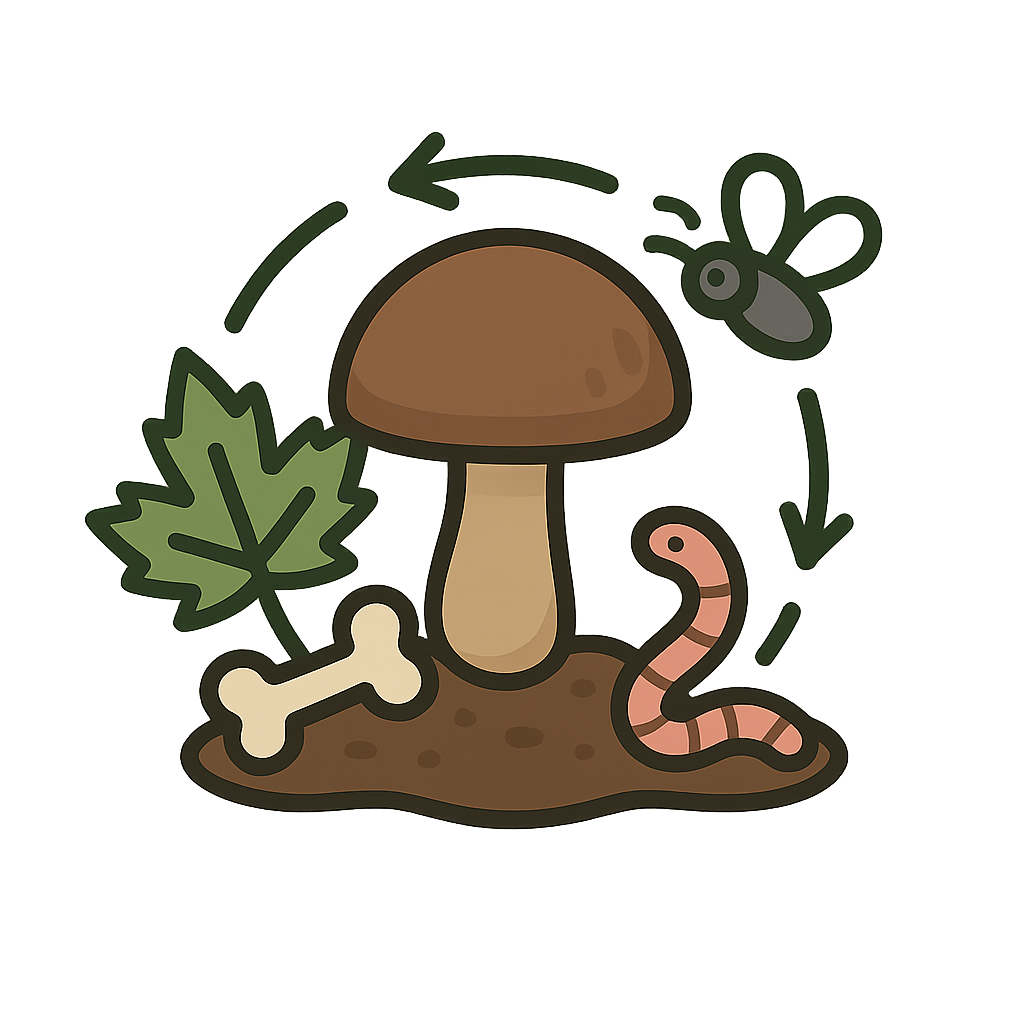
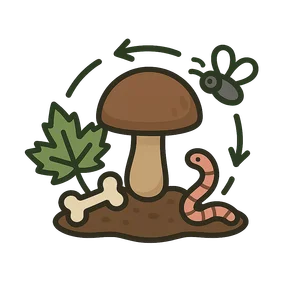
Have you ever walked through a forest after a rainstorm, when the air smells of damp earth and rich soil. Have you seen a giant log, once a mighty tree, slowly crumbling and softening until it sinks back into the ground. Maybe you’ve watched an apple core you tossed aside shrink day by day, disappearing as if by magic. That magic is my work. For ages, I have been the world’s silent clean-up crew, nature’s great recycler. Without me, the planet would be buried under mountains of fallen leaves, ancient trees, and everything that has ever lived. I am not one thing, but a massive, tireless team. My crew includes the mighty earthworms tunneling through the soil, the strange and beautiful fungi that sprout on decaying wood, and an invisible army of workers too small for you to see. We are the great transformers, and our job is to take every ending and turn it into a new beginning. You might not notice my individual workers, but you see our results everywhere life thrives. We are the Decomposers, and we make life from what is left behind.
For thousands of years, humans knew I existed even if they didn't know my name or how I truly worked. Ancient farmers, as far back as 8,000 years ago in places like Mesopotamia, learned to work with me. They piled up vegetable scraps, leaves, and animal manure, waiting for me to transform it all into dark, rich compost that made their crops grow strong. The ancient Egyptians, around 3000 BCE, understood my power so well that they went to extraordinary lengths to stop me. Their detailed process of mummification was a fight against my nature, an attempt to preserve bodies forever by keeping my workers away. For centuries, people who saw my results up close thought it was pure sorcery. They believed that life could burst from non-living things, a theory they called 'spontaneous generation.' They saw maggots wriggling on rotting meat and concluded the meat itself had created them. This idea lasted for a very long time, until a thoughtful Italian scientist named Francesco Redi decided to look closer. In 1668, he set up a brilliant experiment. He placed meat into several jars. Some he left open, some he sealed completely, and others he covered with a fine gauze. Just as he suspected, maggots only appeared in the open jars where flies could land. On the gauze-covered jars, flies laid their eggs on top of the cloth, unable to reach the meat. The sealed jars grew no maggots at all. He proved my maggot-helpers weren't magic; they hatched from tiny eggs. It was the first great step in revealing my secret.
The Great Recycler's Secret
Have you ever walked through a forest after a rainstorm, when the air smells of damp earth and rich soil. Have you seen a giant log, once a mighty tree, slowly crumbling and softening until it sinks back into the ground. Maybe you’ve watched an apple core you tossed aside shrink day by day, disappearing as if by magic. That magic is my work. For ages, I have been the world’s silent clean-up crew, nature’s great recycler. Without me, the planet would be buried under mountains of fallen leaves, ancient trees, and everything that has ever lived. I am not one thing, but a massive, tireless team. My crew includes the mighty earthworms tunneling through the soil, the strange and beautiful fungi that sprout on decaying wood, and an invisible army of workers too small for you to see. We are the great transformers, and our job is to take every ending and turn it into a new beginning. You might not notice my individual workers, but you see our results everywhere life thrives. We are the Decomposers, and we make life from what is left behind.
For thousands of years, humans knew I existed even if they didn't know my name or how I truly worked. Ancient farmers, as far back as 8,000 years ago in places like Mesopotamia, learned to work with me. They piled up vegetable scraps, leaves, and animal manure, waiting for me to transform it all into dark, rich compost that made their crops grow strong. The ancient Egyptians, around 3000 BCE, understood my power so well that they went to extraordinary lengths to stop me. Their detailed process of mummification was a fight against my nature, an attempt to preserve bodies forever by keeping my workers away. For centuries, people who saw my results up close thought it was pure sorcery. They believed that life could burst from non-living things, a theory they called 'spontaneous generation.' They saw maggots wriggling on rotting meat and concluded the meat itself had created them. This idea lasted for a very long time, until a thoughtful Italian scientist named Francesco Redi decided to look closer. In 1668, he set up a brilliant experiment. He placed meat into several jars. Some he left open, some he sealed completely, and others he covered with a fine gauze. Just as he suspected, maggots only appeared in the open jars where flies could land. On the gauze-covered jars, flies laid their eggs on top of the cloth, unable to reach the meat. The sealed jars grew no maggots at all. He proved my maggot-helpers weren't magic; they hatched from tiny eggs. It was the first great step in revealing my secret.
The next part of my story could only be told once humans learned to see a world they never knew existed. In the 1670s, a Dutch shopkeeper named Antonie van Leeuwenhoek, with a passion for grinding lenses, built his own powerful microscopes. He pointed them at everything, from drops of pond water to the plaque on his own teeth. He was stunned to discover a bustling, hidden world of tiny creatures he called 'animalcules.' These were my smallest and most powerful workers: bacteria, yeasts, and other microbes. For the first time, humanity had a glimpse of my invisible army, but they still didn't understand the colossal job these creatures performed. It took nearly two hundred more years for another brilliant mind to make the connection. His name was Louis Pasteur. In the 1860s, he settled the debate about spontaneous generation once and for all. He used special swan-necked flasks filled with broth. Air could get into the flasks, but my microscopic workers floating in the air got trapped in the S-shaped curve of the glass neck. As long as the flask sat upright, the broth remained perfectly clear for months. But the moment he tilted the flask to let the trapped dust touch the broth, it quickly became cloudy and spoiled. He had proven it. My invisible army was everywhere, floating in the very air, and it was they who were the true engines of decay. My identity was no longer a mystery.
Now that you know who I am, you can see my work everywhere, helping you every day. I am the hero in your backyard compost bin, diligently turning your leftover banana peels, eggshells, and coffee grounds into nutrient-rich food for your garden. I am the essential employee at modern water treatment plants, where my microbial workers scrub and purify water so it can be safely returned to rivers and streams. In every ecosystem on the planet, from the deepest ocean floor to the highest mountain forest, I am constantly on the job. I break down every fallen leaf, every withered plant, and every animal that dies, unlocking the vital nutrients trapped inside them. I return essential elements like carbon and nitrogen back to the soil and atmosphere, making them available for new plants to absorb and grow. I make sure that in nature, nothing is ever truly wasted. I am the ultimate recycler, the quiet force that connects all life in a continuous, beautiful loop. My story is a powerful reminder that every ending is simply the start of another adventure, a constant promise of renewal that keeps our world alive and thriving.
Wow facts
About
Decomposers are organisms, such as bacteria and fungi, that break down dead or decaying organisms, carrying out the natural process of decomposition and returning essential nutrients to the ecosystem.
Take a Quiz
Question 1 of 5
What scientific question was Francesco Redi trying to answer with his 1668 experiment involving jars of meat?
Explore next


Want to do even more?
Go beyond exploring. Unlock tools that turn every story into real learning.

Storypie Plus for families
Full stories, quizzes, and printables. Nights and car rides, sorted.
- Unlimited audio stories
- Create Mode: your child stars in the story
- Offline downloads
- Printable worksheets & coloring pages

Why Storypie for Schools
Students engaged. Prep in seconds. Evenings back to you.
- Worksheets & Quizzes
- Classroom Management
- Formative Assessment
- Custom Curriculum & Lesson Plans
- 27 Languages

Why Storypie for Homeschool
Curriculum done. They'll ask for more. Hours back in your day.
- Worksheet Generator
- First-Person Audio Stories
- Built-in Comprehension Quizzes
- Custom Curriculum & Lesson Plans
- Print & Go Activities