English

Decomposers
Decomposers are organisms, such as bacteria and fungi, that break down dead or decaying organisms…
Reads at Grades 3–5 Listens at Grades 1–5
Print & create
Answer keys·No prep·Free with an account
28 worksheets · answer keys · full story · quiz · Ages 8-10 · CEFR B1
Plus adds 102,000+ more stories in 27 languages, audio for every one, and printables for all of them.
Just want Decomposers?
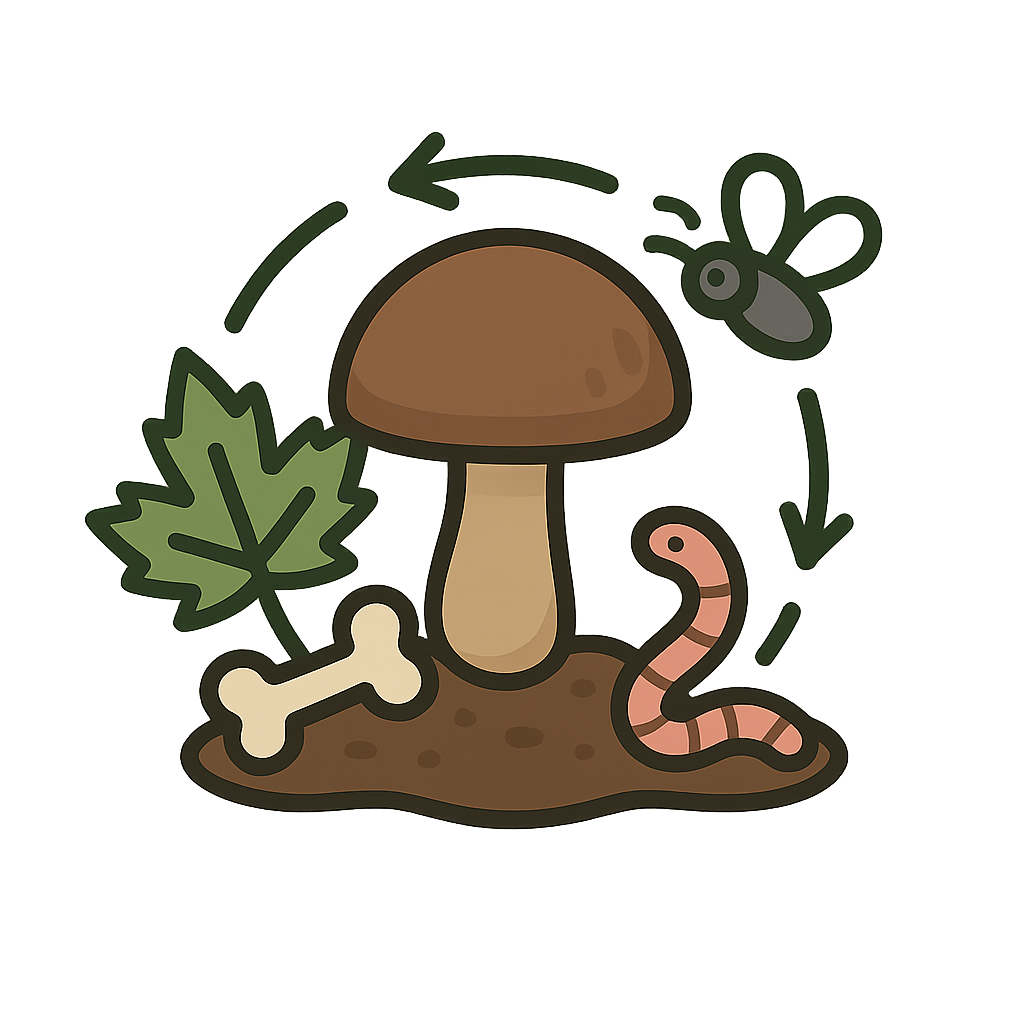
Have you ever wondered what happens to a fallen leaf or an apple core you’ve tossed aside in the woods. At first, it just sits there. But if you watch it day after day, something curious happens. It seems to shrink, get darker, and slowly vanish, as if a tiny magician made it disappear. But it isn't magic, it’s my team and me getting our job done. We are a huge, invisible army of workers, and we are everywhere. Some of us are so small you can't see us, like tiny bacteria and fuzzy fungi. Others are bigger, like wiggly earthworms tunneling through the dirt. We live in the soil, on rotting logs, and in puddles, just waiting for something delicious and dead to clean up. Think of us as nature's ultimate recycling crew. We don't throw anything away; we turn old things into new life. Can you imagine a world where every leaf that ever fell was still lying on the ground. It would be a messy place. We are the Decomposers, and our job is to make sure nothing ever truly goes to waste.
For thousands of years, people saw our work but couldn't see us. Farmers in ancient Egypt and Rome knew that letting old plants rot in the fields made the soil better for their new crops, but they had no idea why. It was a complete mystery. That all began to change in the 1670s, when a very curious man from the Netherlands named Antonie van Leeuwenhoek built one of the world's first powerful microscopes. He decided to look at a single drop of pond water. He was absolutely shocked to see a bustling, secret world filled with tiny creatures zipping and spinning around. He called them 'animalcules,' and he was the very first person to see the smallest members of my team: the bacteria. Still, for a long time, nobody knew what these little critters were doing. It wasn't until the 1860s that a brilliant French scientist named Louis Pasteur proved that these tiny microbes were the ones causing things to break down and rot. He showed everyone that we weren't just hanging around by accident—we were the cause of it all. Then, another one of my most valuable teammates got the credit they deserved. On October 10th, 1881, the famous scientist Charles Darwin published a whole book about the quiet, wiggly earthworm. He showed the world how these amazing workers munch through soil, breaking down leaves and creating rich, healthy earth for plants to grow in. Finally, people were starting to understand my team.
The World's Tidiest Secret
Have you ever wondered what happens to a fallen leaf or an apple core you’ve tossed aside in the woods. At first, it just sits there. But if you watch it day after day, something curious happens. It seems to shrink, get darker, and slowly vanish, as if a tiny magician made it disappear. But it isn't magic, it’s my team and me getting our job done. We are a huge, invisible army of workers, and we are everywhere. Some of us are so small you can't see us, like tiny bacteria and fuzzy fungi. Others are bigger, like wiggly earthworms tunneling through the dirt. We live in the soil, on rotting logs, and in puddles, just waiting for something delicious and dead to clean up. Think of us as nature's ultimate recycling crew. We don't throw anything away; we turn old things into new life. Can you imagine a world where every leaf that ever fell was still lying on the ground. It would be a messy place. We are the Decomposers, and our job is to make sure nothing ever truly goes to waste.
For thousands of years, people saw our work but couldn't see us. Farmers in ancient Egypt and Rome knew that letting old plants rot in the fields made the soil better for their new crops, but they had no idea why. It was a complete mystery. That all began to change in the 1670s, when a very curious man from the Netherlands named Antonie van Leeuwenhoek built one of the world's first powerful microscopes. He decided to look at a single drop of pond water. He was absolutely shocked to see a bustling, secret world filled with tiny creatures zipping and spinning around. He called them 'animalcules,' and he was the very first person to see the smallest members of my team: the bacteria. Still, for a long time, nobody knew what these little critters were doing. It wasn't until the 1860s that a brilliant French scientist named Louis Pasteur proved that these tiny microbes were the ones causing things to break down and rot. He showed everyone that we weren't just hanging around by accident—we were the cause of it all. Then, another one of my most valuable teammates got the credit they deserved. On October 10th, 1881, the famous scientist Charles Darwin published a whole book about the quiet, wiggly earthworm. He showed the world how these amazing workers munch through soil, breaking down leaves and creating rich, healthy earth for plants to grow in. Finally, people were starting to understand my team.
So today, scientists understand just how important we are. We are the final, crucial link in the food chain. When a tree falls or an animal dies, we get to work. We take all the energy and nutrients that are locked inside and we return them to the soil. Those nutrients then become food for plants, the plants become food for animals, and on and on it goes in a never-ending circle. Without us, the world would be buried under a giant pile of old leaves, fallen logs, and everything that has ever lived. There would be no new nutrients for anything to grow. When you see a mushroom popping up from the ground, that's one of my fungal teammates hard at work, breaking down a hidden root or log. When your family puts vegetable scraps into a compost bin, you're giving us a perfect place to do our job. You're helping us turn your leftovers into 'black gold' for your garden. We are the quiet, powerful force that connects death back to life, making sure the great circle of nature keeps spinning and our planet stays healthy and green.
Wow facts
About
Decomposers are organisms, such as bacteria and fungi, that break down dead or decaying organisms, carrying out the natural process of decomposition and returning essential nutrients to the ecosystem.
Take a Quiz
Question 1 of 5
Who was the first person to see the tiniest members of the Decomposers, the bacteria?
Explore next

Want to do even more?
Go beyond exploring. Unlock tools that turn every story into real learning.

Storypie Plus for families
Full stories, quizzes, and printables. Nights and car rides, sorted.
- Unlimited audio stories
- Create Mode: your child stars in the story
- Offline downloads
- Printable worksheets & coloring pages

Why Storypie for Schools
Students engaged. Prep in seconds. Evenings back to you.
- Worksheets & Quizzes
- Classroom Management
- Formative Assessment
- Custom Curriculum & Lesson Plans
- 27 Languages

Why Storypie for Homeschool
Curriculum done. They'll ask for more. Hours back in your day.
- Worksheet Generator
- First-Person Audio Stories
- Built-in Comprehension Quizzes
- Custom Curriculum & Lesson Plans
- Print & Go Activities