English


Drawing
Drawing is among the oldest forms of human expression…
Reads at Grades 6–8 Listens at Grades 4–8
Print & create
Answer keys·No prep·Free with an account
28 worksheets · answer keys · full story · quiz · Ages 10-12 · CEFR B2
Plus adds 244,000+ more stories in 27 languages, audio for every one, and printables for all of them.
Just want Drawing?

I begin as a simple mark, a whisper on a surface. You’ve seen me as a quick scribble in the margin of a notebook, a detailed map of a fantasy world, and the powerful lines that form your favorite comic book hero. I can build towering skyscrapers before a single brick is laid, and I can capture a fleeting expression on a person's face. I am a bridge from your imagination to the real world, a silent language that everyone understands. People use me to plan, to remember, to invent, and to share what's inside their minds when words aren't enough. Before I tell you my name, know this: I am the beginning of almost every great idea, the first step in making the invisible visible. I am Drawing.
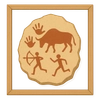
My story with humans began a very, very long time ago, long before cities or written words. Imagine a person, tens of thousands of years ago, picking up a piece of charcoal from a dead fire. They touched it to the rough wall of a cave, and there I was—a dark, bold line against the stone. The earliest trace of me scientists have found is on a small flake of rock from Blombos Cave in South Africa, made around 73,000 BCE. It was a simple cross-hatched pattern, but it was a spark of an idea, a deliberate design. Much later, in places like the Chauvet Cave in France around 30,000 BCE, I exploded into life. I became charging mammoths, graceful lions, and herds of horses that seemed to gallop in the flickering torchlight. I wasn't just a random mark anymore; I was a story, a memory, and maybe even a prayer to the spirits of the hunt. I was how early humans made sense of their world and shared their experiences.
The Story of a Simple Line
I begin as a simple mark, a whisper on a surface. You’ve seen me as a quick scribble in the margin of a notebook, a detailed map of a fantasy world, and the powerful lines that form your favorite comic book hero. I can build towering skyscrapers before a single brick is laid, and I can capture a fleeting expression on a person's face. I am a bridge from your imagination to the real world, a silent language that everyone understands. People use me to plan, to remember, to invent, and to share what's inside their minds when words aren't enough. Before I tell you my name, know this: I am the beginning of almost every great idea, the first step in making the invisible visible. I am Drawing.
My story with humans began a very, very long time ago, long before cities or written words. Imagine a person, tens of thousands of years ago, picking up a piece of charcoal from a dead fire. They touched it to the rough wall of a cave, and there I was—a dark, bold line against the stone. The earliest trace of me scientists have found is on a small flake of rock from Blombos Cave in South Africa, made around 73,000 BCE. It was a simple cross-hatched pattern, but it was a spark of an idea, a deliberate design. Much later, in places like the Chauvet Cave in France around 30,000 BCE, I exploded into life. I became charging mammoths, graceful lions, and herds of horses that seemed to gallop in the flickering torchlight. I wasn't just a random mark anymore; I was a story, a memory, and maybe even a prayer to the spirits of the hunt. I was how early humans made sense of their world and shared their experiences.
As human societies grew more complex, so did I. In ancient Egypt, starting around 3000 BCE, people used me with incredible precision and purpose. On long scrolls of papyrus, they used me to plan the construction of enormous pyramids and temples, ensuring every stone fit perfectly. They also used me to tell the stories of their gods and pharaohs in pictures called hieroglyphs, a beautiful and complex language made of my lines. I had to be clear and perfect. Then, in ancient Greece around the 5th century BCE, artists and mathematicians became my partners in discovery. They explored the secrets of perspective, figuring out how to use my lines to create the illusion of three-dimensional depth on a flat surface. Suddenly, I could open a window into another world, making scenes look realistic and alive. During the Middle Ages, I was often found in quiet monasteries, where monks would spend months, even years, using me to create breathtakingly detailed 'illuminated manuscripts,' making religious books into priceless treasures of art and knowledge.
Then came a time of incredible change and curiosity called the Renaissance, a rebirth of art and science. It was then I met one of my greatest friends, Leonardo da Vinci, who was born on April 15th, 1452. Leonardo showed the world that I was more than just a tool for making beautiful things; I was a tool for understanding everything. In his famous notebooks, he used me to explore the world with an insatiable curiosity. He drew the delicate bones inside a bird’s wing to understand flight, the swirling, chaotic patterns of flowing water, and the intricate muscles of the human body to see how it worked. He even used me to design fantastic inventions, like flying machines, armored tanks, and diving suits, that wouldn't actually be built for hundreds of years. For Leonardo, I became the language of science and invention, a way to think on paper and solve problems visually.
For a long time, my best materials, like fine inks and special papers, were expensive or hard to make, so not everyone could use me easily. But that all changed in 1795 when a French inventor named Nicolas-Jacques Conté created the modern pencil by mixing graphite with clay. Suddenly, I was affordable and accessible, ready to be put in everyone's hands. Today, I am everywhere—in an architect's blueprint for a new building, a fashion designer’s sketchbook filled with new styles, the storyboards that plan your favorite animated movie shot by shot, and the digital app on your tablet. I am a universal language that connects your mind directly to your hand. I am living proof that a simple line has the power to change the world. So go ahead, pick up a tool and make a mark. Let's see what new ideas we can bring to life together.
Wow facts
About
Drawing is among the oldest forms of human expression, though other symbolic behaviors may have come before it. It involves the creation of images, diagrams, or plans using lines and marks on a surface. Drawing is a fundamental tool for communication, artistic expression, and technical planning.
Take a Quiz
Question 1 of 5
How did Leonardo da Vinci's use of drawing, as described in the story, go beyond just creating art?
Explore next



Want to do even more?
Go beyond exploring. Unlock tools that turn every story into real learning.

Storypie Plus for families
Full stories, quizzes, and printables. Nights and car rides, sorted.
- Unlimited audio stories
- Create Mode: your child stars in the story
- Offline downloads
- Printable worksheets & coloring pages

Why Storypie for Schools
Students engaged. Prep in seconds. Evenings back to you.
- Worksheets & Quizzes
- Classroom Management
- Formative Assessment
- Custom Curriculum & Lesson Plans
- 27 Languages

Why Storypie for Homeschool
Curriculum done. They'll ask for more. Hours back in your day.
- Worksheet Generator
- First-Person Audio Stories
- Built-in Comprehension Quizzes
- Custom Curriculum & Lesson Plans
- Print & Go Activities