English


Exponents (Powers)
Exponents, also known as powers, are a mathematical concept representing repeated multiplication…
Reads at Grades 6–8 Listens at Grades 4–8
Print & create
Answer keys·No prep·Free with an account
28 worksheets · answer keys · full story · quiz · Ages 10-12 · CEFR B2
Plus adds 244,000+ more stories in 27 languages, audio for every one, and printables for all of them.
Just want Exponents (Powers)?

Imagine trying to write down a very, very big number. Not just a hundred or a thousand, but a number so large it would take you all day just to write out the zeros. Think about the work involved in multiplying ten by itself nine times: 10 x 10 x 10 x 10 x 10 x 10 x 10 x 10 x 10. It’s long, it’s messy, and it’s so easy to lose count. That’s where I come in. Before I existed in my final form, the world of numbers was a much more tedious place. People needed a shortcut, a way to package immense numerical strength into a tiny, elegant symbol. They needed a secret code to unlock the power of repeated multiplication without all the hassle. I am that secret. I am like a tiny superhero that floats just above and to the right of a regular number, my “base.” When you see me, you know that the number isn't just itself anymore. It has been given a mighty instruction: to multiply by itself, again and again. I take up almost no space, but the power I grant is enormous. I can turn a simple 2 into a colossal 1,024 with just one little number. I am an Exponent, but my friends call me a Power.
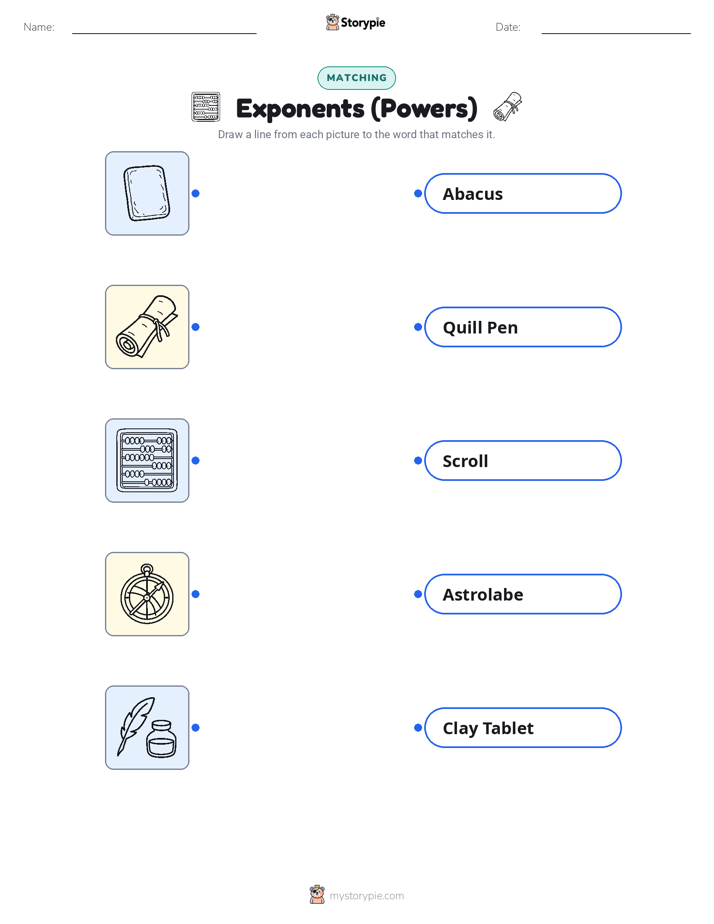
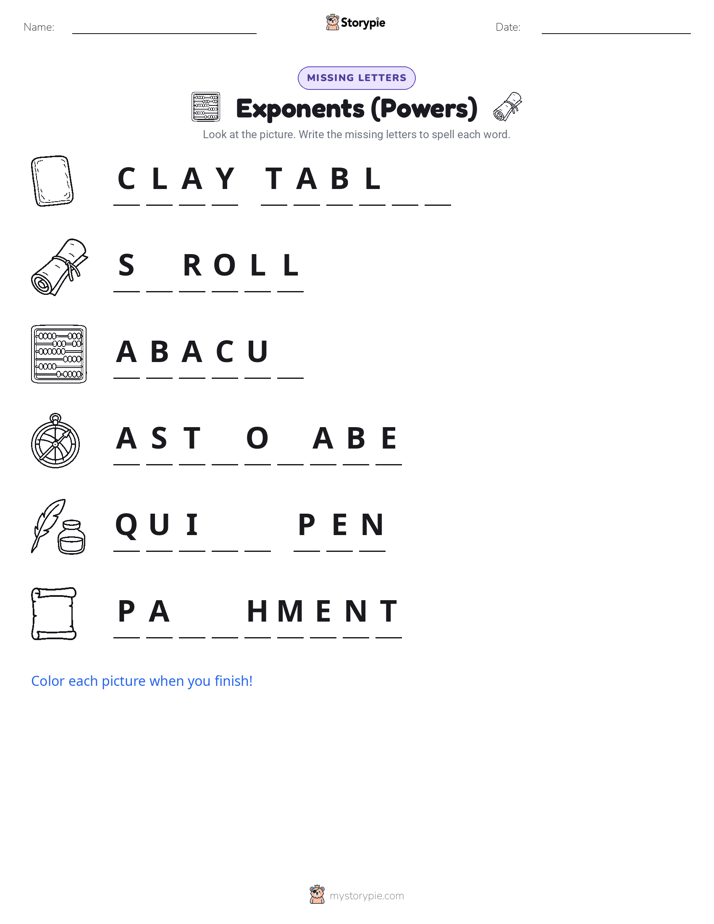
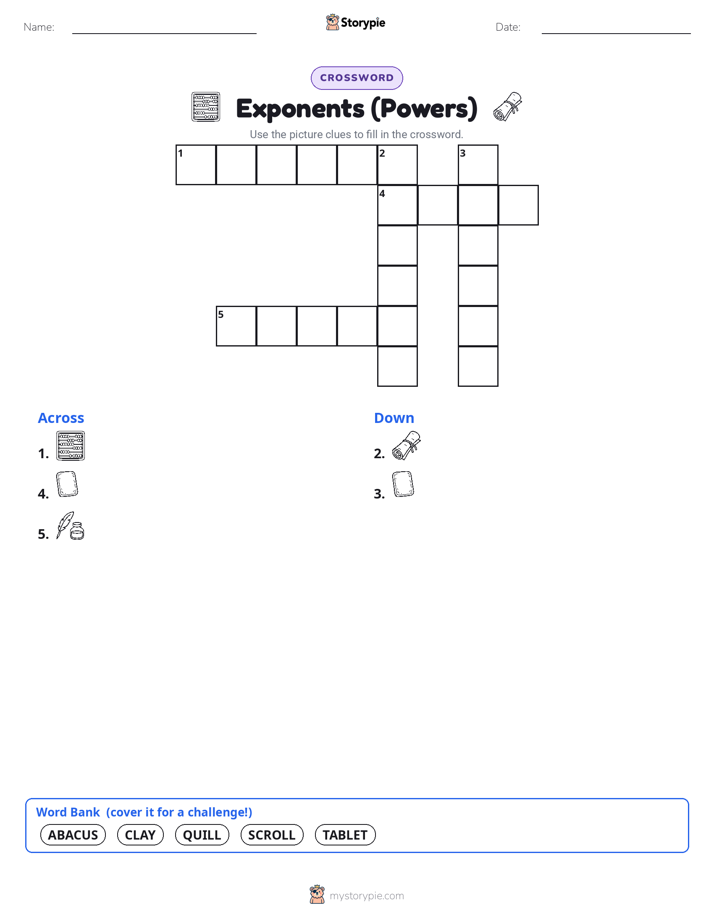
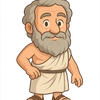
My story didn’t begin in a modern classroom. My spirit has been around for thousands of years, helping the cleverest minds solve the world’s problems. Travel back with me to ancient Babylonia, around the 18th century BCE. There, scribes didn't have paper; they etched symbols into wet clay tablets. On these tablets, they created tables of numbers squared and cubed. They were using my core idea to figure out practical things like the area of a farmer’s field or the interest on a loan. They might not have called me an exponent, but they understood my power to quickly calculate squares and cubes. A long time later, in ancient Greece, a brilliant man named Euclid was writing one of the most famous math books of all time, “Elements,” around 300 BCE. He used my concept constantly when talking about geometry. When he described the area of a square, he was talking about a number raised to my second power. A few decades after him, in the 3rd century BCE, another genius named Archimedes took me on an incredible adventure. He wanted to figure out the number of grains of sand it would take to fill the entire universe. The number was so astronomically huge, it was impossible to write down normally. So Archimedes used me, the power of 10, to wrangle this unimaginable quantity into something he could actually write and calculate with. He showed the world that I wasn't just for calculating the size of a field; I was for measuring the cosmos itself.
The Tiny Superhero of Numbers
Imagine trying to write down a very, very big number. Not just a hundred or a thousand, but a number so large it would take you all day just to write out the zeros. Think about the work involved in multiplying ten by itself nine times: 10 x 10 x 10 x 10 x 10 x 10 x 10 x 10 x 10. It’s long, it’s messy, and it’s so easy to lose count. That’s where I come in. Before I existed in my final form, the world of numbers was a much more tedious place. People needed a shortcut, a way to package immense numerical strength into a tiny, elegant symbol. They needed a secret code to unlock the power of repeated multiplication without all the hassle. I am that secret. I am like a tiny superhero that floats just above and to the right of a regular number, my “base.” When you see me, you know that the number isn't just itself anymore. It has been given a mighty instruction: to multiply by itself, again and again. I take up almost no space, but the power I grant is enormous. I can turn a simple 2 into a colossal 1,024 with just one little number. I am an Exponent, but my friends call me a Power.
My story didn’t begin in a modern classroom. My spirit has been around for thousands of years, helping the cleverest minds solve the world’s problems. Travel back with me to ancient Babylonia, around the 18th century BCE. There, scribes didn't have paper; they etched symbols into wet clay tablets. On these tablets, they created tables of numbers squared and cubed. They were using my core idea to figure out practical things like the area of a farmer’s field or the interest on a loan. They might not have called me an exponent, but they understood my power to quickly calculate squares and cubes. A long time later, in ancient Greece, a brilliant man named Euclid was writing one of the most famous math books of all time, “Elements,” around 300 BCE. He used my concept constantly when talking about geometry. When he described the area of a square, he was talking about a number raised to my second power. A few decades after him, in the 3rd century BCE, another genius named Archimedes took me on an incredible adventure. He wanted to figure out the number of grains of sand it would take to fill the entire universe. The number was so astronomically huge, it was impossible to write down normally. So Archimedes used me, the power of 10, to wrangle this unimaginable quantity into something he could actually write and calculate with. He showed the world that I wasn't just for calculating the size of a field; I was for measuring the cosmos itself.
For centuries, I was more of an idea than a neat symbol. People wrote me out in long, clunky words. If they wanted to show a number to the third power, they might write the Latin word ‘cubus’ next to it. It worked, but it was inefficient. My big makeover began to take shape during the Renaissance. A German mathematician named Michael Stifel was fascinated with numbers. In his 1544 book, “Arithmetica Integra,” he spent a lot of time exploring my rules. He didn't invent my final look, but he was one of the first to clearly lay out the laws of how I work—how to add me when you multiply my bases, or subtract me when you divide. He was creating my rulebook, figuring out the secrets to my power. But my famous look, the one you see in your math book today, came from a brilliant French thinker named René Descartes. In his groundbreaking 1637 book, “La Géométrie,” he decided to simplify things. Instead of writing ‘xxx’ for a number cubed, he just wrote the base number with a small 3 floating above it to the right. It was a simple, elegant solution that changed mathematics forever. Suddenly, complicated algebraic equations became cleaner, shorter, and so much easier to understand. Descartes gave me my modern superhero costume, and I was finally ready to show the world my full potential.
Now that I have my name and my look, I am everywhere, working behind the scenes to power your world. Scientists use me in what they call scientific notation to describe the universe. The distance to the nearest star or the diameter of a tiny atom can be written down neatly thanks to me. I make the impossibly big and the infinitesimally small easy to manage. My power is also inside the phone in your pocket and the computer on your desk. Have you ever heard of a kilobyte, megabyte, or gigabyte? Those are all measures of digital information, and they are all based on me—specifically, powers of the number 2. A kilobyte is 2 to my 10th power. A gigabyte is 2 to my 30th power. I am the reason we can store so much information in such small spaces. From a single biological cell that divides and grows exponentially, to the expanding fabric of the universe itself, I am the language of growth and potential. I show how something small, with repeated effort, can become grand and powerful. I am a reminder that even the tiniest symbol can hold the greatest power, and I continue to help people unlock new ideas and explore the universe every single day.
Wow facts
About
Exponents, also known as powers, are a mathematical concept representing repeated multiplication, where a base number is multiplied by itself a certain number of times, as indicated by the exponent.
Take a Quiz
Question 1 of 5
What is the main idea of the section titled 'My Ancient Beginnings'?
Explore next





Want to do even more?
Go beyond exploring. Unlock tools that turn every story into real learning.

Storypie Plus for families
Full stories, quizzes, and printables. Nights and car rides, sorted.
- Unlimited audio stories
- Create Mode: your child stars in the story
- Offline downloads
- Printable worksheets & coloring pages

Why Storypie for Schools
Students engaged. Prep in seconds. Evenings back to you.
- Worksheets & Quizzes
- Classroom Management
- Formative Assessment
- Custom Curriculum & Lesson Plans
- 27 Languages

Why Storypie for Homeschool
Curriculum done. They'll ask for more. Hours back in your day.
- Worksheet Generator
- First-Person Audio Stories
- Built-in Comprehension Quizzes
- Custom Curriculum & Lesson Plans
- Print & Go Activities