English


Factors and Multiples
Factors and Multiples are fundamental concepts in number theory that describe the relationships between…
Reads at Grades K-2 Listens at K–3
Print & create
Answer keys·No prep·Free with an account
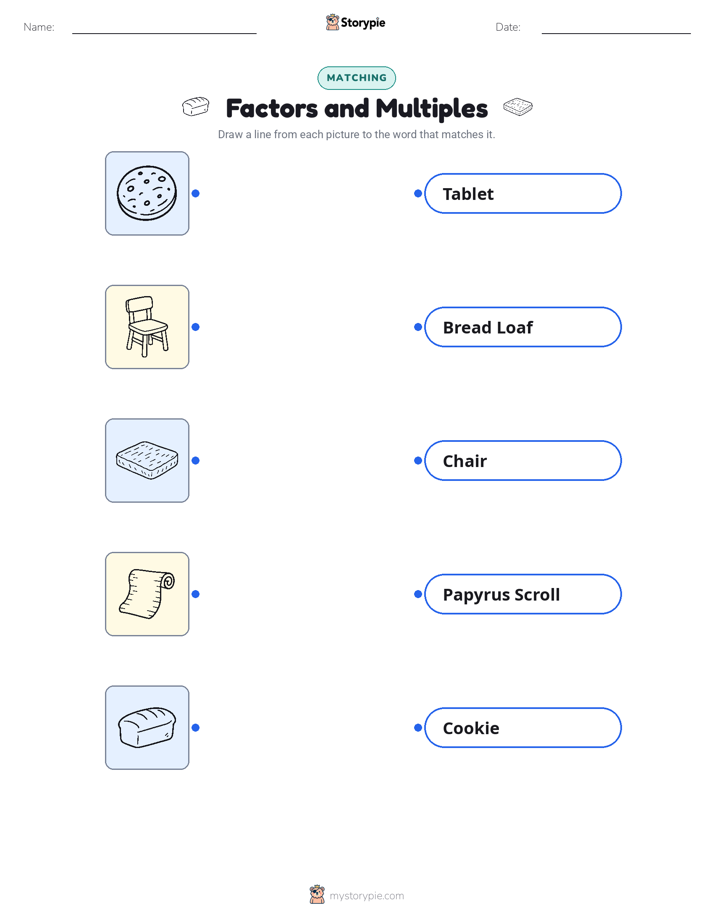
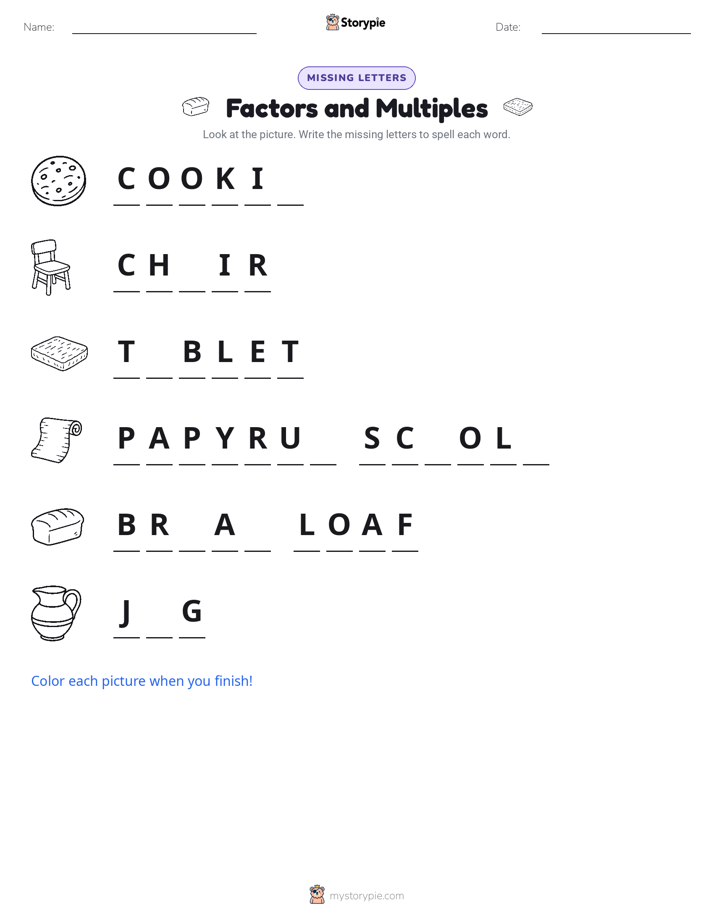
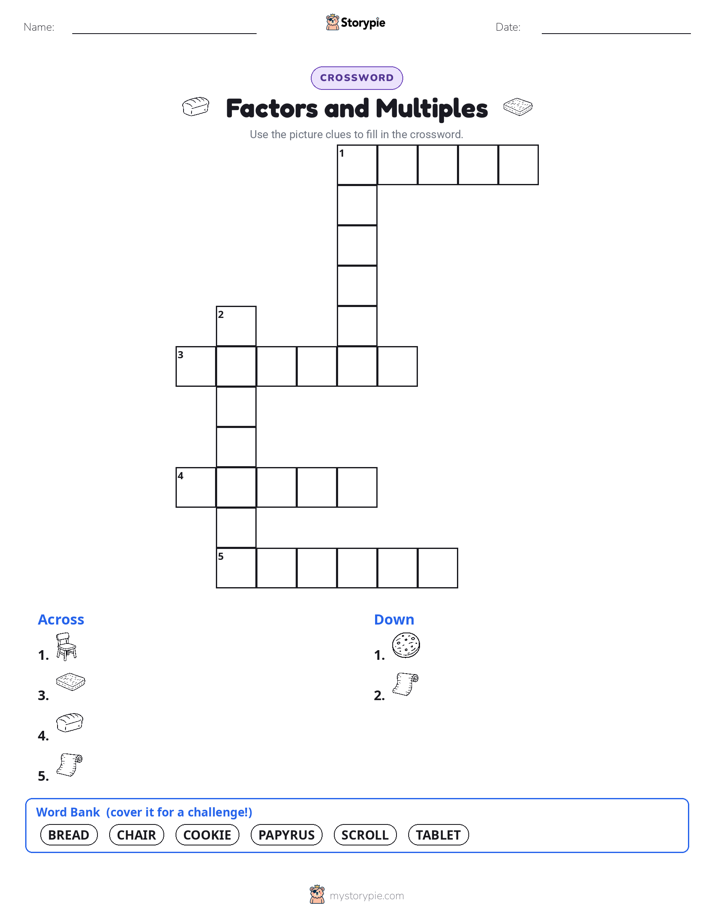
28 worksheets · answer keys · full story · quiz · Ages 6-8 · CEFR A2
Plus adds 244,000+ more stories in 27 languages, audio for every one, and printables for all of them.
Just want Factors and Multiples?

Have you ever shared something with your friends and it worked out just perfectly. Imagine you have twelve warm, chocolatey cookies. You can give two cookies each to six friends, with none left over. Or you could share them with four friends, and everyone gets three. What if you have twenty chairs to set up for a show. You can make two long rows of ten, or four neat rows of five. It’s like a secret puzzle where all the pieces click into place. How does that happen. It feels like magic, but it’s really me, your invisible helper for making things fair and organized. I make sure everything fits together without any messy remainders. Hello. I am the family of numbers called Factors and Multiples, and I'm the secret code that shows how numbers fit together.
I’m not a new secret, though. People discovered me thousands of years ago. Way back around the year 1800 BCE, in a place called Mesopotamia, people used me to solve big problems. They didn't have paper, so they wrote on soft clay tablets. They would press marks into the clay to figure out how to group large numbers of bricks for building huge temples or how to trade grains fairly at the market. I helped them build their whole world. Later, I traveled to ancient Greece. Around 500 BCE, a group of very smart thinkers called the Pythagoreans thought I was truly magical. They found special numbers they called ‘perfect numbers’. For example, the number six is perfect because all of its factors, the numbers that fit inside it perfectly, are one, two, and three. And guess what. When you add one, two, and three together, you get six. They thought that was the most amazing trick. Then, around 300 BCE, a brilliant mathematician named Euclid wrote a famous book called *Elements*. He wrote down all of my rules so that everyone, for thousands of years to come, could understand how I work.
The Secret Code of Numbers
Have you ever shared something with your friends and it worked out just perfectly. Imagine you have twelve warm, chocolatey cookies. You can give two cookies each to six friends, with none left over. Or you could share them with four friends, and everyone gets three. What if you have twenty chairs to set up for a show. You can make two long rows of ten, or four neat rows of five. It’s like a secret puzzle where all the pieces click into place. How does that happen. It feels like magic, but it’s really me, your invisible helper for making things fair and organized. I make sure everything fits together without any messy remainders. Hello. I am the family of numbers called Factors and Multiples, and I'm the secret code that shows how numbers fit together.
I’m not a new secret, though. People discovered me thousands of years ago. Way back around the year 1800 BCE, in a place called Mesopotamia, people used me to solve big problems. They didn't have paper, so they wrote on soft clay tablets. They would press marks into the clay to figure out how to group large numbers of bricks for building huge temples or how to trade grains fairly at the market. I helped them build their whole world. Later, I traveled to ancient Greece. Around 500 BCE, a group of very smart thinkers called the Pythagoreans thought I was truly magical. They found special numbers they called ‘perfect numbers’. For example, the number six is perfect because all of its factors, the numbers that fit inside it perfectly, are one, two, and three. And guess what. When you add one, two, and three together, you get six. They thought that was the most amazing trick. Then, around 300 BCE, a brilliant mathematician named Euclid wrote a famous book called Elements. He wrote down all of my rules so that everyone, for thousands of years to come, could understand how I work.
Even though I am ancient, I am still with you every single day, helping you in ways you might not even notice. Look at a clock. The number sixty is one of my favorite multiples. It can be divided by five, ten, and fifteen, which helps you read the time in chunks. Do you like music. The steady beat you tap your foot to is often grouped into measures, like four beats in a row, over and over. That’s me, organizing sound. When you plan a party, I help you figure out how many packs of juice boxes or hot dog buns to buy so every guest gets one. I am more than just math homework. I am a pattern that helps you share, create, and build. So next time you see numbers fitting together perfectly, you'll know I'm there, helping you make sense of the world.
Wow facts
About
Factors and Multiples are fundamental concepts in number theory that describe the relationships between integers through division and multiplication.
Take a Quiz
Question 1 of 4
Why did the Pythagoreans think the number six was perfect?
Explore next






Want to do even more?
Go beyond exploring. Unlock tools that turn every story into real learning.

Storypie Plus for families
Full stories, quizzes, and printables. Nights and car rides, sorted.
- Unlimited audio stories
- Create Mode: your child stars in the story
- Offline downloads
- Printable worksheets & coloring pages

Why Storypie for Schools
Students engaged. Prep in seconds. Evenings back to you.
- Worksheets & Quizzes
- Classroom Management
- Formative Assessment
- Custom Curriculum & Lesson Plans
- 27 Languages

Why Storypie for Homeschool
Curriculum done. They'll ask for more. Hours back in your day.
- Worksheet Generator
- First-Person Audio Stories
- Built-in Comprehension Quizzes
- Custom Curriculum & Lesson Plans
- Print & Go Activities