English


Germ Theory of Disease
The scientific theory that many diseases are caused by microorganisms, or 'germs'…
Reads at Grades 6–8 Listens at Grades 4–8
Print & create
Answer keys·No prep·Free with an account
28 worksheets · answer keys · full story · quiz · Ages 10-12 · CEFR B2
Plus adds 244,000+ more stories in 27 languages, audio for every one, and printables for all of them.
Just want Germ Theory of Disease?

Have you ever felt it. A tickle in your throat, a warmth spreading across your forehead, a sudden weariness that makes your arms and legs feel heavy. For thousands of years, that feeling was a terrifying mystery. When a sickness swept through a town, people looked for someone or something to blame. They whispered about curses, divine punishments, or a foul-smelling vapor they called ‘miasma,’ or bad air, that rose from swamps and filth. They could feel the effects—the fevers, the coughs, the weakness—but they couldn't see the cause. I was there all along, a hidden world teeming with life, an invisible army of tiny organisms marching through air, water, and soil. But no one could see me or understand my power. I am the big idea that explains these tiny invaders. I am the Germ Theory of Disease.
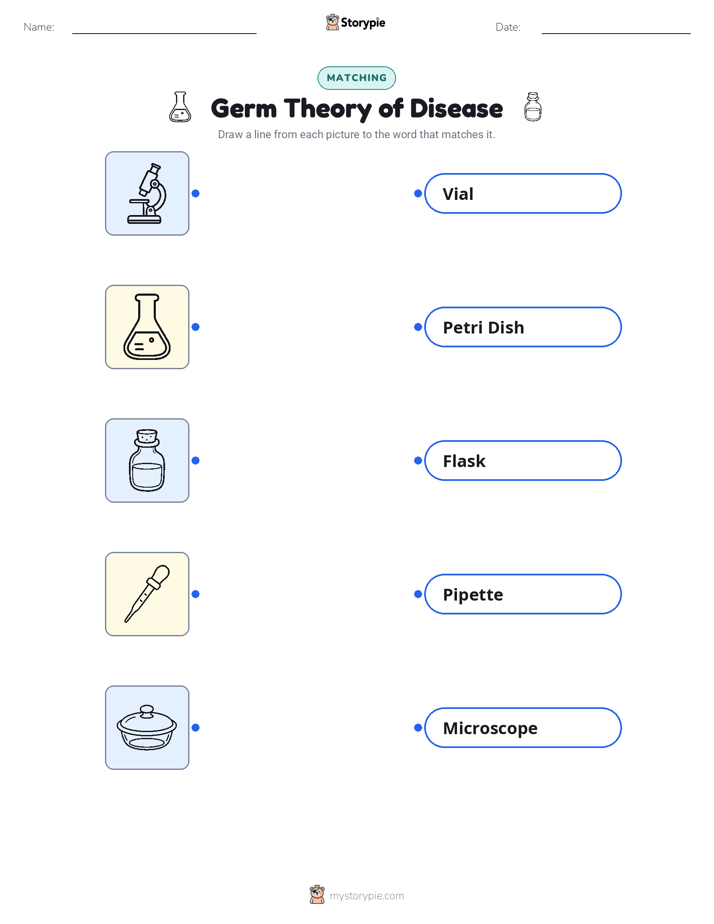
My story, the story of my discovery, began with a few curious minds who dared to imagine a world beyond what the eye could see. It took a very long time for people to piece the clues together. As far back as 1546, an Italian physician named Girolamo Fracastoro proposed a radical idea. He suggested that diseases might be caused by tiny, seed-like entities that could spread from person to person. It was a brilliant guess, but without proof, it remained just an idea. More than a century later, in the 1670s, a Dutch shopkeeper with an incredible hobby, Antonie van Leeuwenhoek, built one of the most powerful microscopes of his time. He pointed its lens at a drop of pond water and was astonished to see a bustling world of tiny creatures zipping and tumbling about. He called them 'animalcules,' or little animals. He found them everywhere—in rainwater, on his teeth—but he never made the connection that they could be the cause of human sickness. The mystery deepened in the 1840s, when a Hungarian doctor named Ignaz Semmelweis worked in a hospital where many new mothers were tragically dying from a fever. He noticed that doctors would go from examining the dead directly to delivering babies without cleaning their hands. He ordered the doctors to wash their hands in a chlorine solution, and the death rate plummeted. He had found a monumental clue, but he couldn't explain the scientific reason why it worked, and many other doctors tragically dismissed his life-saving discovery.
The Secret of the Invisible Invaders
Have you ever felt it. A tickle in your throat, a warmth spreading across your forehead, a sudden weariness that makes your arms and legs feel heavy. For thousands of years, that feeling was a terrifying mystery. When a sickness swept through a town, people looked for someone or something to blame. They whispered about curses, divine punishments, or a foul-smelling vapor they called ‘miasma,’ or bad air, that rose from swamps and filth. They could feel the effects—the fevers, the coughs, the weakness—but they couldn't see the cause. I was there all along, a hidden world teeming with life, an invisible army of tiny organisms marching through air, water, and soil. But no one could see me or understand my power. I am the big idea that explains these tiny invaders. I am the Germ Theory of Disease.
My story, the story of my discovery, began with a few curious minds who dared to imagine a world beyond what the eye could see. It took a very long time for people to piece the clues together. As far back as 1546, an Italian physician named Girolamo Fracastoro proposed a radical idea. He suggested that diseases might be caused by tiny, seed-like entities that could spread from person to person. It was a brilliant guess, but without proof, it remained just an idea. More than a century later, in the 1670s, a Dutch shopkeeper with an incredible hobby, Antonie van Leeuwenhoek, built one of the most powerful microscopes of his time. He pointed its lens at a drop of pond water and was astonished to see a bustling world of tiny creatures zipping and tumbling about. He called them 'animalcules,' or little animals. He found them everywhere—in rainwater, on his teeth—but he never made the connection that they could be the cause of human sickness. The mystery deepened in the 1840s, when a Hungarian doctor named Ignaz Semmelweis worked in a hospital where many new mothers were tragically dying from a fever. He noticed that doctors would go from examining the dead directly to delivering babies without cleaning their hands. He ordered the doctors to wash their hands in a chlorine solution, and the death rate plummeted. He had found a monumental clue, but he couldn't explain the scientific reason why it worked, and many other doctors tragically dismissed his life-saving discovery.
The final pieces of the puzzle clicked into place thanks to two brilliant and determined scientists. The first was a French chemist named Louis Pasteur. In the 1860s, he was asked to solve a very practical problem: why were local wine and beer spoiling. Through careful experiments, he proved that microscopic organisms floating in the air were landing in the vats and causing the spoilage. He demonstrated that by heating the liquid just enough to kill these invaders, a process we now call pasteurization, the beverage would be preserved. This was a revolutionary moment. He had proven that these invisible microbes weren't just present; they were active agents of change. It was no longer a great leap to suggest that if they could spoil wine, they could also 'spoil' the human body and cause disease. Shortly after, a German doctor named Robert Koch provided the irrefutable proof. In the 1880s, he developed a precise, four-step method to identify the specific germ that caused a specific disease. Using these steps, known as Koch's Postulates, he identified the exact bacterium responsible for anthrax, a deadly disease in cattle and people. He then went on to discover the bacteria that caused tuberculosis and cholera, two of the most feared diseases of his time. With Pasteur's framework and Koch's methodical proof, I was no longer a theory. I was a scientific fact.
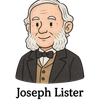
Once humanity understood me, the world was transformed forever. A British surgeon named Joseph Lister, inspired by Pasteur's work, began using carbolic acid as an antiseptic to clean wounds and surgical instruments in the 1860s. Suddenly, surgery went from being a life-threatening gamble to a life-saving procedure. Armed with the knowledge I provided, cities began building massive sewer systems and water-purification plants to separate waste from drinking water, stopping the spread of diseases like cholera. Scientists were inspired to develop vaccines to train the body to fight off specific germs, and later, antibiotics to kill them directly. I am the reason you wash your hands with soap, why doctors wear masks and gloves, why you get vaccinations to protect you from measles or the flu, and why your milk and juice are safe to drink. I am a constant reminder that the greatest mysteries can be solved with curiosity, careful observation, and a willingness to see the world in a new way. And I continue to inspire scientists today as they work to understand and fight new diseases, proving that even the smallest things in the universe can teach us the biggest lessons.
Wow facts
About
The scientific theory that many diseases are caused by microorganisms, or 'germs', which are mostly too small to see without a microscope, but some tiny living things made of many cells can be seen without one.
Take a Quiz
Question 1 of 5
In your own words, describe the key contributions of both Louis Pasteur and Robert Koch.
Explore next





Want to do even more?
Go beyond exploring. Unlock tools that turn every story into real learning.

Storypie Plus for families
Full stories, quizzes, and printables. Nights and car rides, sorted.
- Unlimited audio stories
- Create Mode: your child stars in the story
- Offline downloads
- Printable worksheets & coloring pages

Why Storypie for Schools
Students engaged. Prep in seconds. Evenings back to you.
- Worksheets & Quizzes
- Classroom Management
- Formative Assessment
- Custom Curriculum & Lesson Plans
- 27 Languages

Why Storypie for Homeschool
Curriculum done. They'll ask for more. Hours back in your day.
- Worksheet Generator
- First-Person Audio Stories
- Built-in Comprehension Quizzes
- Custom Curriculum & Lesson Plans
- Print & Go Activities