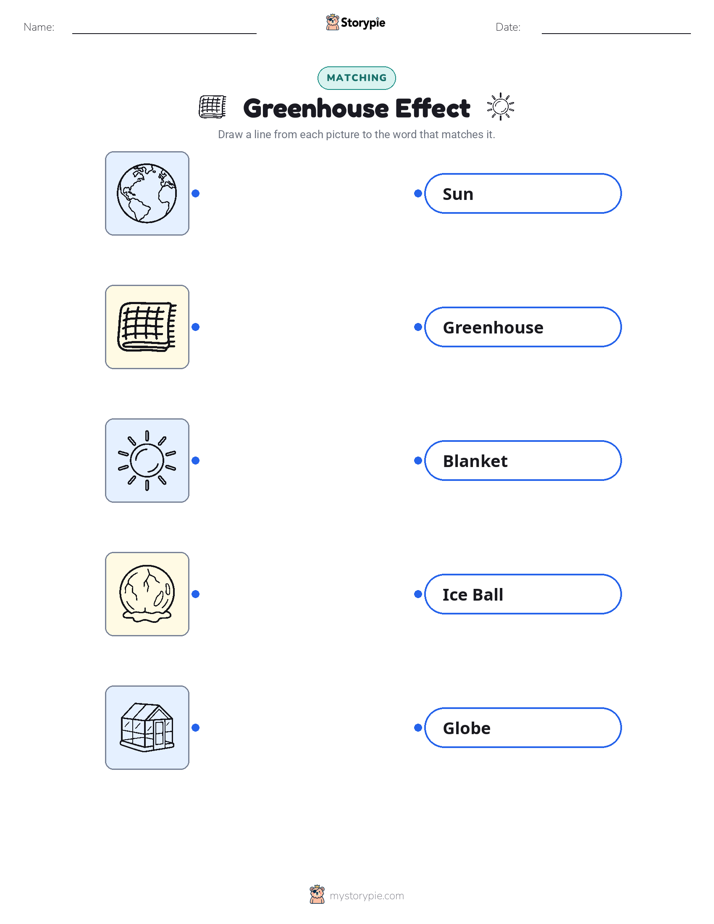
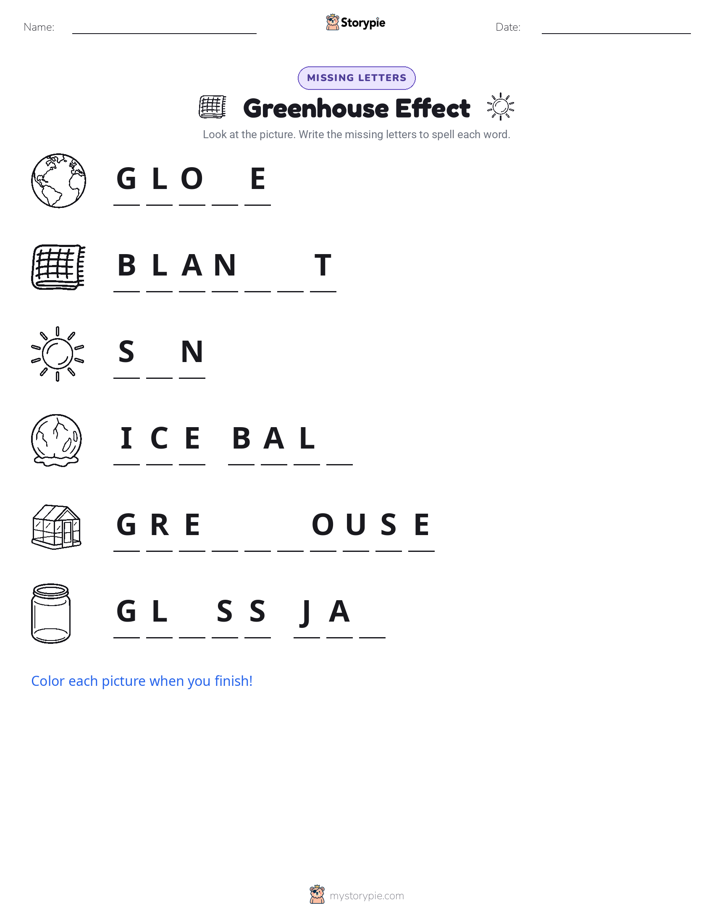
English

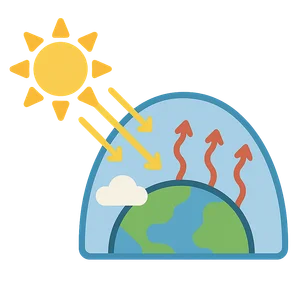
Greenhouse Effect
The Greenhouse Effect is a natural process where certain gases in Earth's atmosphere trap the sun's heat…
Reads at Grades 6–8 Listens at Grades 4–8
Print & create
Answer keys·No prep·Free with an account
28 worksheets · answer keys · full story · quiz · Ages 10-12 · CEFR B2
Plus adds 102,000+ more stories in 27 languages, audio for every one, and printables for all of them.
Just want Greenhouse Effect?
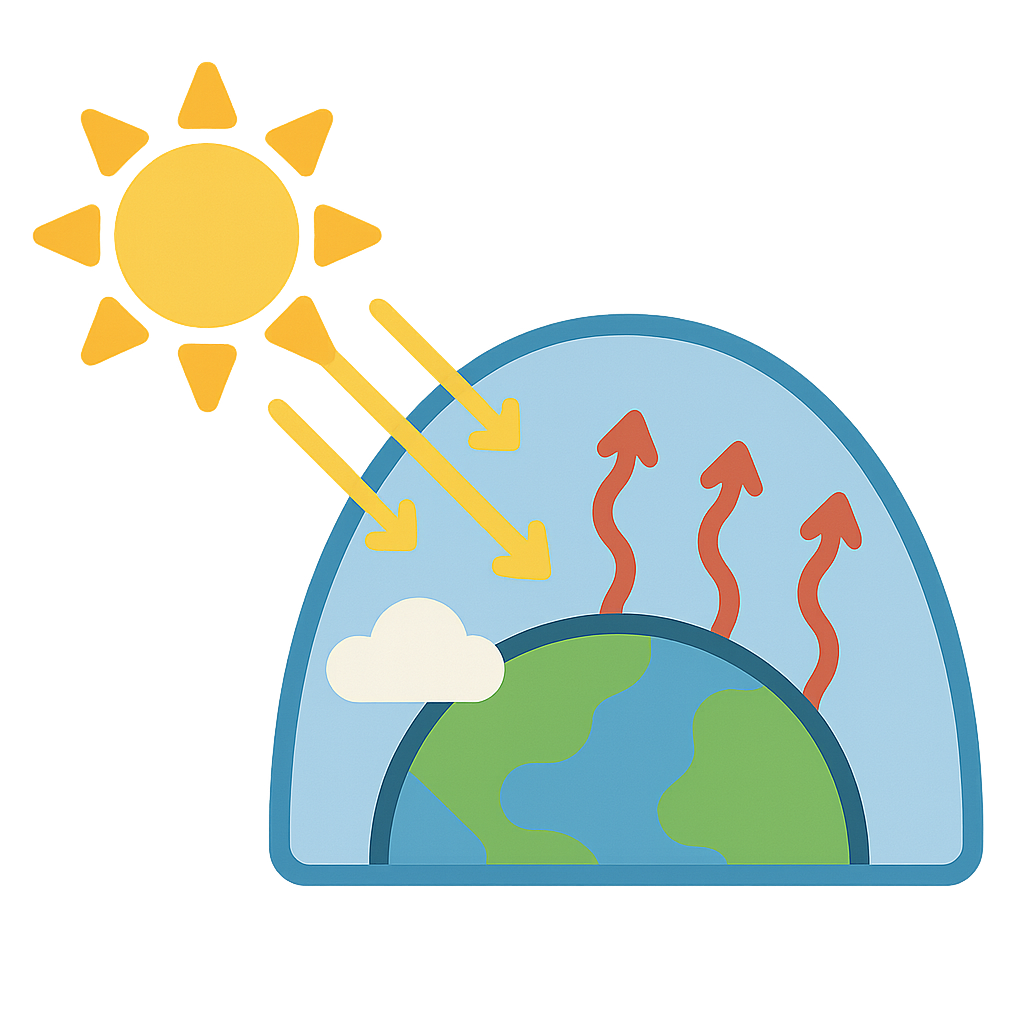
Imagine for a moment that you are floating in the vast, silent cold of space, looking down at a swirling blue and green marble. That marble is Earth, your home. From out here, you can’t see me, but I am the reason that marble is alive. I am a giant, invisible blanket wrapped snugly around the entire planet. I work tirelessly day and night, managing the sun’s powerful, golden rays. When sunlight travels through space and reaches Earth, I let some of its warmth touch the lands and oceans. Some of that heat then tries to bounce back into space, but that’s where I step in. I catch a portion of it, holding it close, keeping the planet perfectly cozy. Without me, Earth would be a desolate, frozen ice ball, with an average temperature far below freezing. The oceans would be solid blocks of ice and the vibrant green forests you know would be barren, frosty landscapes. I am like the crystal-clear glass walls of a greenhouse. The glass lets the sun’s light stream in to warm the soil and help the plants grow, but it doesn't let all the heat escape. I do the same thing for the entire world, creating a stable climate where life can flourish. I am the reason you can feel warm sunshine, swim in cool oceans, and breathe the air that rustles the leaves on the trees. I am the Greenhouse Effect, and I make your world livable.
For most of human history, people felt my warmth but never truly understood me. They knew the sun was hot and the night was cold, but the reason Earth was ‘just right’ remained a mystery. That began to change in the 1820s, thanks to a deeply curious French scientist named Jean-Baptiste Joseph Fourier. He was a brilliant thinker who studied heat, and he found a major puzzle. Around the year 1824, he sat down with his calculations. He knew how far the Earth was from the sun and how much energy the sun produced. When he did the math, he was stumped. His numbers showed that the Earth should be significantly colder than it actually was. It should have been a frozen world. So, he asked a monumental question: Why isn't this planet frozen solid. He began to theorize, imagining the planet’s atmosphere as a kind of bell jar, or perhaps the lid on a pot, trapping heat that would otherwise escape. He didn’t have the tools to prove it, and he couldn’t identify which parts of the air were responsible for my work, but his insight was the critical first step. He was the first person to realize that the air itself was performing a vital job, actively warming the planet. Fourier’s puzzling question sparked a scientific journey that would take decades to unfold, a quest to truly understand how I work.
The Earth's Invisible Blanket
Imagine for a moment that you are floating in the vast, silent cold of space, looking down at a swirling blue and green marble. That marble is Earth, your home. From out here, you can’t see me, but I am the reason that marble is alive. I am a giant, invisible blanket wrapped snugly around the entire planet. I work tirelessly day and night, managing the sun’s powerful, golden rays. When sunlight travels through space and reaches Earth, I let some of its warmth touch the lands and oceans. Some of that heat then tries to bounce back into space, but that’s where I step in. I catch a portion of it, holding it close, keeping the planet perfectly cozy. Without me, Earth would be a desolate, frozen ice ball, with an average temperature far below freezing. The oceans would be solid blocks of ice and the vibrant green forests you know would be barren, frosty landscapes. I am like the crystal-clear glass walls of a greenhouse. The glass lets the sun’s light stream in to warm the soil and help the plants grow, but it doesn't let all the heat escape. I do the same thing for the entire world, creating a stable climate where life can flourish. I am the reason you can feel warm sunshine, swim in cool oceans, and breathe the air that rustles the leaves on the trees. I am the Greenhouse Effect, and I make your world livable.
For most of human history, people felt my warmth but never truly understood me. They knew the sun was hot and the night was cold, but the reason Earth was ‘just right’ remained a mystery. That began to change in the 1820s, thanks to a deeply curious French scientist named Jean-Baptiste Joseph Fourier. He was a brilliant thinker who studied heat, and he found a major puzzle. Around the year 1824, he sat down with his calculations. He knew how far the Earth was from the sun and how much energy the sun produced. When he did the math, he was stumped. His numbers showed that the Earth should be significantly colder than it actually was. It should have been a frozen world. So, he asked a monumental question: Why isn't this planet frozen solid. He began to theorize, imagining the planet’s atmosphere as a kind of bell jar, or perhaps the lid on a pot, trapping heat that would otherwise escape. He didn’t have the tools to prove it, and he couldn’t identify which parts of the air were responsible for my work, but his insight was the critical first step. He was the first person to realize that the air itself was performing a vital job, actively warming the planet. Fourier’s puzzling question sparked a scientific journey that would take decades to unfold, a quest to truly understand how I work.
Fourier had asked the question, but the world needed detectives to find the answers. The first major clue came from an American scientist and women's rights advocate named Eunice Newton Foote. In 1856, she conducted a simple but profoundly important experiment. She took several glass jars, placed a thermometer in each, and filled them with different gases. One jar had normal air, another had moist air, and a crucial one had carbon dioxide. She then placed the jars in the sunlight and watched. She observed that the jar filled with carbon dioxide became much hotter than the others and took longer to cool down once it was moved into the shade. She had discovered one of my most powerful secret ingredients. She wrote that an atmosphere of that gas would give our Earth a high temperature. Just a few years later, in 1859, an Irish physicist named John Tyndall took the investigation to the next level. He was a meticulous experimenter and built sophisticated laboratory equipment to measure precisely how different gases absorbed heat. His experiments confirmed Foote's findings with incredible accuracy and added another key ingredient to my recipe: water vapor. Tyndall proved beyond a doubt that gases like carbon dioxide and water vapor, even in tiny amounts, were incredible heat-trappers. The mystery was being solved, piece by piece. They had found the specific components of the atmosphere that allowed me to hold onto the sun’s warmth.
With my main ingredients identified, the final piece of the puzzle was to understand the scale of my power. That piece was put into place by a Swedish scientist named Svante Arrhenius. In 1896, he spent countless hours performing complex calculations by hand. He wanted to figure out something very specific: how much would the Earth's temperature change if the amount of carbon dioxide in the atmosphere was cut in half or even doubled. He was the first person to create a model that connected the concentration of carbon dioxide directly to global temperature. His work brought the understanding of me into the modern age. It showed that I am part of a delicate balance. Naturally, I am a good and essential thing. But in the last couple of centuries, human activities have started to change my composition. The burning of fossil fuels like coal and oil for factories, cars, and electricity has released enormous amounts of extra carbon dioxide into the air, making my blanket a little too thick and trapping more heat than usual. But the story doesn't end there. The very same human curiosity that discovered me is now working to protect that delicate balance. Now that people understand me so well, they have the power to innovate. By developing clean energy sources like solar and wind power and working together across the globe, humanity can ensure I keep the planet 'just right' for all the generations to come. It is a powerful reminder that understanding the world is the first step toward caring for it.
Wow facts
About
The Greenhouse Effect is a natural process where certain gases in Earth's atmosphere trap the sun's heat, warming the planet and making it habitable.
Take a Quiz
Question 1 of 5
In your own words, summarize the main idea of the story.
Explore next






Want to do even more?
Go beyond exploring. Unlock tools that turn every story into real learning.

Storypie Plus for families
Full stories, quizzes, and printables. Nights and car rides, sorted.
- Unlimited audio stories
- Create Mode: your child stars in the story
- Offline downloads
- Printable worksheets & coloring pages

Why Storypie for Schools
Students engaged. Prep in seconds. Evenings back to you.
- Worksheets & Quizzes
- Classroom Management
- Formative Assessment
- Custom Curriculum & Lesson Plans
- 27 Languages

Why Storypie for Homeschool
Curriculum done. They'll ask for more. Hours back in your day.
- Worksheet Generator
- First-Person Audio Stories
- Built-in Comprehension Quizzes
- Custom Curriculum & Lesson Plans
- Print & Go Activities