English

Pax Romana
The Pax Romana, Latin for 'Roman Peace…
Reads at Grades 6–8 Listens at Grades 4–8
Print & create
Answer keys·No prep·Free with an account
28 worksheets · answer keys · full story · quiz · Ages 10-12 · CEFR B2
Plus adds 102,000+ more stories in 27 languages, audio for every one, and printables for all of them.
Just want Pax Romana?
I am the quiet on a long, paved road stretching from the misty forests of Britain to the sun-baked sands of Egypt. I am the familiar gleam of a shared coin, a denarius, used to buy bread in a Gallic market and fragrant spices in a Syrian port. Before I arrived, the world known to the Romans was a place of chaos, torn apart by nearly a century of bitter and bloody civil wars. Brother fought against brother, and great armies clashed not to defend the borders, but to seize power. Fear was a constant companion. But then, a deep and lasting calm began to settle over the Mediterranean world. People could plan for the future. A merchant could send a ship from Alexandria to Rome and feel confident it would arrive safely. A family could build a home knowing it was unlikely to be burned in a sudden conflict. I was the invisible shield that protected millions, the steady ground upon which an empire could not only stand but thrive. I was the opportunity to build, to think, and to connect across vast distances. What am I?
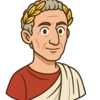
I am the Pax Romana, a Latin phrase that means 'Roman Peace.' I was not born in a single day, nor was I created by a single law. My existence was earned through exhaustion and a deep desire for order after generations of turmoil. My story truly begins as the old Roman Republic crumbled, its foundations shaken by the ambitions of powerful men like Julius Caesar, Pompey, and Mark Antony. Their struggles for supreme control plunged the world into relentless warfare. The turning point came in 27 BCE, after the final naval battle at Actium. The victor, a young and clever leader named Octavian, returned to Rome. Instead of declaring himself a king, which the Romans despised, he took a new title: Augustus. As the first Roman Emperor, he declared that the time for internal fighting was over. He knew that peace could not be maintained by words alone. Augustus skillfully reorganized the massive Roman army, stationing the legions along the frontiers of the empire to defend against external threats, not to fight each other. He established a professional civil service to govern the provinces fairly and passed laws that brought order and predictability to daily life. My era officially began with his long and stable reign, and I would hold the empire in my embrace for nearly two hundred years, a remarkable span of tranquility in a violent age.
The Roman Peace
I am the quiet on a long, paved road stretching from the misty forests of Britain to the sun-baked sands of Egypt. I am the familiar gleam of a shared coin, a denarius, used to buy bread in a Gallic market and fragrant spices in a Syrian port. Before I arrived, the world known to the Romans was a place of chaos, torn apart by nearly a century of bitter and bloody civil wars. Brother fought against brother, and great armies clashed not to defend the borders, but to seize power. Fear was a constant companion. But then, a deep and lasting calm began to settle over the Mediterranean world. People could plan for the future. A merchant could send a ship from Alexandria to Rome and feel confident it would arrive safely. A family could build a home knowing it was unlikely to be burned in a sudden conflict. I was the invisible shield that protected millions, the steady ground upon which an empire could not only stand but thrive. I was the opportunity to build, to think, and to connect across vast distances. What am I?
I am the Pax Romana, a Latin phrase that means 'Roman Peace.' I was not born in a single day, nor was I created by a single law. My existence was earned through exhaustion and a deep desire for order after generations of turmoil. My story truly begins as the old Roman Republic crumbled, its foundations shaken by the ambitions of powerful men like Julius Caesar, Pompey, and Mark Antony. Their struggles for supreme control plunged the world into relentless warfare. The turning point came in 27 BCE, after the final naval battle at Actium. The victor, a young and clever leader named Octavian, returned to Rome. Instead of declaring himself a king, which the Romans despised, he took a new title: Augustus. As the first Roman Emperor, he declared that the time for internal fighting was over. He knew that peace could not be maintained by words alone. Augustus skillfully reorganized the massive Roman army, stationing the legions along the frontiers of the empire to defend against external threats, not to fight each other. He established a professional civil service to govern the provinces fairly and passed laws that brought order and predictability to daily life. My era officially began with his long and stable reign, and I would hold the empire in my embrace for nearly two hundred years, a remarkable span of tranquility in a violent age.
With the constant threat of civil war lifted, the energy of the Roman people was unleashed in incredible ways. I watched with pride as Roman engineers, the greatest of their time, achieved monumental feats. They built a network of over 50,000 miles of straight, stone-paved roads that crisscrossed the empire, connecting faraway provinces and allowing armies, messengers, and merchants to travel with unprecedented speed and safety. Great arched aqueducts, like magnificent bridges for water, were constructed to carry fresh streams from the mountains into bustling cities, allowing places like Rome to grow to a population of over a million people. But my influence was more than just stone and mortar. Along these safe roads, it was not just goods that traveled, but ideas. New philosophies and beliefs, including a small but growing faith called Christianity, spread from the Middle East all the way to Spain and Britain. A single system of Roman law brought justice and a sense of shared rights to diverse peoples, and a common currency made trade simple and efficient. Though soldiers still fought battles on the distant frontiers in Germany or Persia, for the vast majority of the fifty million people living within the Roman Empire, I was a golden age. I was a time of prosperity, security, and cultural exchange that the world had never seen before.
Like all things, my time had an end. My strength began to fade after the death of the philosopher-emperor Marcus Aurelius in 180 CE. The calm I had maintained for so long began to fray as internal conflicts and economic troubles returned. But I never truly disappeared. The legacy of my era was too strong to be erased. The roads, bridges, and aqueducts built during my time were so well-made that they were used for centuries, and many, like the Pont du Gard in France, still stand as a testament to the skill of their builders. The legal principles developed to govern a peaceful and complex society influenced the laws of countless modern nations in Europe and beyond. More than anything, I left behind a powerful idea: the understanding that peace is not merely the absence of war. It is the foundation upon which people can create, connect, and build a better, more prosperous world together. That idea, my lasting echo, continues to inspire leaders and citizens to work for stability and understanding, hoping to create their own periods of peace to this day.
Wow facts
About
The Pax Romana, Latin for 'Roman Peace,' was a period of approximately 200 years of relative peace and stability across the Roman Empire, beginning with the reign of Emperor Augustus in 27 BCE.
Take a Quiz
Question 1 of 5
According to the story, what major problem did Augustus solve to begin the era of the Pax Romana?
Explore next


Want to do even more?
Go beyond exploring. Unlock tools that turn every story into real learning.

Storypie Plus for families
Full stories, quizzes, and printables. Nights and car rides, sorted.
- Unlimited audio stories
- Create Mode: your child stars in the story
- Offline downloads
- Printable worksheets & coloring pages

Why Storypie for Schools
Students engaged. Prep in seconds. Evenings back to you.
- Worksheets & Quizzes
- Classroom Management
- Formative Assessment
- Custom Curriculum & Lesson Plans
- 27 Languages

Why Storypie for Homeschool
Curriculum done. They'll ask for more. Hours back in your day.
- Worksheet Generator
- First-Person Audio Stories
- Built-in Comprehension Quizzes
- Custom Curriculum & Lesson Plans
- Print & Go Activities