English

Pythagorean Theorem
The Pythagorean Theorem is a fundamental principle in geometry stating that in a right-angled triangle…
Reads at Grades 6–8 Listens at Grades 4–8
Print & create
Answer keys·No prep·Free with an account
28 worksheets · answer keys · full story · quiz · Ages 10-12 · CEFR B2
Plus adds 244,000+ more stories in 27 languages, audio for every one, and printables for all of them.
Just want Pythagorean Theorem?

Have you ever noticed the perfect corners all around you? Look at the edge of your book, the corner of your screen, or where the wall meets the floor. I live in those corners. I am a secret, a special rule that exists inside any triangle that has one of those perfect, square corners. These are called right-angled triangles, and they are my favorite shape. I connect their three sides in a way that is so reliable, it feels like magic. If you know the length of two of my sides, I can always tell you the length of the third. For thousands of years, people saw me at work, building and measuring, but they did not know my name. They used my power without understanding the source of my strength. I was a silent helper, a pattern hidden in plain sight, waiting for a curious mind to ask not just 'how,' but 'why.' I was an unspoken truth in the architecture of the world, a predictable wonder that held buildings up and kept borders straight, waiting patiently to be discovered and given a name.
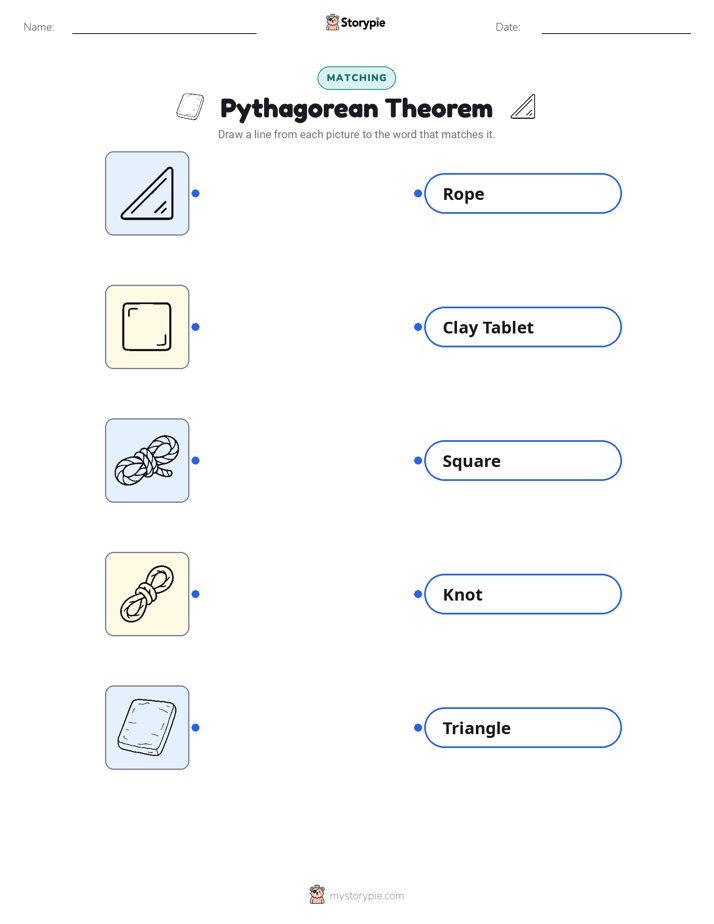
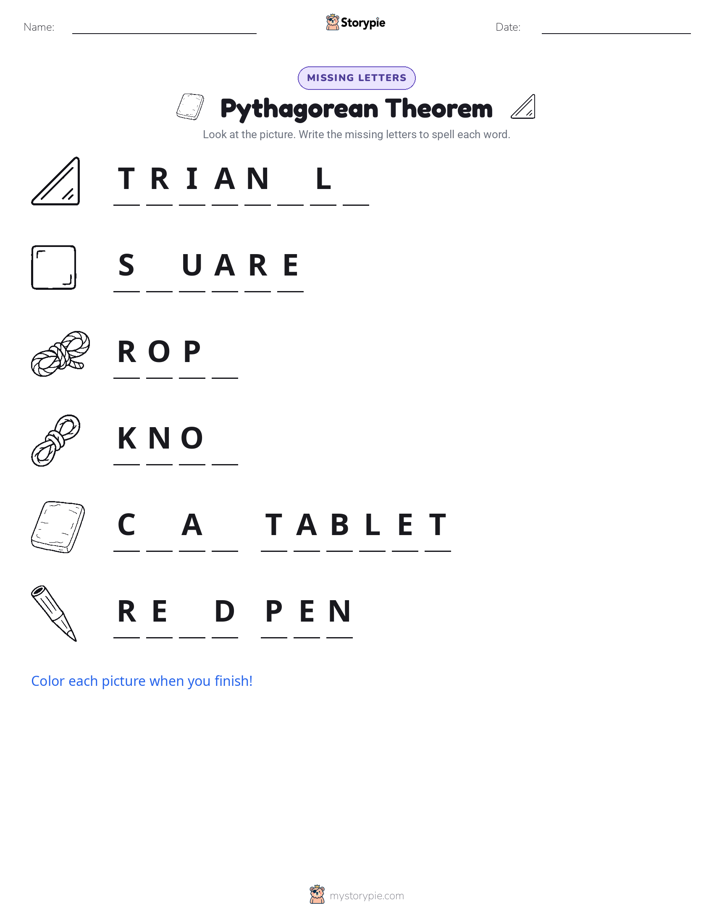
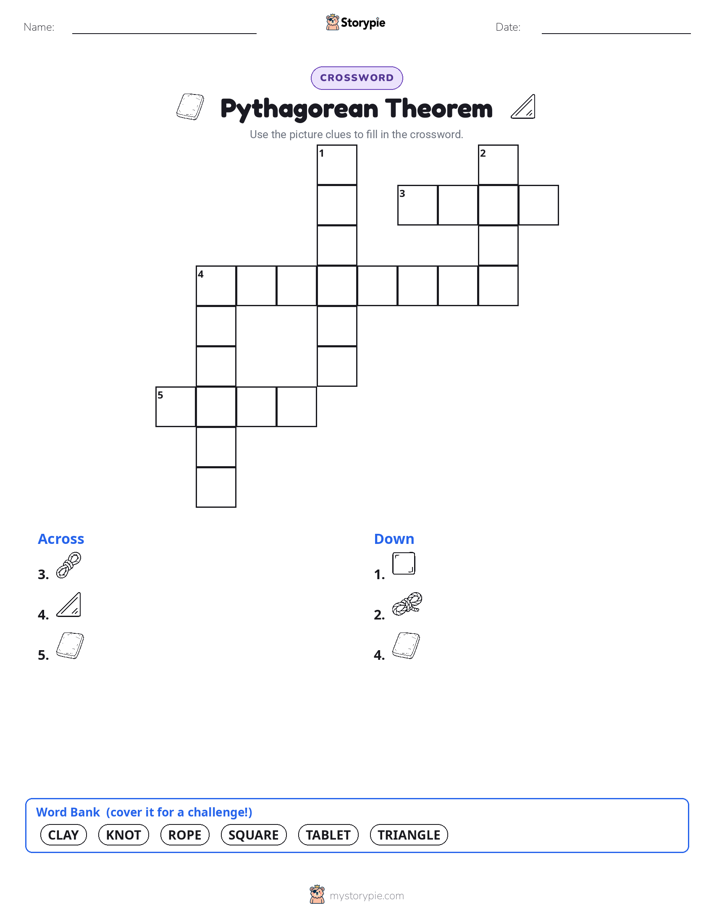
Long before the famous ancient Greeks, other brilliant civilizations knew my secret. In Mesopotamia, around 1800 BCE, wise Babylonian scribes etched numbers onto wet clay tablets with reed pens. One famous tablet, which we now call Plimpton 322, is like a cheat sheet of my favorite number combinations. They knew that if a triangle's shorter sides were 3 and 4 units long, the longest side had to be 5. They used this knowledge to divide land with precision and build their magnificent ziggurats, stacking temples that seemed to touch the sky. Far away, along the Nile River in Egypt, around 2500 BCE, people had a very clever way of using me. They were called 'rope-stretchers.' They would take a long rope and tie 12 knots in it at equal distances. By stretching it out to form a triangle with sides of 3, 4, and 5 knots, they created a perfect right angle every single time. This was incredibly important for building the foundations of the Great Pyramids and for re-drawing property lines after the river flooded each year, washing away the old boundaries. These clever people knew I worked. I was a practical tool, a recipe for precision. But the deep, universal reason for my existence was still a mystery.
The Secret of the Square Corner
Have you ever noticed the perfect corners all around you? Look at the edge of your book, the corner of your screen, or where the wall meets the floor. I live in those corners. I am a secret, a special rule that exists inside any triangle that has one of those perfect, square corners. These are called right-angled triangles, and they are my favorite shape. I connect their three sides in a way that is so reliable, it feels like magic. If you know the length of two of my sides, I can always tell you the length of the third. For thousands of years, people saw me at work, building and measuring, but they did not know my name. They used my power without understanding the source of my strength. I was a silent helper, a pattern hidden in plain sight, waiting for a curious mind to ask not just 'how,' but 'why.' I was an unspoken truth in the architecture of the world, a predictable wonder that held buildings up and kept borders straight, waiting patiently to be discovered and given a name.
Long before the famous ancient Greeks, other brilliant civilizations knew my secret. In Mesopotamia, around 1800 BCE, wise Babylonian scribes etched numbers onto wet clay tablets with reed pens. One famous tablet, which we now call Plimpton 322, is like a cheat sheet of my favorite number combinations. They knew that if a triangle's shorter sides were 3 and 4 units long, the longest side had to be 5. They used this knowledge to divide land with precision and build their magnificent ziggurats, stacking temples that seemed to touch the sky. Far away, along the Nile River in Egypt, around 2500 BCE, people had a very clever way of using me. They were called 'rope-stretchers.' They would take a long rope and tie 12 knots in it at equal distances. By stretching it out to form a triangle with sides of 3, 4, and 5 knots, they created a perfect right angle every single time. This was incredibly important for building the foundations of the Great Pyramids and for re-drawing property lines after the river flooded each year, washing away the old boundaries. These clever people knew I worked. I was a practical tool, a recipe for precision. But the deep, universal reason for my existence was still a mystery.
Then, a man came along who was not content with just knowing that I worked; he was obsessed with understanding why. His name was Pythagoras, and he was born on the Greek island of Samos around the year 570 BCE. Pythagoras was a thinker, a traveler, and a lover of numbers. He believed the entire universe was built on the logic and beauty of mathematics. He journeyed to Egypt and Babylon, where he saw the knotted ropes and the clay tablets. He saw people using me, but no one could give him the one thing he truly wanted: a proof. A proof is a logical argument that shows something is not just true sometimes, but that it must be true all the time, for every single right-angled triangle in existence, no matter how big or small. Around 530 BCE, Pythagoras started a school in Croton, a Greek colony in southern Italy. He and his followers, known as the Pythagoreans, dedicated their lives to studying music, astronomy, and, of course, numbers. They were not just using me as a tool; they were putting me under a microscope to discover my deepest truth. They drew shapes in the sand, debated ideas for hours, and searched relentlessly for the elegant reason behind my magic. They challenged each other, tested my limits, and refused to accept 'it just works' as an answer.
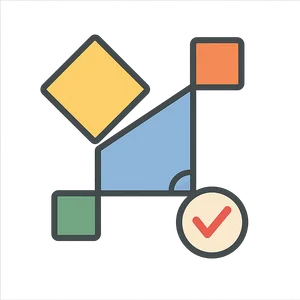
Finally, after much thought, Pythagoras and his students found it—the beautiful proof they were looking for. They imagined drawing a square on each of the three sides of a right-angled triangle. What they proved was that the area of the two squares on the shorter sides, when added together, would always and forever exactly equal the area of the big square on the longest side. This was the universal 'why'. It was not a trick or a coincidence; it was a fundamental law of the universe. To honor this incredible achievement, they gave me the name I carry to this day: the Pythagorean Theorem. They also gave me a famous mathematical nickname: a² + b² = c². Here, 'a' and 'b' are the two shorter sides that form the right angle, and 'c' is the long, sloping side across from it, called the hypotenuse. My identity was no longer a secret; it was a celebrated truth.
For over 2,500 years, I have been one of the most important tools in the world. Architects use me to make sure buildings are safe and strong. Engineers use me to design bridges, roads, and even roller coasters, ensuring every angle is perfect. When your phone's GPS tells you the shortest way to get somewhere, it's using me to calculate the distance as the crow flies, creating an invisible triangle between you, your destination, and a point on the map. I am even inside your favorite video games, helping characters move realistically across the screen by calculating their paths and positions. I help astronomers measure the vast distances between stars and planets. I started as a whisper on a clay tablet and a trick with a knotted rope, but a hunger to know 'why' turned me into a key that unlocks the universe. I am proof that numbers are more than just symbols; they are a language that describes the world. And I am here for you, waiting to help you measure, build, and imagine whatever you can dream up next.
Wow facts
About
The Pythagorean Theorem is a fundamental principle in geometry stating that in a right-angled triangle, the square of the hypotenuse is equal to the sum of the squares of the other two sides (a² + b² = c²).
Take a Quiz
Question 1 of 5
What is the main idea of this story?
Explore next





Want to do even more?
Go beyond exploring. Unlock tools that turn every story into real learning.

Storypie Plus for families
Full stories, quizzes, and printables. Nights and car rides, sorted.
- Unlimited audio stories
- Create Mode: your child stars in the story
- Offline downloads
- Printable worksheets & coloring pages

Why Storypie for Schools
Students engaged. Prep in seconds. Evenings back to you.
- Worksheets & Quizzes
- Classroom Management
- Formative Assessment
- Custom Curriculum & Lesson Plans
- 27 Languages

Why Storypie for Homeschool
Curriculum done. They'll ask for more. Hours back in your day.
- Worksheet Generator
- First-Person Audio Stories
- Built-in Comprehension Quizzes
- Custom Curriculum & Lesson Plans
- Print & Go Activities