English

Pythagorean Theorem
The Pythagorean Theorem is a fundamental principle in geometry stating that in a right-angled triangle…
Reads at Grades 3–5 Listens at Grades 1–5
Print & create
Answer keys·No prep·Free with an account
28 worksheets · answer keys · full story · quiz · Ages 8-10 · CEFR B1
Plus adds 244,000+ more stories in 27 languages, audio for every one, and printables for all of them.
Just want Pythagorean Theorem?

Have you ever looked closely at the corner of a book, a floor tile, or a windowpane? That perfect, sharp corner where two straight lines meet is my favorite place to hide. I am a secret rule, a kind of magic that lives inside any shape with one of those perfect corners. We call that shape a right-angled triangle. It has two straight sides that make the corner, like little arms reaching out, and one long, slanted side that connects them. I have a wonderful secret: if you know the lengths of the two shorter sides, you can always, without fail, figure out the length of the long one. It’s like a secret code that connects all three sides together, a puzzle that always has an answer. Can you imagine knowing a secret that powerful, one that unlocks the mystery of shapes?
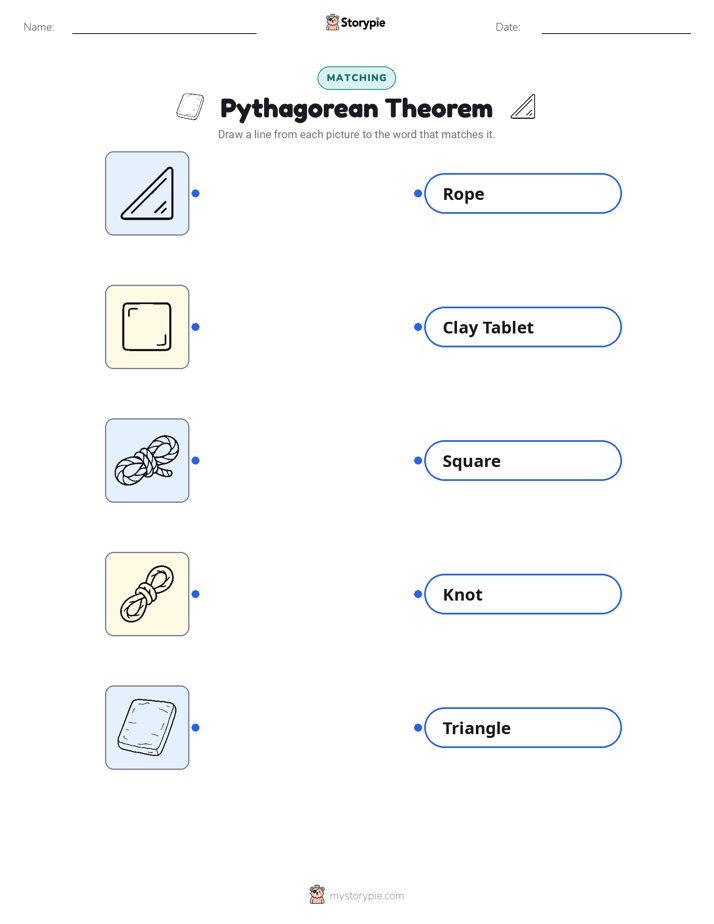
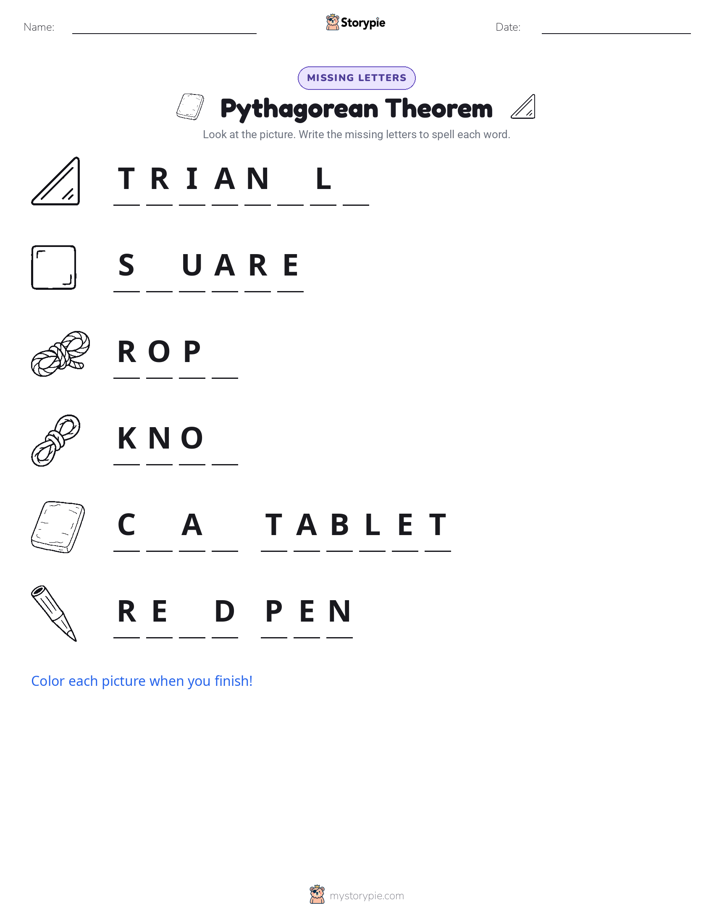
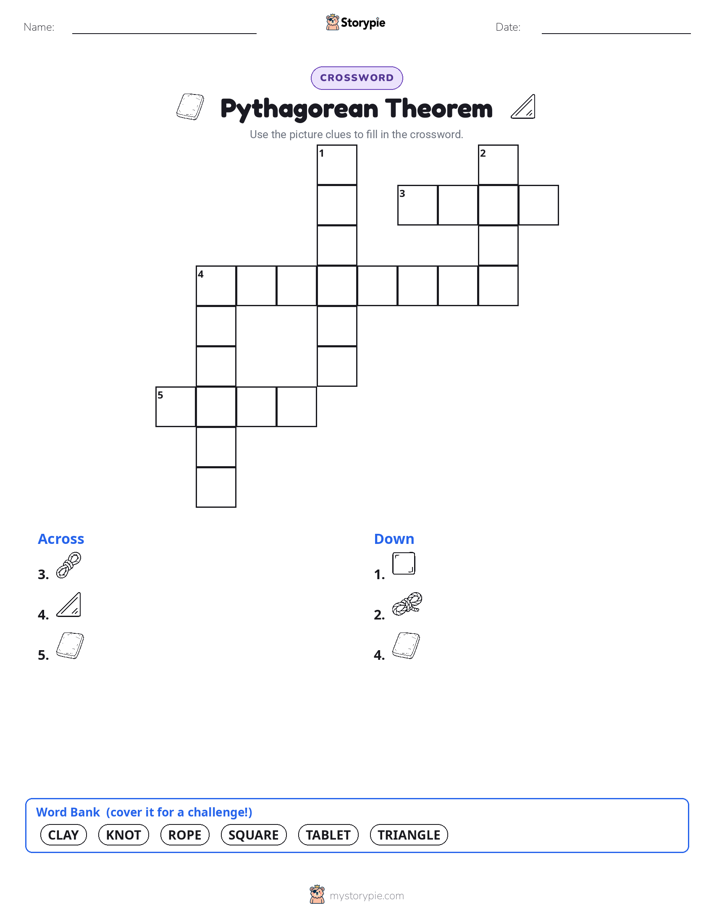
Long before anyone knew my name, clever people all over the world were using my secret to build amazing things. Let’s travel back in time, nearly 4,000 years ago, to a place called Babylon. Around the year 1800 BCE, farmers needed to measure their fields after big floods washed away the boundary lines. They took soft clay tablets and etched my secret onto them, using my power to draw straight lines and perfect corners to make sure everyone got their fair share of land. Thousands of miles away, in ancient Egypt, builders were creating the most incredible structures: the great pyramids. To make sure the bases of these giant pyramids were perfect squares, they had people called rope-stretchers. These workers used a long rope with 12 knots tied at equal distances. When they pulled it into a triangle with sides of 3, 4, and 5 knots long, pop. A perfect right angle appeared. They were using my magic to build wonders.
The Secret of the Square Corner
Have you ever looked closely at the corner of a book, a floor tile, or a windowpane? That perfect, sharp corner where two straight lines meet is my favorite place to hide. I am a secret rule, a kind of magic that lives inside any shape with one of those perfect corners. We call that shape a right-angled triangle. It has two straight sides that make the corner, like little arms reaching out, and one long, slanted side that connects them. I have a wonderful secret: if you know the lengths of the two shorter sides, you can always, without fail, figure out the length of the long one. It’s like a secret code that connects all three sides together, a puzzle that always has an answer. Can you imagine knowing a secret that powerful, one that unlocks the mystery of shapes?
Long before anyone knew my name, clever people all over the world were using my secret to build amazing things. Let’s travel back in time, nearly 4,000 years ago, to a place called Babylon. Around the year 1800 BCE, farmers needed to measure their fields after big floods washed away the boundary lines. They took soft clay tablets and etched my secret onto them, using my power to draw straight lines and perfect corners to make sure everyone got their fair share of land. Thousands of miles away, in ancient Egypt, builders were creating the most incredible structures: the great pyramids. To make sure the bases of these giant pyramids were perfect squares, they had people called rope-stretchers. These workers used a long rope with 12 knots tied at equal distances. When they pulled it into a triangle with sides of 3, 4, and 5 knots long, pop. A perfect right angle appeared. They were using my magic to build wonders.
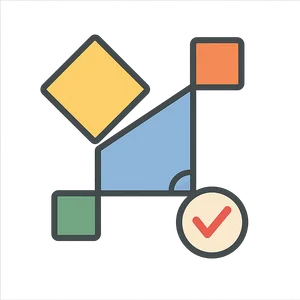
For centuries, I was a useful trick, a handy tool for builders and planners. But then, a man came along who wasn’t just happy that I worked; he wanted to know why I worked. His name was Pythagoras, and he was a brilliant thinker who lived in ancient Greece during the 6th century BCE. He and his students, who called themselves the Pythagoreans, were fascinated by numbers and shapes. They saw patterns everywhere and believed that numbers could explain the entire universe. They studied me, drew countless triangles, and thought very hard. They were the first ones to create a proof—a clear, logical explanation showing that my secret works for every single right-angled triangle, no matter how big or small. It was then that I was finally given my famous name: the Pythagorean Theorem. They wrote my secret down for everyone to see with a simple, beautiful formula: a² + b² = c². This means the square of one short side plus the square of the other short side equals the square of the long side.
You might think an ancient rule like me would be sitting in a dusty old book, but I am busier today than ever before. I am all around you. The architect who designed your school used me to make sure the walls are straight and the corners are strong. The person who designed your favorite video game used me to calculate how far a character needs to jump to land safely on a platform. When your family uses a map on a phone, I am quietly working inside. The GPS uses me to find the shortest path between two points—that long, slanted side of the triangle. From building skyscrapers to exploring space, I am there. I am an ancient secret that connects numbers and shapes, and I'm still helping you build, create, and explore your world today.
Wow facts
About
The Pythagorean Theorem is a fundamental principle in geometry stating that in a right-angled triangle, the square of the hypotenuse is equal to the sum of the squares of the other two sides (a² + b² = c²).
Take a Quiz
Question 1 of 5
The story says ancient Babylonians 'etched my secret onto wet clay tablets.' What does the word 'etched' most likely mean?
Explore next





Want to do even more?
Go beyond exploring. Unlock tools that turn every story into real learning.

Storypie Plus for families
Full stories, quizzes, and printables. Nights and car rides, sorted.
- Unlimited audio stories
- Create Mode: your child stars in the story
- Offline downloads
- Printable worksheets & coloring pages

Why Storypie for Schools
Students engaged. Prep in seconds. Evenings back to you.
- Worksheets & Quizzes
- Classroom Management
- Formative Assessment
- Custom Curriculum & Lesson Plans
- 27 Languages

Why Storypie for Homeschool
Curriculum done. They'll ask for more. Hours back in your day.
- Worksheet Generator
- First-Person Audio Stories
- Built-in Comprehension Quizzes
- Custom Curriculum & Lesson Plans
- Print & Go Activities