English

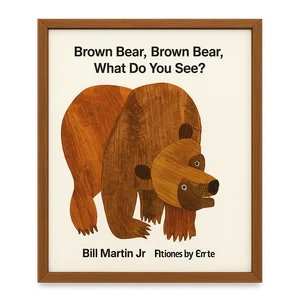
Brown Bear, Brown Bear, What Do You See? (book)
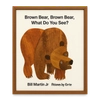
A classic children's picture book written by Bill Martin Jr.
Reads at Grades 6–8 Listens at Grades 4–8
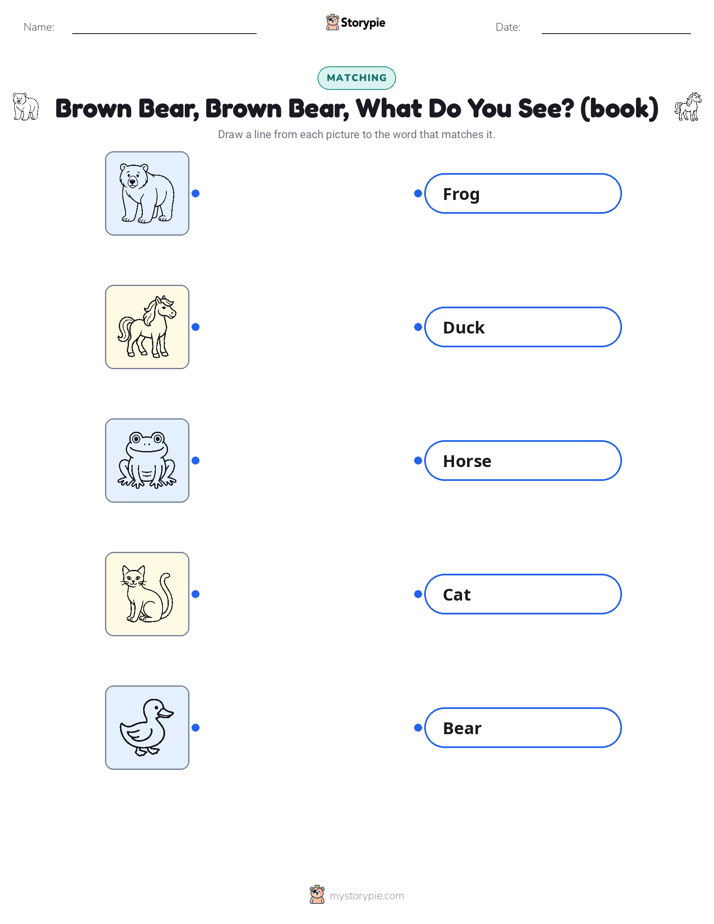
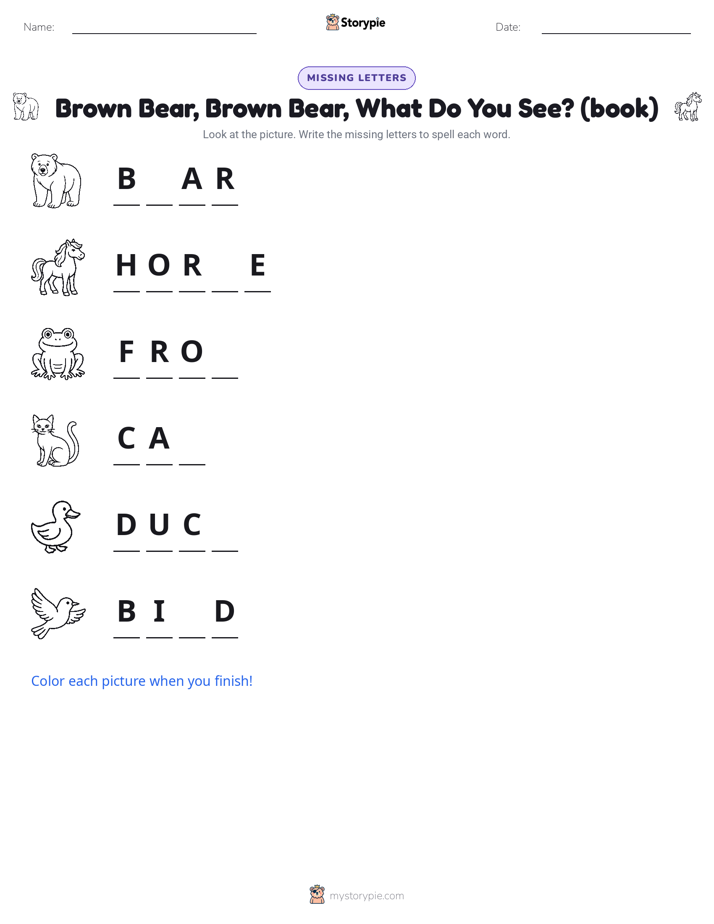
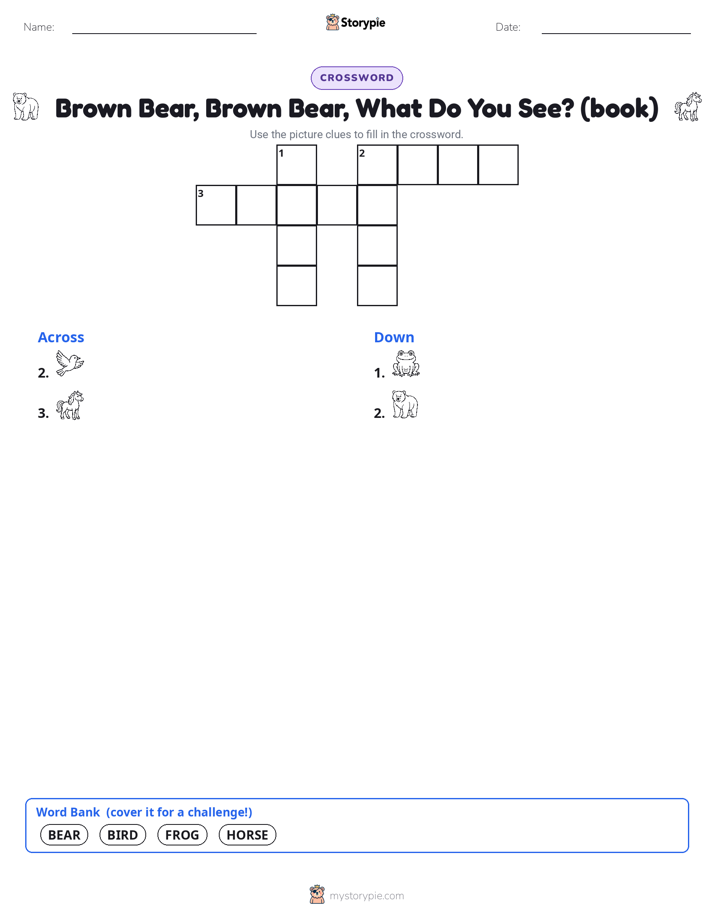
Print & create
Answer keys·No prep·Free with an account
28 worksheets · answer keys · full story · quiz · Ages 10-12 · CEFR B2
Plus adds 244,000+ more stories in 27 languages, audio for every one, and printables for all of them.
Just want Brown Bear, Brown Bear, What Do You See? (book)?
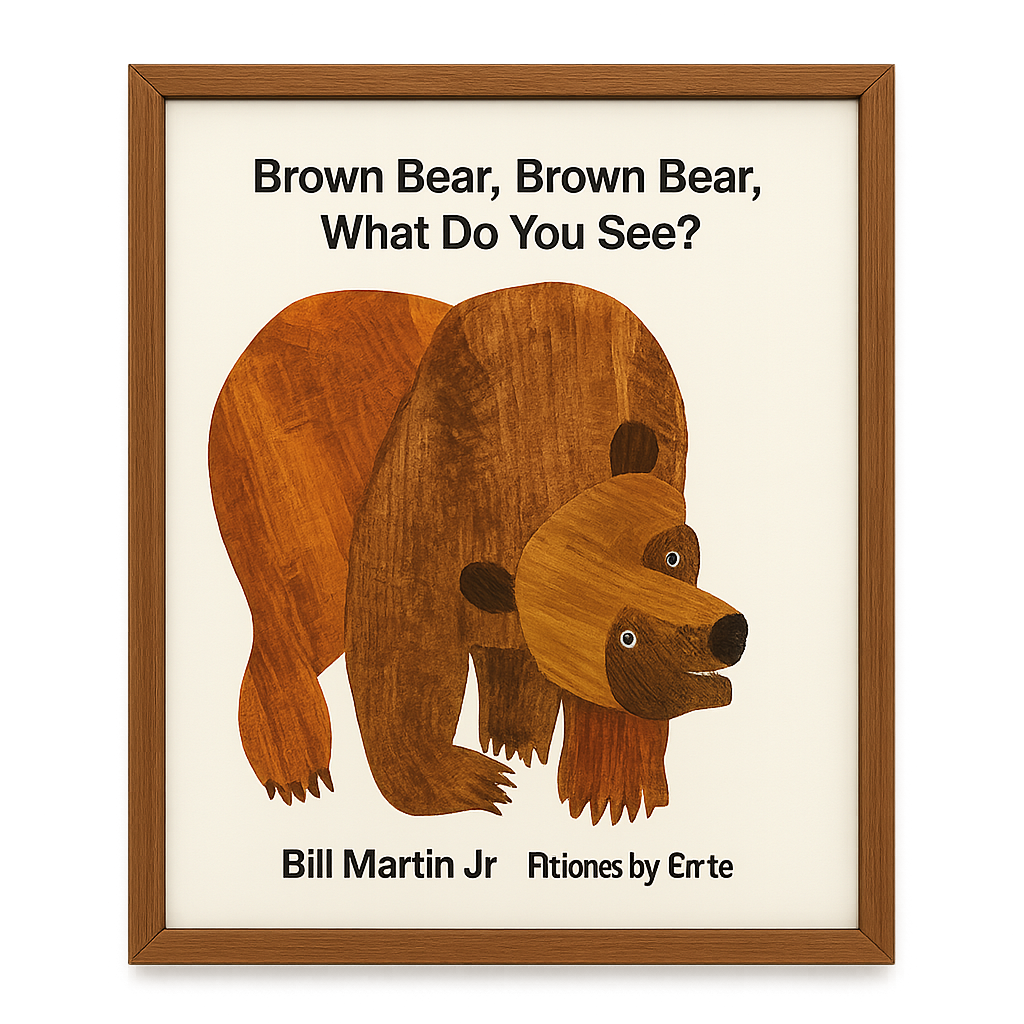
I am a world held in your hands. Feel the smooth strength of my cover, the crisp whisper of my pages as they turn, each one a promise of something new to see. I am not just paper and ink; I am a parade, a question, and a song all at once. Inside me, colors don’t just sit quietly—they shout. A bold red bird, a vibrant yellow duck, a deep blue horse. Animals don’t just appear; they walk proudly, one after another, filling my pages with life and personality. A great big brown bear greets you first, his gaze steady and curious. He is followed by a proud horse, a surprising green frog with wide eyes, and a graceful purple cat. I am a window into a world that feels both simple and endless, where every creature has something important to share, but only if you ask them the right question. Before you even knew my official name, you felt the steady, comforting rhythm of my voice. You recognized the bold, textured shapes that make up my world, learning the names of colors and creatures through a game of call and response. I was designed to be a first friend on the journey of reading, a predictable and joyful experience that makes turning the page feel like a triumph.
Now that you recognize my rhythm, let me properly introduce myself. I am the book 'Brown Bear, Brown Bear, What Do You See?'. My life began not on a shelf, but as a simple idea in the mind of a man who understood the music of words: Bill Martin Jr. He was an educator and an author who believed deeply that learning to read should be a joyful, natural experience, not a difficult chore. He wanted to create books that sang, books that invited children to participate and feel successful from their very first try. The spark for my existence came to him one day in 1966, while he was riding on a train from New York City to his home. As the wheels clicked rhythmically along the track, a simple, catchy phrase got stuck in his head. It was a chant, a back-and-forth cadence that he knew children would instinctively love to repeat. He realized that this very rhythm could be the key to unlocking reading for countless children. He saw how a predictable pattern would allow young readers to guess the upcoming words based on the established structure and the visual clues on the page. This turns the act of reading into an exciting and empowering game instead of an intimidating struggle with unfamiliar letters and sounds. He scribbled my words down on a piece of paper right then and there, creating a chain of animals, each one looking at and introducing the next. But at that point, I was just a collection of words on a page, a melody waiting for its instruments. I had my voice, but I was still waiting for someone to give me my vibrant, unforgettable face.
A Bear, a Book, and a Question
I am a world held in your hands. Feel the smooth strength of my cover, the crisp whisper of my pages as they turn, each one a promise of something new to see. I am not just paper and ink; I am a parade, a question, and a song all at once. Inside me, colors don’t just sit quietly—they shout. A bold red bird, a vibrant yellow duck, a deep blue horse. Animals don’t just appear; they walk proudly, one after another, filling my pages with life and personality. A great big brown bear greets you first, his gaze steady and curious. He is followed by a proud horse, a surprising green frog with wide eyes, and a graceful purple cat. I am a window into a world that feels both simple and endless, where every creature has something important to share, but only if you ask them the right question. Before you even knew my official name, you felt the steady, comforting rhythm of my voice. You recognized the bold, textured shapes that make up my world, learning the names of colors and creatures through a game of call and response. I was designed to be a first friend on the journey of reading, a predictable and joyful experience that makes turning the page feel like a triumph.
Now that you recognize my rhythm, let me properly introduce myself. I am the book 'Brown Bear, Brown Bear, What Do You See?'. My life began not on a shelf, but as a simple idea in the mind of a man who understood the music of words: Bill Martin Jr. He was an educator and an author who believed deeply that learning to read should be a joyful, natural experience, not a difficult chore. He wanted to create books that sang, books that invited children to participate and feel successful from their very first try. The spark for my existence came to him one day in 1966, while he was riding on a train from New York City to his home. As the wheels clicked rhythmically along the track, a simple, catchy phrase got stuck in his head. It was a chant, a back-and-forth cadence that he knew children would instinctively love to repeat. He realized that this very rhythm could be the key to unlocking reading for countless children. He saw how a predictable pattern would allow young readers to guess the upcoming words based on the established structure and the visual clues on the page. This turns the act of reading into an exciting and empowering game instead of an intimidating struggle with unfamiliar letters and sounds. He scribbled my words down on a piece of paper right then and there, creating a chain of animals, each one looking at and introducing the next. But at that point, I was just a collection of words on a page, a melody waiting for its instruments. I had my voice, but I was still waiting for someone to give me my vibrant, unforgettable face.
The second person who gave me life was an artist named Eric Carle. In the mid-1960s, he wasn't yet the world-famous creator of books like 'The Very Hungry Caterpillar'. He was working as a graphic designer and art director for an advertising agency in New York City. He loved art and design, but his path to becoming a children's book illustrator was unexpected, a happy accident. Bill Martin Jr. was searching for the perfect artist to bring my simple words to life. He didn't want traditional, delicate drawings; he wanted something bold, modern, and full of texture that would capture a child's imagination and stand out from other books on the shelf. One day, he saw an advertisement Eric had created in a magazine. It was for an antihistamine, a type of medicine, and it featured a bright, brilliant red lobster. Bill was immediately captivated. The lobster wasn't just a drawing; it was a powerful image, built from layers of color and texture that made it feel alive. He knew instantly that this was the artist he had been looking for. He found Eric’s phone number and called him, an act that would change both of their lives. Eric had never illustrated a children's book before, but he was intrigued by the project and Bill's rhythmic text. He had a truly magical way of working, a technique called collage that he had developed. He would take thin sheets of tissue paper and paint them with bright acrylics, sometimes using his fingers, sponges, or brushes to create his own unique palette of colors and textures. Then, he would carefully cut shapes from these papers and arrange them in layers to form his pictures. This is how I got my look—not from smooth, perfect lines drawn with a pen, but from vibrant, hand-crafted shapes that seem to burst with energy and personality. Each of my animals is a small masterpiece of color and form, a testament to an artist discovering his true calling.
In 1967, after Bill's words and Eric's art were finally united, I was published and introduced to the world. My arrival on bookstore shelves was met with a mix of reactions. For some adults, I was a bit of a puzzle. My art style was unlike anything they were used to seeing in children's literature. It was bold, abstract, and modern, not the soft, gentle illustrations that were common at the time. My words were also unusual. The simple, repetitive chant felt too basic to some critics. They wondered if there was enough of a 'story' inside my pages. But while some grown-ups were scratching their heads, children understood me immediately. They didn't need a complex plot; they responded instinctively to the rhythm of the language and the brilliance of the colors. They loved chanting along, their voices growing with confidence as they correctly guessed which animal and color would come next. Teachers and librarians quickly recognized my power. They saw how my predictable pattern wasn't a weakness, but my greatest strength. It provided a scaffold for early readers, giving them the confidence to 'read' long before they had mastered phonics. I wasn't just a story; I was a tool for learning, a joyful bridge into the wide world of books. My pages have since been turned by millions of tiny hands, and my words have been spoken and sung in classrooms, libraries, and at bedsides all across the globe.
More than fifty years have passed since my first printing in 1967. Both of my creators, Bill Martin Jr. and Eric Carle, have since passed away, but the world they built together continues to thrive. They went on to create more books together, expanding my universe of questions and answers. In 'Polar Bear, Polar Bear, What Do You Hear?', they explored the world of sound. In 'Panda Bear, Panda Bear, What Do You See?', they introduced children to endangered species. My family grew, but I remain the first, the original question that started it all. I am a living reminder that the simplest ideas, like a rhythm heard on a train, can grow into something that connects people across generations. My story proves that a catchy chant and a splash of vibrant, textured color can create a bond that lasts a lifetime. I live on, not just as an object on a bookshelf, but in the cherished memories of every child who ever looked at my pages, pointed a finger at the big brown bear, and confidently shouted out what he could see, excited and ready to discover what was coming next.
Wow facts
About
A classic children's picture book written by Bill Martin Jr. and illustrated by Eric Carle, known for its rhythmic text and colorful collage art that teaches children about animals and colors.
Take a Quiz
Question 1 of 5
Which sentence best summarizes the main idea of the story?
Explore next





Want to do even more?
Go beyond exploring. Unlock tools that turn every story into real learning.

Storypie Plus for families
Full stories, quizzes, and printables. Nights and car rides, sorted.
- Unlimited audio stories
- Create Mode: your child stars in the story
- Offline downloads
- Printable worksheets & coloring pages

Why Storypie for Schools
Students engaged. Prep in seconds. Evenings back to you.
- Worksheets & Quizzes
- Classroom Management
- Formative Assessment
- Custom Curriculum & Lesson Plans
- 27 Languages

Why Storypie for Homeschool
Curriculum done. They'll ask for more. Hours back in your day.
- Worksheet Generator
- First-Person Audio Stories
- Built-in Comprehension Quizzes
- Custom Curriculum & Lesson Plans
- Print & Go Activities