English

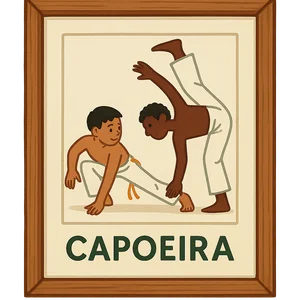
Capoeira
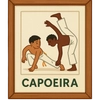
Capoeira is an Afro-Brazilian martial art that combines elements of dance, acrobatics, and music.
Reads at Grades 6–8 Listens at Grades 4–8
Print & create
Answer keys·No prep·Free with an account
28 worksheets · answer keys · full story · quiz · Ages 10-12 · CEFR B2
Plus adds 164,000+ more stories in 27 languages, audio for every one, and printables for all of them.
Just want Capoeira?
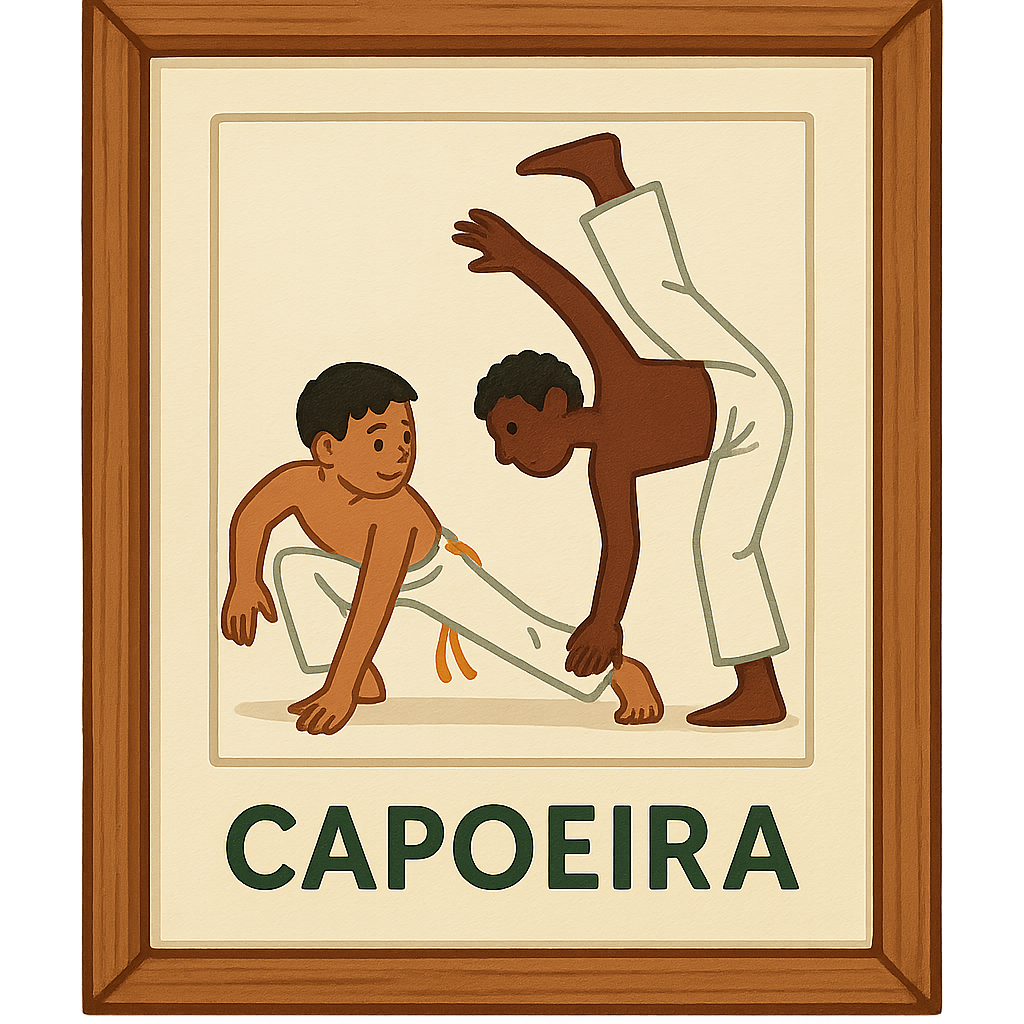
Listen closely. Can you hear it? It begins with a single, vibrating twang from a musical bow, the berimbau. That sound is my heartbeat. Then comes the steady beat of the pandeiro drum and the sharp rhythm of clapping hands. A circle of people forms, the 'roda,' and their voices rise together in a song of call and response. Inside the circle, two figures begin to move. They don't just walk; they flow, cartwheeling and spinning in a fluid, continuous motion. One lunges with a graceful kick that seems to slice the air, but the other dodges, melting into a low crouch before springing back up. It looks like a dance, a playful game, a breathtaking display of acrobatics. But it is so much more. I am not just a dance. I am not just a fight. I am a conversation spoken with the body, a story of survival told through movement. I am Capoeira, and I was born from a clever secret, a deep desire for freedom that had to be hidden in plain sight. My movements are the words of a language created to look like joy, but which carried the weight of a hidden strength and the promise of liberation.
My story begins in a place of great sorrow, colonial Brazil, during the 16th century. My creators were Africans, brought to this new land in chains and forced into slavery. They were strong and resilient people, carrying the cultures and traditions of their homelands within them. Their captors, the Portuguese slave owners, feared them and took away their weapons and forbade them from practicing any form of combat. But you cannot truly disarm the human spirit. Needing a way to defend themselves, to resist, and to keep their culture alive, my creators invented me. They cleverly wove their fighting techniques—powerful kicks, swift dodges, and strategic takedowns—into the rhythm of music and the spectacle of dance. To an outsider, it looked like a harmless party. But for those inside the roda, it was a training ground. The berimbau wasn't just for music; its rhythm dictated the speed and style of the 'game,' and it could change its tune to warn of an approaching overseer. The songs they sang told stories of their history, their heroes, and their longing for home. I was their secret weapon, a tool for self-defense that was also a powerful expression of community and cultural identity. In hidden communities called 'quilombos,' formed by escaped slaves deep in the Brazilian countryside, I could be practiced openly, becoming a symbol of freedom and resistance.
The Story of Capoeira
Listen closely. Can you hear it? It begins with a single, vibrating twang from a musical bow, the berimbau. That sound is my heartbeat. Then comes the steady beat of the pandeiro drum and the sharp rhythm of clapping hands. A circle of people forms, the 'roda,' and their voices rise together in a song of call and response. Inside the circle, two figures begin to move. They don't just walk; they flow, cartwheeling and spinning in a fluid, continuous motion. One lunges with a graceful kick that seems to slice the air, but the other dodges, melting into a low crouch before springing back up. It looks like a dance, a playful game, a breathtaking display of acrobatics. But it is so much more. I am not just a dance. I am not just a fight. I am a conversation spoken with the body, a story of survival told through movement. I am Capoeira, and I was born from a clever secret, a deep desire for freedom that had to be hidden in plain sight. My movements are the words of a language created to look like joy, but which carried the weight of a hidden strength and the promise of liberation.
My story begins in a place of great sorrow, colonial Brazil, during the 16th century. My creators were Africans, brought to this new land in chains and forced into slavery. They were strong and resilient people, carrying the cultures and traditions of their homelands within them. Their captors, the Portuguese slave owners, feared them and took away their weapons and forbade them from practicing any form of combat. But you cannot truly disarm the human spirit. Needing a way to defend themselves, to resist, and to keep their culture alive, my creators invented me. They cleverly wove their fighting techniques—powerful kicks, swift dodges, and strategic takedowns—into the rhythm of music and the spectacle of dance. To an outsider, it looked like a harmless party. But for those inside the roda, it was a training ground. The berimbau wasn't just for music; its rhythm dictated the speed and style of the 'game,' and it could change its tune to warn of an approaching overseer. The songs they sang told stories of their history, their heroes, and their longing for home. I was their secret weapon, a tool for self-defense that was also a powerful expression of community and cultural identity. In hidden communities called 'quilombos,' formed by escaped slaves deep in the Brazilian countryside, I could be practiced openly, becoming a symbol of freedom and resistance.
For centuries, I thrived in the shadows. Then, on May 13th, 1888, slavery was officially abolished in Brazil. You might think this was a moment of triumph for me, but the struggle was far from over. The Brazilian authorities, now seeing me on the streets, feared my power and the skilled practitioners, the 'capoeiristas,' who wielded me. They saw me not as a cultural art form, but as a weapon of criminals. In 1890, the government officially outlawed my practice. Anyone caught playing in the roda could be arrested. For decades, I was forced back into secrecy. But my spirit could not be broken. Two great masters, or 'mestres,' emerged in the 20th century to bring me into the light. The first was Mestre Bimba. He believed I was a legitimate and valuable martial art. In 1932, he opened the first-ever capoeira academy in Salvador, Bahia. He developed a structured teaching method he called 'Capoeira Regional,' emphasizing my efficiency as a fight. His work helped change public perception and gave me respectability. At the same time, another great master, Mestre Pastinha, dedicated his life to preserving my traditional roots. He championed 'Capoeira Angola,' which emphasizes my strategic, playful, and ritualistic elements. He ensured that my history and the clever deception at my core would never be forgotten.
Thanks to the dedication of Mestre Bimba, Mestre Pastinha, and countless other capoeiristas, I not only survived, but I began a new journey. From the cities and shores of Brazil, I traveled across the oceans. People all over the world were captivated by my unique blend of grace, power, music, and history. Academies and schools began to open in North America, Europe, and Asia. My roda became a global circle, welcoming people of all backgrounds to learn my movements and my story. My journey from a secret act of defiance to a celebrated global art form reached a pinnacle on November 26th, 2014. On that day, UNESCO, the United Nations organization for culture, recognized me as an Intangible Cultural Heritage of Humanity. I was officially declared a treasure belonging to the whole world. Today, when you see a roda, you are seeing more than just an acrobatic game. You are witnessing a living piece of history. I am a testament to how people can turn pain into beauty, oppression into art, and a fight for freedom into a dance that connects us all.
Wow facts
About
Capoeira is an Afro-Brazilian martial art that combines elements of dance, acrobatics, and music. It was developed by enslaved Africans in Brazil, with the term 'Capoeiragem' first documented in 1789 as a means of self-defense disguised as a dance.
Take a Quiz
Question 1 of 5
What is the central lesson that the story of Capoeira teaches about facing hardship?
Explore next


Want to do even more?
Go beyond exploring. Unlock tools that turn every story into real learning.

Storypie Plus for families
Full stories, quizzes, and printables. Nights and car rides, sorted.
- Unlimited audio stories
- Create Mode: your child stars in the story
- Offline downloads
- Printable worksheets & coloring pages

Why Storypie for Schools
Students engaged. Prep in seconds. Evenings back to you.
- Worksheets & Quizzes
- Classroom Management
- Formative Assessment
- Custom Curriculum & Lesson Plans
- 27 Languages

Why Storypie for Homeschool
Curriculum done. They'll ask for more. Hours back in your day.
- Worksheet Generator
- First-Person Audio Stories
- Built-in Comprehension Quizzes
- Custom Curriculum & Lesson Plans
- Print & Go Activities